
Beyond the Shortest Path: Identifying Trusted Circles via Weighted Flow Dynamics
A group trust metric for identifying people of trust in online social networks
Identifying people of trust in online social networks by extending the Advogato trust metric. The method incorporates relationship strength and a "capacity-first maximum flow" algorithm to achieve state-of-the-art performance in simultaneously identifying reliable users and blocking malicious ones.
TL;DR
This research tackles the growing concern of privacy and misinformation in social networks by introducing an extended Advogato trust metric. Unlike traditional models that treat all connections equally, this approach weights relationships and uses a "Capacity-First Maximum Flow" algorithm. It doesn't just find who you might know; it identifies who you can actually trust, significantly reducing the chance of exposing data to malicious actors.
Contextual Positioning
Trust is the currency of social networks, but not all "friends" are equal. In the academic landscape, trust metrics are split into Global (reputation-based, like PageRank) and Local (personalized). This paper enhances the local approach, taking the classic Advogato metric—originally designed for open-source communities—and making it robust for complex, weighted social graphs.
The Core Motivation: Why Shortest Paths Fail
Most existing systems assume that if User A knows User B, and User B knows User C, then User A should trust User C based simply on the distance (2 hops). This is a flawed Inductive Bias. In reality:
- Distance Trust: A close acquaintance 3 hops away might be more reliable than a "friend of a friend" who is a bot.
- Asymmetry: I may trust you, but you might not trust me.
- The Malicious Infiltrator: Attackers often create "bridge" accounts to appear high-trust in distance-based metrics.
The authors' insight is that Relationship Strength (calculated via Jaccard similarity of neighborhoods) must act as a "bandwidth" limit for how much trust can flow through any given connection.
Methodology: The Capacity-First Flow
The proposed framework operates in three distinct phases:
1. Capacity Assignment & Weighting
The seed node (the user) is given an initial "trust capacity" . Weights are assigned to edges using the normalized Jaccard coefficient:
2. Weighted Propagation
Trust capacity is diffused through the network. Instead of uniform distribution, the capacity at any node is determined by the strongest incoming path, adjusted by a decay factor ():
3. Capacity-First Maximum Flow
The graph is transformed into a flow network with a "supersink." The algorithm then searches for the strongest paths first (Maximum Capacity-First), rather than the shortest paths (Breadth-First). This ensures the most "meaningful" relationships are prioritized in the trusted group.
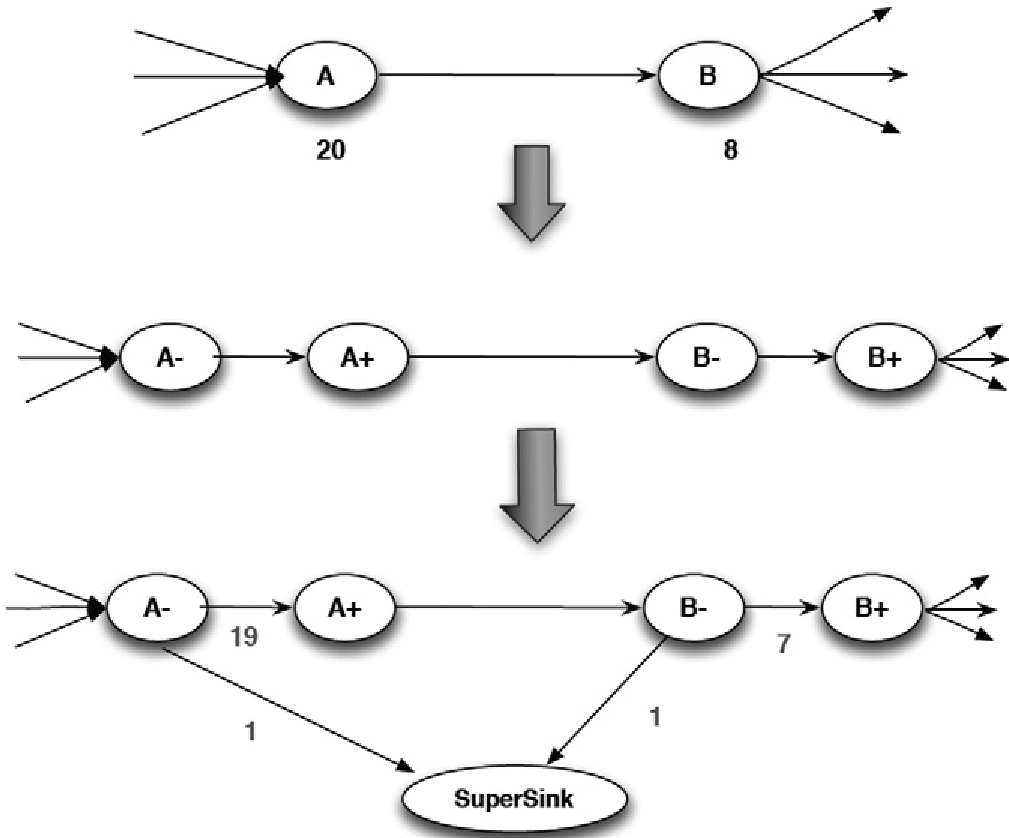 Graph node splitting for the Advogato flow structure.
Experimental Showdown: Precision vs. Security
The researchers tested their model against heavyweights like Personalized PageRank and Katz Proximity using the Epinions "Trust/Distrust" dataset.
- The "Katz" Paradox: While the Katz method was slightly better at finding any trusted user (high Recall), it failed miserably at security. It had a high Error-Hit rate, often recommending users that the seed had explicitly marked as "distrust."
- ExAdvogato's Edge: The extended Advogato model achieved a superior balance. It effectively "throttled" the flow of trust toward suspicious clusters, resulting in an Error-Hit rate 2.5 times lower than Katz.
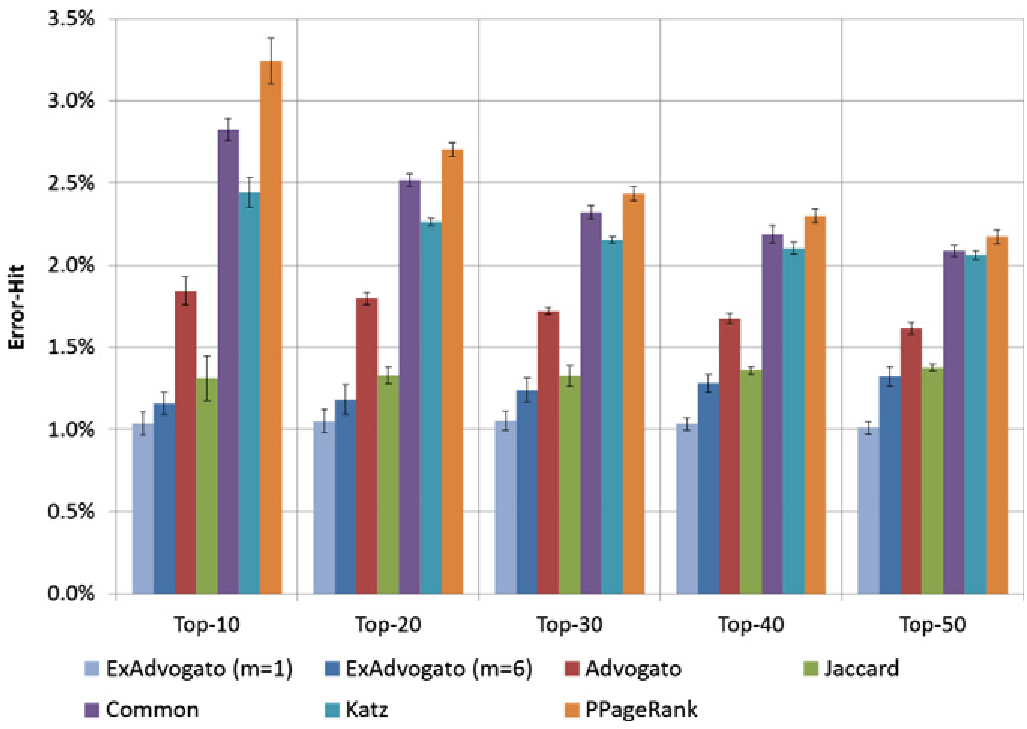 Comparison of Precision and Recall: ExAdvogato demonstrates robust localized performance.
Critical Insight & Future Outlook
The primary takeaway is that attack-resistance in social networks cannot be achieved through structural analysis alone; it requires the integration of behavioral weights.
Limitations: The model currently relies on Jaccard similarity to infer weights. In future iterations, integrating explicit semantic labels (e.g., "Family" vs "Acquaintance") or using Temporal Dynamics (how long have they been connected?) could further refine the trust flow.
Conclusion: This work provides a rigorous mathematical bridge between graph theory and social psychology, offering a blueprint for more secure, personalized social platforms where trust is earned through shared context, not just proximity.