
GIA: Minimizing Costs for Group-Level Influence in Social Networks
Groups Influence with Minimum Cost in Social Networks
The paper introduces the Groups Influence with Minimum cost (GIM) problem, which aims to identify a seed set of minimal financial cost capable of influencing all target groups in a social network. The authors propose GIA (Groups Influence Approximation), a bi-criteria polynomial-time approximation algorithm that utilizes a novel Group Reachable Reverse (GRR) sampling technique to handle non-submodular influence functions.
TL;DR
Information diffusion in social networks is evolving from targeting individuals to influencing entire communities. This paper tackles the Groups Influence with Minimum cost (GIM) problem. Since influencing a group is a complex, non-submodular task, the authors propose GIA, an algorithm that uses a new sampling method called Group Reachable Reverse (GRR) to find the cheapest set of "seed" users who can activate all target groups.
The Shift from Nodes to Groups
Most existing Influence Maximization (IM) research focuses on the "what": maximizing the number of people reached. However, real-world marketing and social engineering often care about the "who" and "how much":
- Group Dynamics: A group is only "influenced" if a specific threshold of its members (weighted by their importance or score) is reached.
- Cost Efficiency: Instead of working with a fixed budget, organizations often want to achieve a total coverage goal (influencing all groups) at the literal minimum cost.
The mathematical "nightmare" here is that the group influence function is neither submodular nor supermodular. In plain English: adding one more seed node doesn't follow the law of diminishing returns in a predictable way, making traditional greedy algorithms fail.
Methodology: The GRR Sampling Innovation
To solve this, the authors introduced the Group Reachable Reverse (GRR) sample.
How GRR Works:
Unlike standard RR samples that start from a random node, a GRR sample:
- Starts by picking a source group.
- Traces nodes reachable within that group back to potential seeds.
- Accounts for the individual scores of nodes within that group and the group's specific influence threshold.
 Note: The image illustrates the complex graph structure and sampling foundations utilized in the paper.
The GIA Algorithm
The core algorithm, Groups Influence Approximation (GIA), uses a bi-criteria approach. It doesn't just run once; it iterates through a "Stop-and-Stare" framework:
- MoGreedy Step: It uses a modified greedy approach to select nodes that provide the best "marginal gain per dollar."
- Verification Step: It uses Martingale inequalities to check if the current solution is actually "good enough" with high probability. If not, it doubles the samples and tries again.
Experiments and Results
The authors tested GIA against state-of-the-art (SOTA) algorithms like UBG and MAF on real-world datasets (Facebook, Wiki, Epinions).
Key Findings:
- Lower Costs: GIA consistently found seed sets that were significantly cheaper (up to 50% cheaper) than the modified SOTA competitors.
- Speed: Because GIA optimizes the sampling count dynamically, it reached conclusions several times faster than algorithms using static Monte Carlo estimations.
- Reliability: It maintained a group influence rate of , strictly adhering to the "bi-criteria" guarantee.
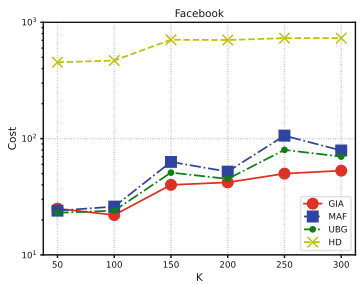 Figure 1: Comparison of total seed costs. GIA (red line) consistently stays at the bottom, indicating the highest cost-efficiency.
Critical Insight: Why This Matters
The GIM problem is a more natural fit for B2B marketing and political campaigning, where the goal isn't just "going viral" but "winning over specific committees or demographics."
The beauty of the GIA framework is its robust handling of the threshold effect. In groups, influence is binary: you either have the total score to "flip" the group, or you don't. By using GRR sampling to transform this binary threshold into a probabilistic expectation, the authors have provided a bridge between rigid combinatorial optimization and fluid social network dynamics.
Limitations
Despite its success, the model assumes groups are disjoint. In real life, users belong to multiple circles (e.g., family, work, and sports teams). Extending GIA to overlapping groups remains a challenging frontier for future research.
Conclusion
GIA represents a significant step forward in making influence maximization practical for real-world scenarios where budgets are tight and targets are group-oriented. By combining specialized sampling with rigorous statistical stopping conditions, it provides a rare blend of theoretical guarantee and empirical performance.