
Groupsourcing: Transforming Crowdsourcing through Team-Based Competition
Groupsourcing: Team Competition Designs for Crowdsourcing
This paper introduces "Groupsourcing," a framework that leverages team-based competition designs to enhance the cost-efficiency of crowdsourcing tasks. By implementing balanced and self-organizing team strategies, the authors achieve a state-of-the-art performance boost, specifically increasing annotation volume by 30% compared to individual competition baselines.
TL;DR
Researchers have moved beyond simple "pay-per-task" models to create Groupsourcing, a framework where workers form teams to compete for prizes. By combining team-based rewards with individual incentives, the study achieved a 30% increase in productivity and a 24% reduction in costs for image annotation tasks without sacrificing accuracy.
The Demotivation Trap in Traditional Crowdsourcing
Crowdsourcing platforms like Amazon Mechanical Turk typically rely on linear reward schemes: you do one task, you get one cent. While simple, this approach fails to capitalize on human psychology. Recent shifts toward individual competitions (leaderboards and prizes) helped, but they created a "winner-take-all" environment where average workers quit once they realized they couldn't beat the "hyper-performers" at the top.
The authors hypothesized that teamwork could solve this. By grouping people together, lower-performing individuals could contribute to a collective goal, feeling the "social pull" of their teammates and staying engaged longer.
Methodology: Designing the "Group" in Groupsourcing
The paper explores three primary architectures for team competition:
- Balanced Teams: The system automatically assigns workers to teams to ensure everyone enters a balanced "playing field."
- Self-Organizing Teams: Workers start as "one-man teams" and can invite others to merge, creating an organic, agglomerative growth of groups.
- Hybrid Strategy (The Winner): A dual-reward system where a worker earns money based on their individual rank AND their team's rank.
Model Architecture and Information Policy
To keep the competition fierce but fair, the researchers used a Medium Information Policy. Instead of showing the entire leaderboard, workers only saw their own rank and a few neighbors immediately above and below them. This prevents "leaderboard despair" while maintaining the "chase" instinct.
 The study utilized a face recognition task where workers identified celebrities across millions of images.
Experimental Battleground: 1.6 Million Annotations
The researchers conducted a massive multi-day study. The results were telling: the Balanced Team + Individual Reward (ind-balanceTS) configuration was the clear victor.
Key Metrics:
- Volume: 391,620 images (vs. 298,332 for individual competition).
- Cost-Efficiency: 2.55 cents per 100 images (vs. 3.35 cents).
- Engagement: Top workers annotated over 20,000 images each, but the "fat tail" (the average workers) contributed significantly more than in individual setups.
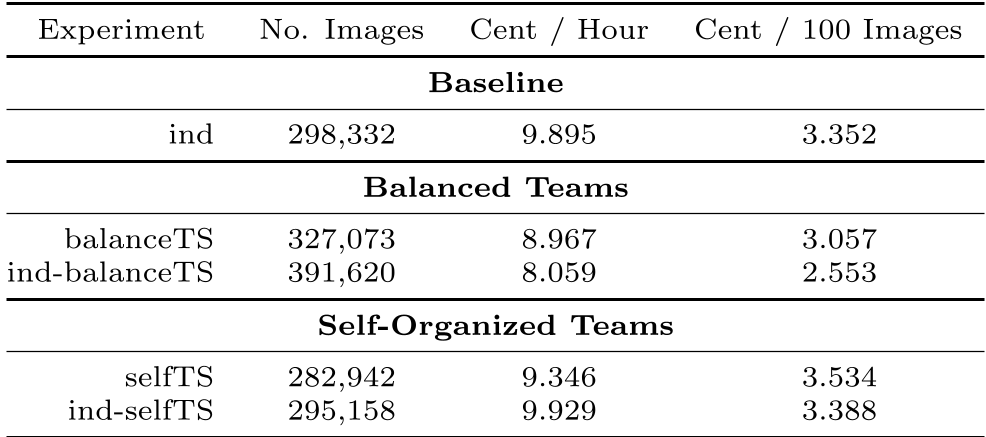 Table 1: The hybrid strategy (ind-balanceTS) achieving the lowest cost per 100 images while maintaining the highest volume.
Deep Insight: Why Teams Work
The most fascinating part of the study is the Social Dynamics. The researchers integrated a chat system, revealing that workers weren't just clicking—they were strategizing.
- Mentorship: Experienced workers taught newcomers how to use keyboard shortcuts (F11) to work faster.
- Collaborative Merging: In the self-organizing phase, teams would merge to "jump" higher in the rankings—a phenomenon the authors call "Winning Team Joining."
- Pressure & Support: The chat logs showed workers encouraging each other to "focus on work fast" when another team was catching up.
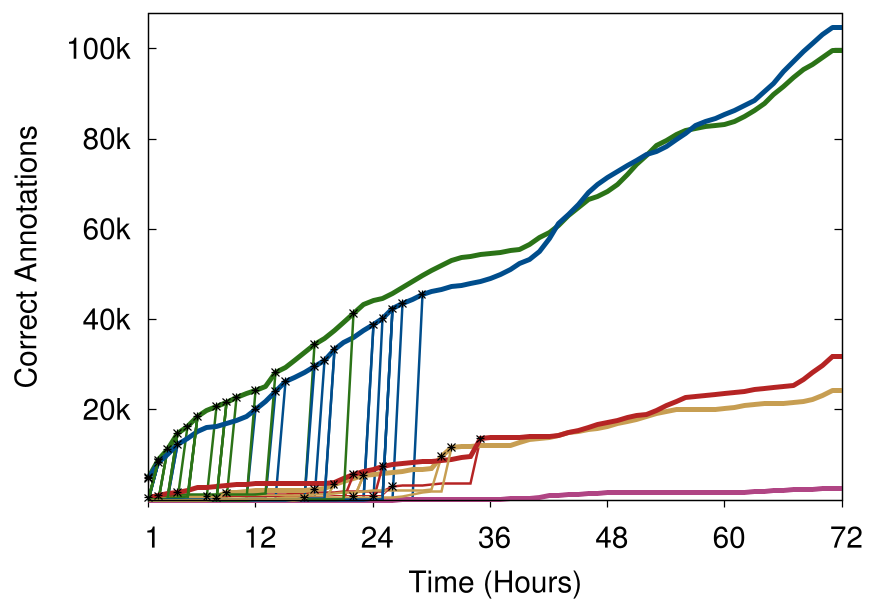 Figure 3: Temporal characteristics shows fierce last-minute competitions between teams, driving massive spikes in productivity.
Conclusion and Future Outlook
The "Groupsourcing" paper proves that crowdsourcing is not just an optimization problem—it's a social engineering problem. By treating workers as members of a team rather than isolated "click-bots," platforms can unlock massive reservoirs of untapped human potential.
Limitations: The self-organizing model sometimes led to "monopoly teams" that discouraged outsiders. Future work will likely focus on "hiring and firing" mechanisms within teams and democratic leadership structures to keep the competition healthy.
Takeaway for the AI Industry: As the demand for high-quality training data for LLMs grows, moving toward collaborative, team-based labeling environments could be the key to scaling human-in-the-loop systems efficiently.