
OSLP: Boosting OS Learning Motivation Through Facebook Pet Battling
Using Growing Pet Game in Facebook to Enhance Students' Learning Motivation: In Operating System Course
This paper introduces OSLP (Operating System Little Pet), a Facebook-based social network game designed to teach complex Operating System concepts. By integrating "Pet Fighting" and leaderboard mechanics into the social graph, the study achieved a significant increase in the learning motivation growth rate compared to traditional game-based learning.
TL;DR
Operating System (OS) courses are notoriously difficult, often leading to a "motivation desert." This paper presents OSLP (Operating System Little Pet), a Facebook-embedded game that transforms OS concepts like CPU Scheduling and Memory Management into a pet-growing simulator. By adding a social "Battle" mechanic, researchers successfully reversed the downward trend of student motivation, proving that healthy peer competition is the "secret sauce" for effective digital learning.
Background: The Motivation Gap in OS Education
The "Operating System" course is a cornerstone of Computer Science, yet topics like Process Synchronization and Deadlocks are often abstract and overwhelming. Traditional Game-Based Learning (GBL) has tried to fix this, but usually fails because:
- Isolation: Students play alone with no social tether.
- Friction: Games require specific hardware or classroom installations.
The authors hypothesized that if they could place the learning where students already spend their time—Facebook—and add a competitive social layer, the "fun" would drive the "work."
Methodology: Gaming the Social Graph
The researchers developed OSLP using the Facebook API and Flash. The loop is simple but effective:
- The Pet Loop: Players buy food and train pets to level them up.
- The Knowledge Gate: To get "OS Points" (the premium currency needed for high-level growth), students must explore islands and answer questions regarding OS course content.
- The Social Catalyst: Unlike the control group, the experimental group had access to a "Battle" system and a Scoreboard.
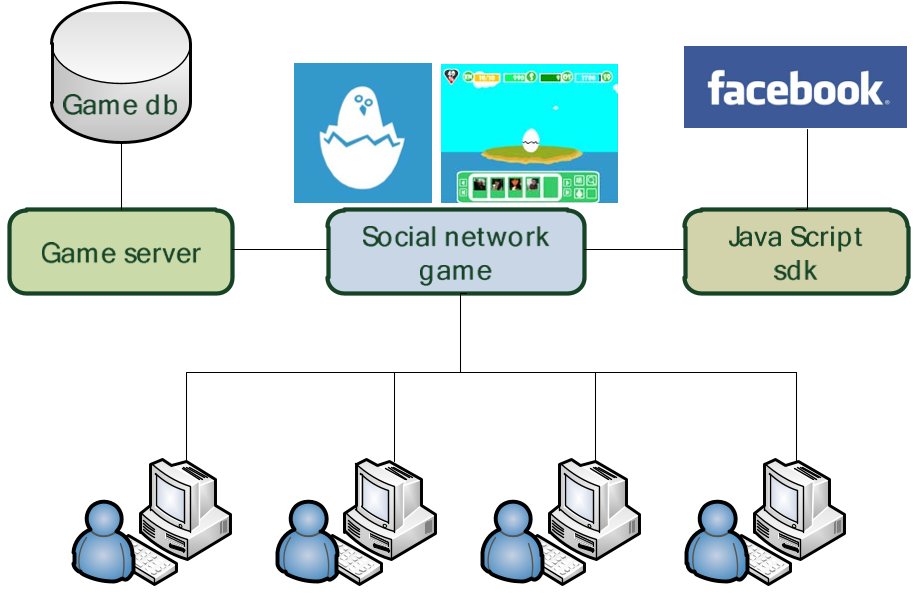 Figure 1: The OSLP System structure integrated with Facebook API.
The Asynchronous Advantage
By using Facebook, the system leveraged Asynchronicity. A student could challenge a friend's pet even if that friend was offline. The friend would see the result upon their next login, creating a persistent "living" world that bypassed the limitations of a 50-minute classroom session.
Experimental Analysis: Frictionless Learning
The study involved 141 students at Chung Yuan Christian University.
Key Findings:
- Motivation Reversal: In the control group (no battle feature), motivation actually declined over time. In the experimental group, motivation increased.
- Midnight Learners: Log data showed students playing at midnight and outside school hours, verifying that the social/mobile nature of the platform eliminated environmental barriers.
- The Power of Pride: Students reported that winning a fight against a peer who was technically "better" at the subject provided a massive psychological boost.
 Table 1: ANOVA results showing the shift in learning motivation between experimental (EG) and control groups (CG).
Deep Insight: Why "Battle" Matters
The core takeaway is that Game-Based Learning is not just about the game; it is about the social context.
The "Battle" mechanic acted as a validation mechanism. When a pet’s strength is tied to OS knowledge, the pet becomes a proxy for the student's mastery. The scoreboard transforms "learning for a grade" into "learning for status" within a peer group. This pivot from extrinsic (passing a test) to social (winning a duel) motivation is what makes SNGBL (Social Network Game-Based Learning) a potent tool for difficult engineering subjects.
Limitations & Future Outlook
While successful, the study noted that:
- Content Variety: Students quickly exhausted the question bank.
- Game Depth: Some players wanted more tactical control in battles (e.g., choosing "Attack" or "Defense" moves) rather than automated stats-based results.
As we move from 2012-era Facebook Flash games to modern Metaverses and mobile ecosystems, the principle remains: Education must follow the friction-less path of social habits.
Conclusion
OSLP proves that by harnessing "Inherent Sociability" and "Asynchronicity," we can turn even the driest subjects into a competitive sport. The future of GBL lies not in better graphics, but in deeper social integration.