
The Social Dividend: How Organizational Crowdfunding Grows Your Professional Network
Growth in Social Network Connectedness among Different Roles in Organizational Crowdfunding
This paper investigates the bidirectional relationship between social network connectedness and organizational crowdfunding roles within a large-scale enterprise (IBM). By analyzing activity logs and "friending" data of over 100,000 employees, the study demonstrates that active participation in crowdfunding—particularly in leadership roles—significantly drives social network growth (egonet expansion).
TL;DR
Does participating in a company-wide crowdfunding campaign actually make you more "connected"? This study of an IBM-wide initiative involving 100,000+ employees proves that it does—but only if you take a leading role. While project leaders saw massive spikes in their social network size (egonet), "Investors" remained socially stagnant, treating the process more like a private transaction than a networking opportunity.
Background: Beyond the Funding Goal
We’ve known for years that "who you know" determines if your project gets funded. In the academic world, social networks have long been treated as the input (predictor) for success. However, this paper flips the script: it treats social networking as the output. In the context of a massive enterprise like IBM, the authors asked: Does the intense collaboration required to launch a project actually leave participants with a richer, denser network after the dust settles?
The Hierarchy of Engagement
The researchers categorized employees into an ordinal scale based on their "effort" or "stake" in the crowdfunding ecosystem:
- TeamLeads: High leadership, high initiative.
- TeamMembers: High collaboration.
- Investors: Allocation of resources.
- Peripheral Roles: Commenters, Likers, and Followers.
- Non-participants: The control group.
Initial Social Capital (The "Self-Selection" Hypothesis)
The study first confirmed that social butterflies are more likely to lead. TeamLeads started the campaign with significantly larger networks than anyone else. This suggests a "selection bias": those already comfortable navigating the social fabric of an organization are the ones most likely to step up as innovators.
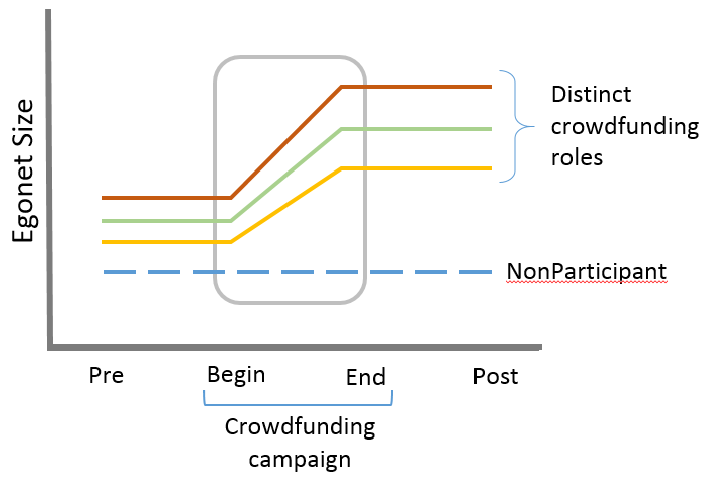 Figure 1: The hypothesized flow—Pre-existing ties lead to role selection, which in turn leads to network growth.
Methodology: High-Resolution Networking Logs
Because this occurred within the IBM Intranet, the researchers had a "God view" of the data. Unlike the public internet where users have fragmented IDs, IBM employees had a unique, invariant ID. The team tracked:
- Activity Logs: Every "like," "comment," and "investment."
- SNS Data: Bilateral "friending" relationships recorded at four specific intervals over a 7-month period.
Key Finding: Leaders Win, Investors Stay Small
The most striking result was the disparity in growth rates between roles.
- The "Proposer" Surge: TeamLeads and TeamMembers experienced a steep, linear growth in their egonets (number of friends). To get funded, they had to reach out to strangers, pitch ideas, and collaborate across silos, effectively "knitting" themselves into the organizational fabric.
- The "Investor" Paradox: Despite being a "necessary" role for crowdfunding, Investors did not grow their networks. They behaved more like "silent partners," making internal investment decisions in isolation rather than using the platform to meet new colleagues.
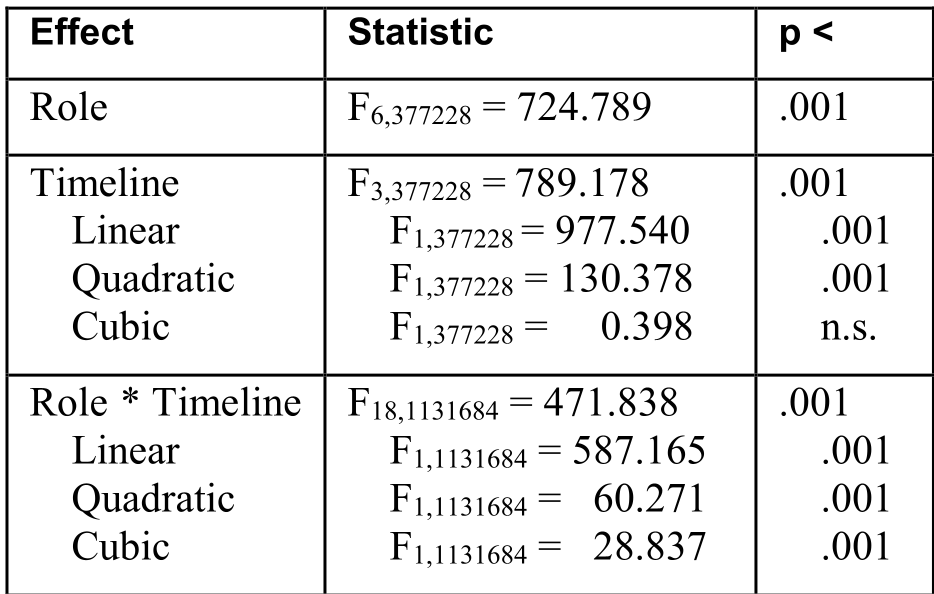 Table 2: Statistical significance showing that "Role * Timeline" interactions were highly deterministic of network growth.
Deep Insight: Success isn't just about the Money
The paper offers a vital lesson for both HR departments and employees:
- For the Organization: Internal crowdfunding isn't just a way to find the "next big idea"; it's a social engineering tool. It forces employees out of their functional silos and builds a denser, more resilient corporate network.
- For the Individual: If you want to increase your visibility and social capital, don't just "invest" or "like"—lead. The network growth for TeamLeads didn't just happen during the campaign; it set them on a higher trajectory even after the campaign ended.
Conclusion & Limitations
This "Social Note" provides the first empirical evidence that crowdfunding participation acts as a "career accelerant" for social connectivity. However, the study was limited to one company (IBM) and couldn't measure "tie strength" (e.g., how deep the friendships were). Future research should look at whether these new ties lead to better career outcomes, such as promotions or higher-quality collaborations in the years following the "crowd" event.
Final Takeaway: Participation is not equal. In the economy of organizational attention, leadership roles pay the highest social dividends.