
gSCorr: Solving the Cold-Start Problem in Location-Based Social Networks
gSCorr: Modeling Geo-Social Correlations for New Check-ins on Location-Based Social Networks
This paper introduces gSCorr, a geo-social correlation model designed to predict "new check-ins" (cold-start locations) on Location-Based Social Networks (LBSNs). By categorizing social ties into four geo-social circles based on friendship and geographical distance, the model achieves a significant accuracy of 19.21% (Top-1) and 28.69% (Top-3) in predicting locations a user has never visited before.
TL;DR
The "cold-start" problem in location prediction—predicting where a user will go when they visit a place for the very first time—has long plagued LBSNs. While history-based models fail here, the gSCorr model leverages a nuanced "geo-social" perspective. By dividing social ties into four circles based on friendship and distance, it proves that "local strangers" are actually better predictors of your next move than your distant best friends.
Problem & Motivation: The Failure of Trajectory Mining
Predicting human mobility usually relies on a simple premise: "You are where you have been." However, the available data shows a power-law property where users constantly explore new locations. Traditional trajectory mining reaches a dead end here.
While social networks seem like a logical alternative (modeling the "word-of-mouth" effect), previous research suggests that adding social features often yields marginal gains. The authors of gSCorr argue this is because we treat all "friends" the same. They posited that a friend living 1,000km away has a fundamentally different influence on your check-ins than a local stranger living in your neighborhood.
Methodology: The Geo-Social Matrix
The core innovation is the breakdown of social correlations into a 2x2 matrix of Friendship and Distance.
1. The Four Geo-Social Circles
- (Local Friends): People you know who live nearby.
- (Distant Friends): Social ties across different states.
- (Confined/Local Non-Friends): Strangers who share your geographic environment.
- (Unknown Effect): Distant strangers (treated as noise/random jump).
2. The gSCorr Model Architecture
The model defines the probability of a check-in as a weighted combination of these four circles.
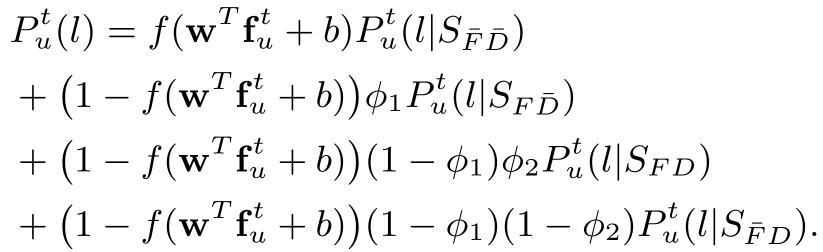
Rather than using static weights, gSCorr employs a Sigmoid-based active function that adapts based on the user's current context (e.g., how many check-ins they have already performed). As a user gains more history, the influence of different circles shifts dynamically.
Experiments & Results: The Power of Local Strangers
The researchers tested gSCorr on a massive Foursquare dataset (1.3M+ check-ins).
Key Performance Insights
- Individual Strengths: The model confirms that the strength of correlation is not equal across circles.
- The "Local Non-Friend" Surprise: Surprisingly, social correlations with local non-friends () were significantly higher than with direct friends. This suggests that people in the same city—regardless of social connection—tend to follow similar exploration patterns governed by local popularity and geography.
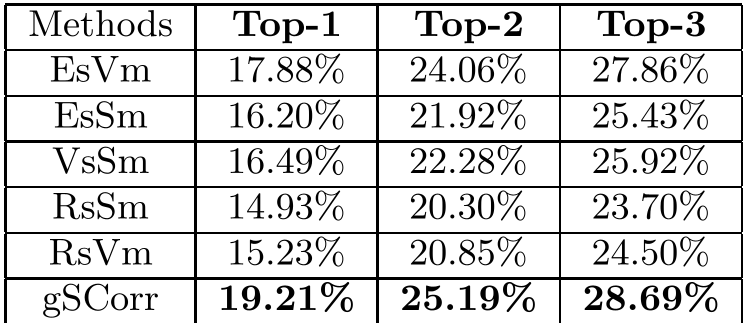
As shown in the table above, the gSCorr (Various Strength + Various Metrics) approach consistently beats simpler models (Equal Strength/Single Metric) across Top-1, Top-2, and Top-3 accuracy metrics.
Critical Analysis & Conclusion
The significance of gSCorr lies in its successful disentanglement of social influence and geographic proximity.
Takeaways:
- Social isn't everything: In "new check-in" scenarios, spatial relevance often trumps social bonds.
- Dynamic Weighting is Key: Capturing the changing influence of social circles over a user's lifecycle (from a new user to a regular) is vital for accuracy.
Limitations: The study uses a binary definition of distance (same state vs. different state). Future work could improve this by using a continuous distance decay function (e.g., power-law distribution) to model the "geo" aspect more granularly.
Future Outlook: This work paves the way for modern POI (Point of Interest) recommendation engines used in apps like Yelp or Google Maps, emphasizing the need to blend "global" social trends with "hyper-local" movement patterns.