
Guarding the Walled Garden: Semantic Interoperability in Social Privacy
Guarding a Walled Garden — Semantic Privacy Preferences for the Social Web
The paper introduces a semantic model for Social Web privacy that utilizes Datalog rules to define fine-grained concept definitions for data protection. It proposes an extension to the OpenSocial standard, allowing users to define and export cross-platform privacy preferences that transcend the "Walled Garden" of individual social networks.
TL;DR
Social networks are currently data silos ("Walled Gardens") where privacy settings are platform-specific and manually intensive. This paper proposes a Semantic Privacy Model that uses rule-based logic (Datalog) to create fine-grained, cross-platform privacy policies. By extending the OpenSocial standard and using the Protune policy engine, the authors allow a user’s "Skype contacts" to govern who can see their "Facebook photos," effectively making privacy settings portable and intelligent.
The "Walled Garden" Problem: Why Privacy is Broken
The Social Web has grown into a fragmented landscape. As the authors argue, current privacy preferences suffer from three critical failures:
- Categorical Poverty: You can usually only choose "Friends" or "Everyone." You can't specify "People I worked with at ESWC 2024" or "Photos taken in June that are tagged with #Secret."
- Information Isolation: Facebook doesn't know who your LinkedIn business contacts are, so you can't use your professional network to filter your social messages.
- Redundancy: If you join a new platform, you have to painstakingly rebuild your privacy settings from scratch.
The authors identify that in the real world, privacy decisions are based on social context, not platform boundaries. The paper seeks to bridge this gap by introducing semantic reasoning into the access control layer.
Methodology: Rules, Graphs, and Logic
The core of the proposal is the transformation of privacy settings from simple key-value pairs into Datalog rules.
1. Subject and Object Categories
Instead of hardcoded categories, the model treats "Objects" (what to protect) and "Subjects" (who is asking) as unary predicates.
- Object Category Example: A photo is an
eswc_pictureif it is both apictureANDtagged_with_eswc. - Subject Category Example: A person is a
sw_fellowif they are in a specific Facebook group OR listed in a FOAF (Friend-of-a-Friend) profile.
2. The AND/OR Logic
These definitions are represented as Directed Acyclic Graphs (DAGs). This allows for complex hierarchical reasoning. If Alice wants to restrict "Messages," the system can automatically infer that "Skype Messages" (a sub-category) should inherit the same protection levels unless specified otherwise.
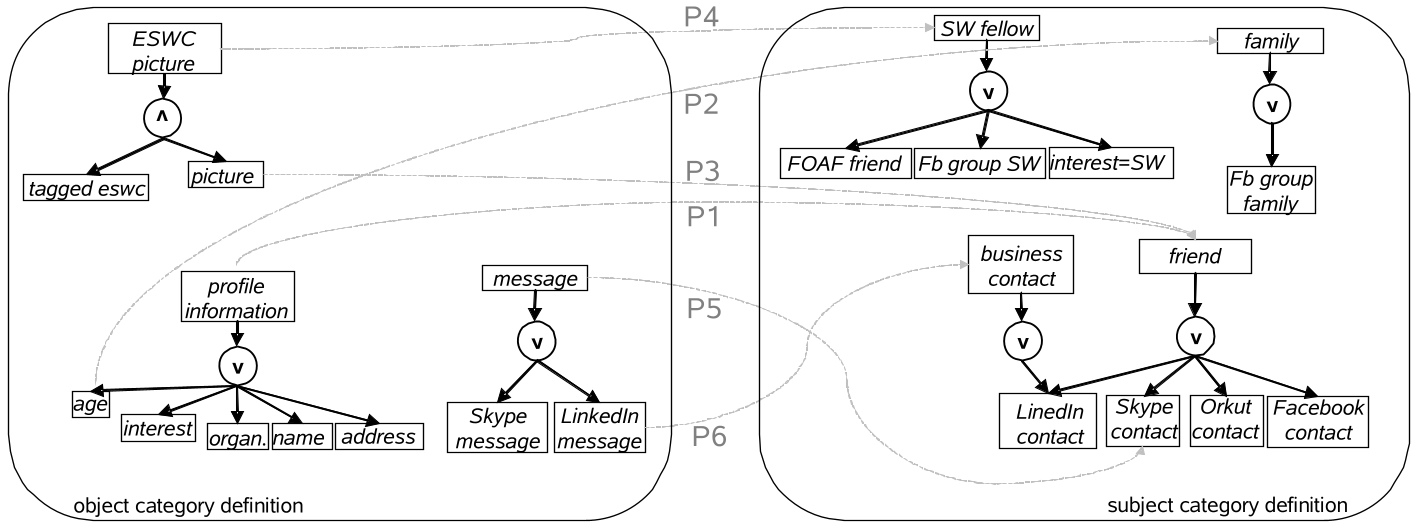 Figure 1: Graphical representation of user-defined semantic categories using AND/OR logic.
Implementation: Extending OpenSocial
To prove this isn't just theoretical, the authors implemented the model using Apache Shindig (an OpenSocial container) and Protune (a policy reasoning engine).
The workflow is elegant:
- A request arrives (e.g., "Bob wants to see Alice's Age").
- The system identifies the Descriptive Category of the age field.
- The Protune Engine reaches out to the Web (Twitter, DBLP, FOAF) to gather facts about Bob.
- The engine evaluates whether the facts about Bob satisfy the semantic rules Alice defined.
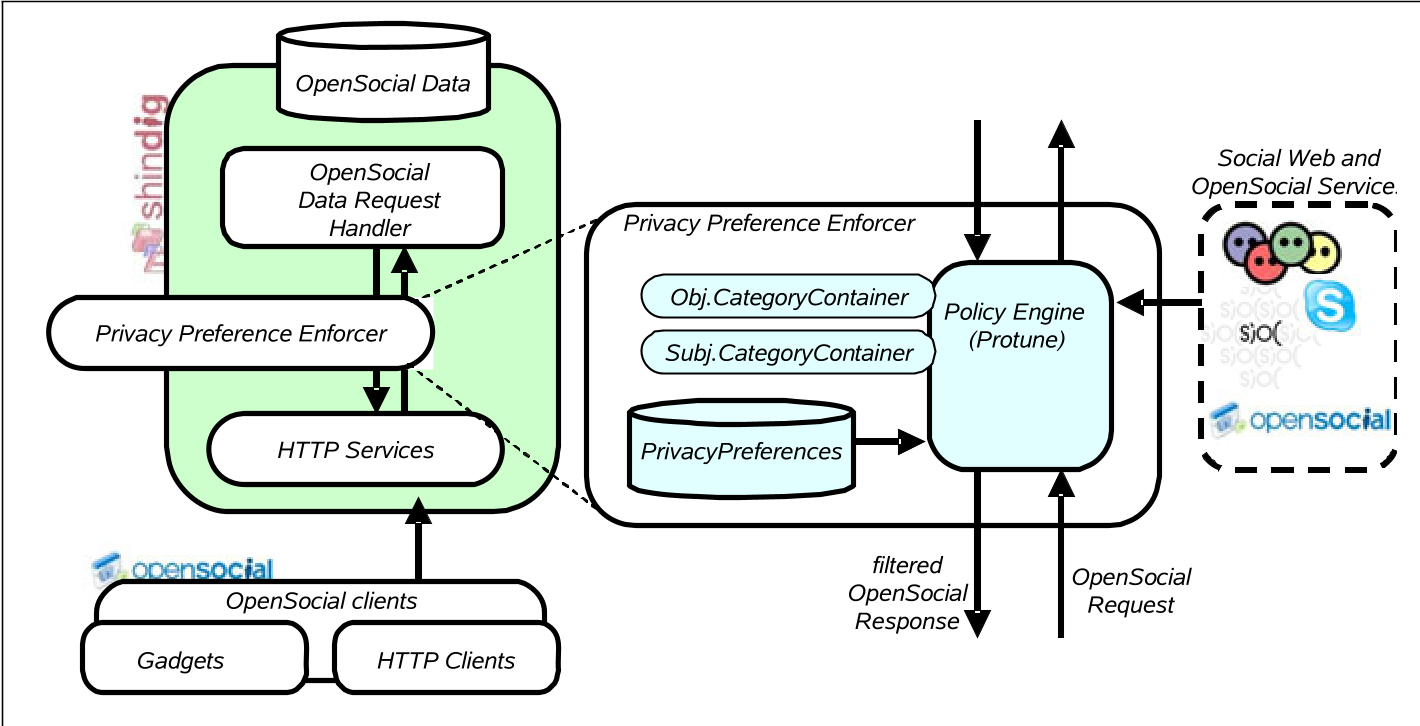 Figure 2: The architecture of the extended OpenSocial container featuring the Protune Policy Engine.
Experimental Insights
The research demonstrates that privacy can be portable. By serializing these rules into RDF, Alice can host her privacy "master file" in one location, and any OpenSocial-compliant platform can consume it. This kills the need to set up "Friends Only" on every new site—the platform simply asks the policy engine: "Does the requester meet Alice's global definition of a friend?"
Critical Analysis & Conclusion
This paper serves as a precursor to modern decentralized identity movements. Its strength lies in using Description Logic principles to solve a very human problem: the nuance of social relationships.
Limitations:
- Complexity for Users: While the backend is robust, asking an average user to define Datalog rules (even via a GUI) is a high hurdle.
- Latency: Real-time reasoning that fetches data from external APIs (like Twitter or DBLP) introduces significant latency in the authorization flow.
Future Outlook: With the rise of the Fediverse (Mastodon, Pixelfed) and Web3 identities, the concepts in this paper—decoupling the policy from the platform—are more relevant than ever. This work provides the mathematical and logical foundation for a future where the user, not the "Walled Garden," truly owns their privacy.