
Deciphering the Matrix: A Quantitative Guideline for Evaluating Social Network Frameworks
Guideline for Evaluating Social Networks
This paper introduces a comprehensive evaluation guideline and a quantitative matrix for selecting Social Network frameworks and platforms. The core contribution is a weighted formula that balances functional diversity against implementation quality (Coefficient of Variation) to assist organizations in choosing the most suitable internal communication tools.
TL;DR
As social networks transitioned from public entertainment to vital internal corporate tools, the "gut-feeling" approach to picking a platform became a liability. This paper presents a standardized, mathematical framework to evaluate social platforms, moving beyond simple feature checklists to a weighted quality-assurance model. By factoring in implementation consistency—not just feature count—it provides a robust roadmap for enterprise software selection.
Background & Motivation: The Selection Paradox
In the era of Web 2.0, organizations realized that intranets needed to behave more like social networks to foster knowledge sharing. However, IT departments faced a paradox: Should they prioritize a "Tool Network" (specialized) or an "All-in-One" solution?
Existing literature by researchers like Richter and Koch provided classifications but lacked a benchmark scale. The authors identify this gap, noting that a platform with "more features" isn't necessarily better if those features are poorly integrated or lack robust APIs for corporate extensibility.
Methodology: The Anatomy of Evaluation
The authors break down the evaluation into two fundamental pillars: Functionality and Extensibility (APIs).
1. Functional Categorization
The study analyzes over 30 networks to define 13 core categories including Accounting, Privacy, Tagging, and Search. Crucially, they introduce a 0-5 scoring system:
- 0: Feature non-existent.
- 3: Properly implemented basic functionality.
- 5: Significant extras (e.g., cross-platform API access).
2. The API Deep-Dive
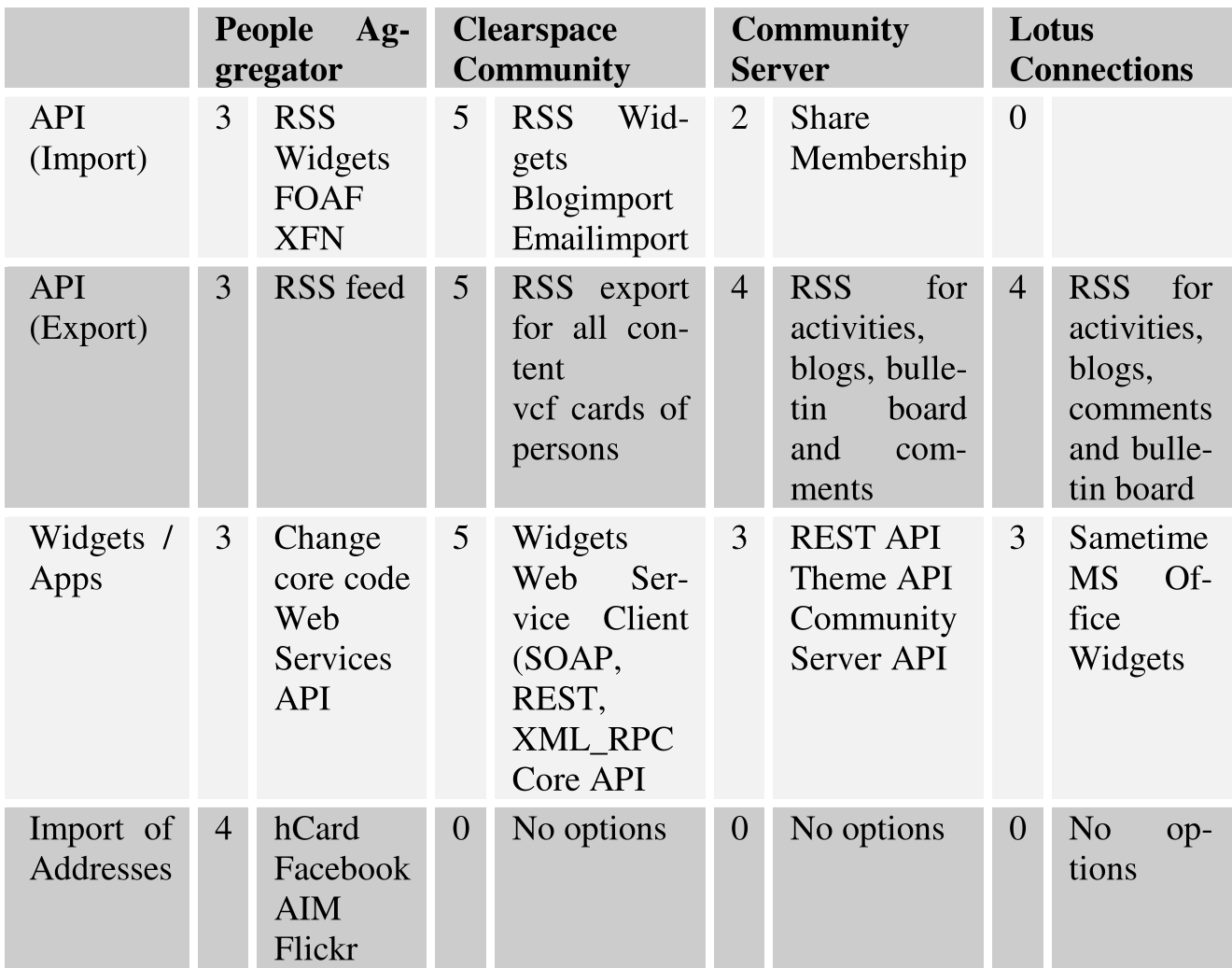
Recognizing that enterprise tools must "talk" to other software, the paper emphasizes two API types:
- Application APIs: Allowing external code to run within the network (e.g., OpenSocial).
- Data Exchange APIs: Real-time access to user data (e.g., Facebook Connect).
3. The Evaluation Formula
The most significant contribution is the mathematical synthesis of these scores. Instead of a simple sum, they utilize a formula that rewards platforms for having a consistent level of quality across all modules.

- Loading: Allows customers to weight specific categories (e.g., if Privacy is more important than Guestbooks).
- Coefficient of Variation (CoV): This acts as the denominator. A platform with wildly inconsistent quality (some 5s, some 1s) is penalized compared to a platform that is consistently "good" (all 3s or 4s).
Proof of Concept: Battle of the Frameworks
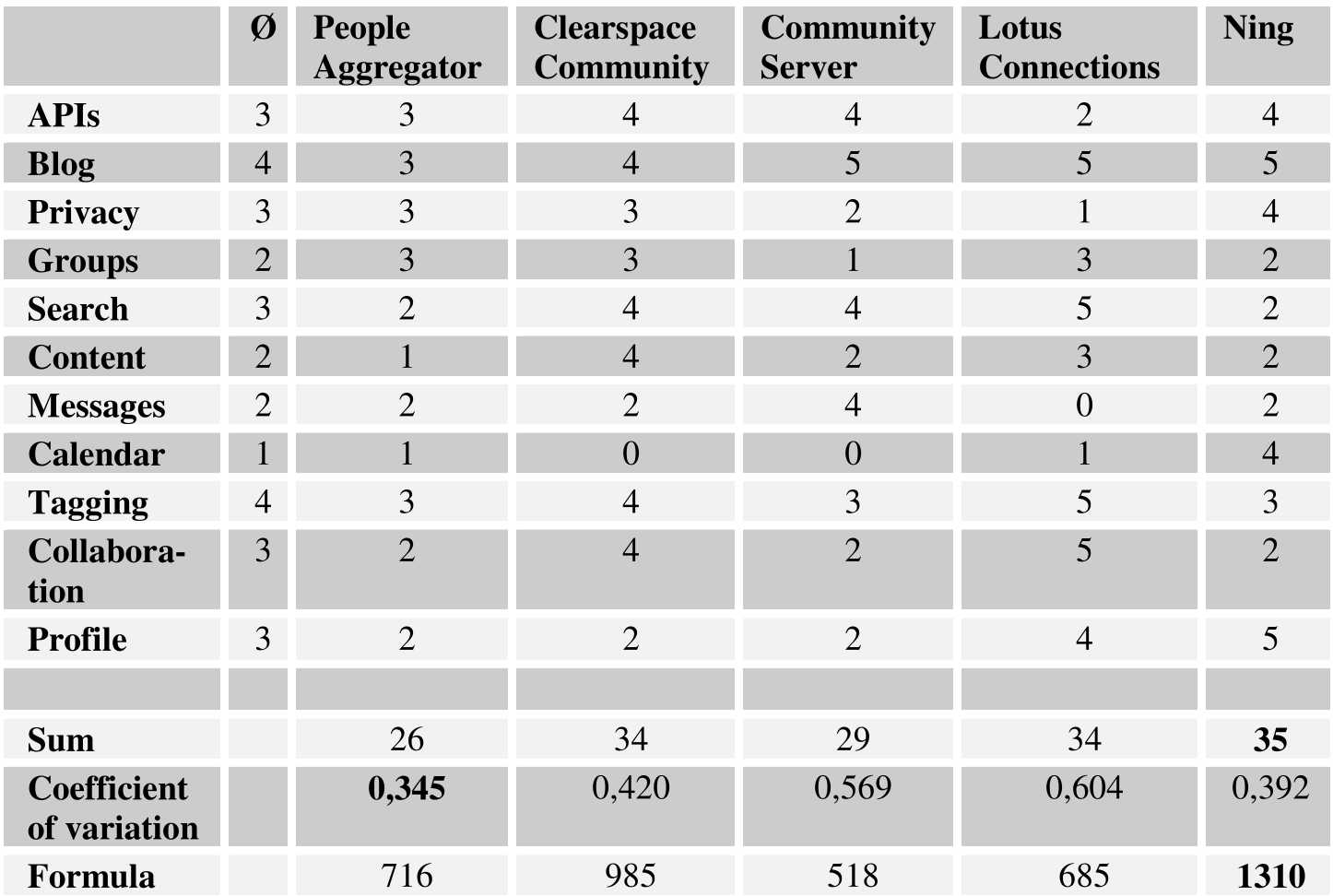
The authors applied this matrix to five frameworks: PeopleAggregator, Clearspace Community, Community Server, Lotus Connections, and Ning.
Key Findings from the Experiment:
- The Consistency Penalty: While Lotus Connections had high scores in specific business features (Search and Collaboration), it suffered from a high Coefficient of Variation (0.604) because it lacked basic social features like "Messaging."
- Ning's Dominance: Ning scored the highest (1310) due to its high functionality sum and a relatively low CoV (0.392), indicating a balanced, well-rounded product.
- API Gaps: Interestingly, the study found that business-centric frameworks often had "static" connections, whereas SaaS products like Ning embraced a wider variety of import/export formats.
Critical Analysis & Future Outlook
The paper’s approach remains a gold standard for Inductive Bias in software evaluation—it correctly assumes that a "jack-of-all-trades, master-of-none" approach is often superior to a "specialist" tool with gaping holes in its core experience.
Limitations: Technically, the study was conducted during the transition of Web 2.0. In today’s landscape, criteria like Scalability, Containerization (Docker/K8s), and Security/Compliance (GDPR) would likely carry higher "Loading" values than "Guestbooks" or "Photos."
Conclusion: The "Schnitzler Matrix" provides a timeless logic: don't just count the features; measure the variance of their quality. For modern Cloud-Native architectures, this methodology is ripe for adaptation, particularly when choosing between "Headless" social APIs and monolithic community platforms.