
Decoding H.264 SVC: Performance Trade-offs in Quality Scalable Video
7745_H.264 Coarse Grain Scalable (CGS) and Medium Grain Scalable (MGS) Encoded Video A Trace Based Traffic and Quality Evaluation.
This paper presents a large-scale evaluation of the H.264 Scalable Video Coding (SVC) extension, specifically focusing on Coarse Grain (CGS) and Medium Grain Scalability (MGS). By analyzing long-form video traces across diverse genres, the authors characterize the Rate-Distortion (RD) performance and traffic variability, demonstrating that MGS can achieve RD efficiency comparable to single-layer H.264 SVC while introducing significant frame-level variability.
TL;DR
Is scalable video coding worth the overhead? This comprehensive study by Gupta et al. evaluates H.264's Coarse Grain (CGS) and Medium Grain Scalability (MGS) using 30-minute video traces. The verdict: MGS is surprisingly efficient—matching single-layer quality at certain ranges—but it introduces a hidden "tax" in the form of massive frame-level traffic burstiness.
The Scalability Dilemma: Quality vs. Bitrate
In the world of IPTV and wireless streaming, bandwidth is a moving target. H.264 SVC was designed to solve this by providing a base layer for minimum quality and enhancement layers for higher fidelity. However, the industry has long debated the "overhead" cost—the extra bits required to make a stream scalable compared to a dedicated single-layer stream of the same quality.
The authors dive into two specific modes:
- CGS (Coarse Grain): Dropping entire enhancement layers.
- MGS (Medium Grain): A finer approach where transform coefficients are split into up to 16 sub-layers.
Methodology: Beyond Short Clips
Most academic studies use clips of only a few seconds. This paper breaks that mold by using 30-minute sequences (Star Wars, NBC News, etc.), providing a realistic look at how traffic variability (Coefficient of Variation, or CoV) behaves over time.
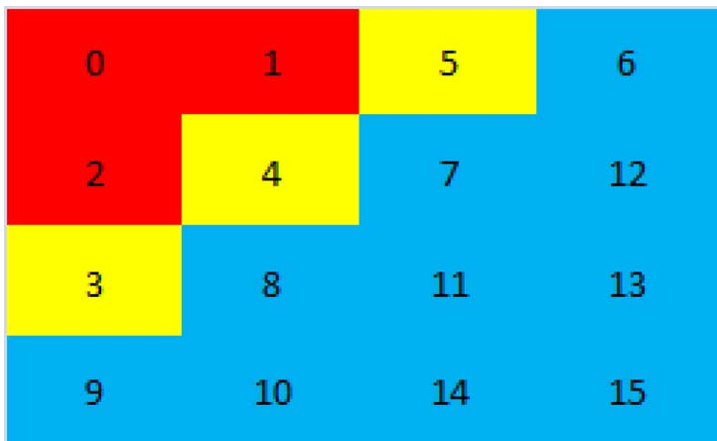 The figure above illustrates how MGS splits transform coefficients into multiple NAL units, allowing for surgical bit-rate reduction.
Key Insights: MGS is the Efficiency King
The study reveals a surprising "MGS Advantage." In the low-to-moderate bit rate range, MGS extraction based on Priority IDs (RD-optimized) can actually outperform single-layer encoding.
Why? Because the extractor selectively keeps only the most "RD-efficient" coefficients (the high-value, low-frequency data) across the entire sequence. While a single-layer stream is "locked" into a specific Quantization Parameter (QP), MGS acts like a dynamic filter, providing the best possible quality for the given bit budget.
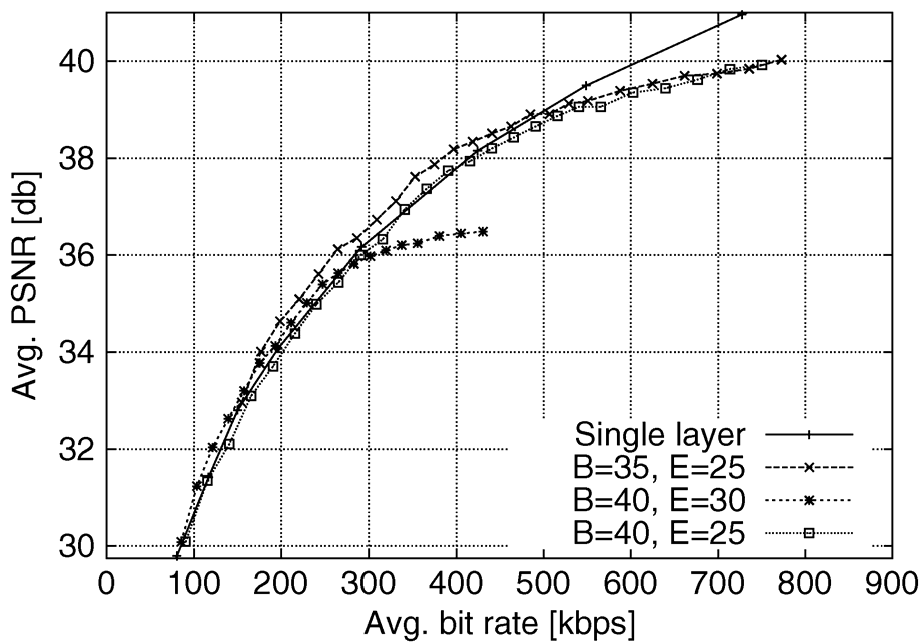 Experimental results showing MGS (Priority ID) tracking closely with or exceeding the single-layer baseline.
The Catch: The "Jitter Tax"
Efficiency isn't free. The "Rate Variability-Distortion" (VD) analysis shows that MGS streams are significantly more "bursty" at the frame level.
- The Problem: Because the extractor only picks the most important parts of certain frames, the size of frames within a sequence fluctuates wildly.
- Quantification: For the movie Die Hard, the CoV (traffic variability) jumped from 1.4 (single-layer) to 2.4 (MGS).
For network hardware, this means MGS doesn't look like a steady stream; it looks like a series of unpredictable explosions of data.
Deep Insight: Smoothing is Mandatory
The authors propose a solution: GoP-level extraction. By performing the MGS extraction over a 16-frame Group of Pictures (GoP) rather than the whole 30-minute sequence, the traffic becomes much more manageable. Smoothing the traffic to the GoP time scale effectively reduces the variability to levels near or even below single-layer video.
Conclusion
This research confirms that while H.264 SVC MGS is a powerful tool for quality adaptation, it is not a "plug-and-play" replacement for single-layer coding.
- For Coders: MGS is excellent for fine-tuning quality, but avoid the "upper end" of the enhancement layer where overhead finally kills efficiency.
- For Network Engineers: Don't trust frame-level metrics. Use GoP-scale smoothing to prevent scalable video from overwhelming the buffers in wireless routers.
Limitations: The study focuses on H.264; while many principles carry over to H.265 (HEVC) or VVC, the specific overhead percentages will likely be lower in more modern codecs due to improved inter-layer prediction.