
LLM Hallucination Mitigation: From Stochastic Parrots to Verifiable Experts
A comprehensive survey of hallucination mitigation techniques in large language models
This paper presents a comprehensive survey of over 32 techniques designed to mitigate hallucinations in Large Language Models (LLMs). It introduces a systematic taxonomy categorizing methods into Prompt Engineering (e.g., RAG, Feedback loops) and Model Development (e.g., Decoding strategies, Knowledge Graphs, and SFT), providing a clear roadmap for achieving factual reliability in generative AI.
TL;DR
Large Language Models (LLMs) are notorious for "hallucinating"—confidently stating falsehoods. This survey paper provides the most comprehensive taxonomy to date, detailing over 32 techniques to ground these models. Key methods include Retrieval-Augmented Generation (RAG), Self-Reflection, and Context-Aware Decoding, moving LLMs from purely probabilistic text generators to reliable information systems.
The "Hallucination" Crisis in AI
Despite the capabilities of GPT-4 and Llama-2, their lack of a "grounding" mechanism means they often prioritize linguistic fluency over factual truth. This is not just a technical glitch; it is a fundamental challenge for the adoption of AI in medicine, law, and finance. The problem stems from the training phase—models learn to predict the next token based on patterns, not necessarily the truth. When their internal "parametric memory" is outdated or biased, they simply hallucinate a plausible-sounding answer.
Methodology: The Two Pillars of Truth
The paper categorizes mitigation into two major engineering directions:
1. Prompt Engineering & RAG
Instead of relying on what the model "remembers," we provide it with an open-book exam.
- RAG (Retrieval-Augmented Generation): The model queries an external database (like Wikipedia or a private cloud) before answering.
- Chain-of-Verification (CoVe): The model drafts an answer, generates verification questions for its own draft, answers them independently, and then revises its original response.
2. Model Development & Decoding
This involves changing how the model "thinks" at a structural level.
- DoLa (Decoding by Contrasting Layers): Authors found that factual knowledge is often localized in specific Transformer layers. By contrasting the outputs of later layers with earlier ones, the model can "amplify" factual signals.
- Context-Aware Decoding (CAD): This shifts the probability distribution to favor the provided context over the model’s internal (and potentially wrong) prior knowledge.
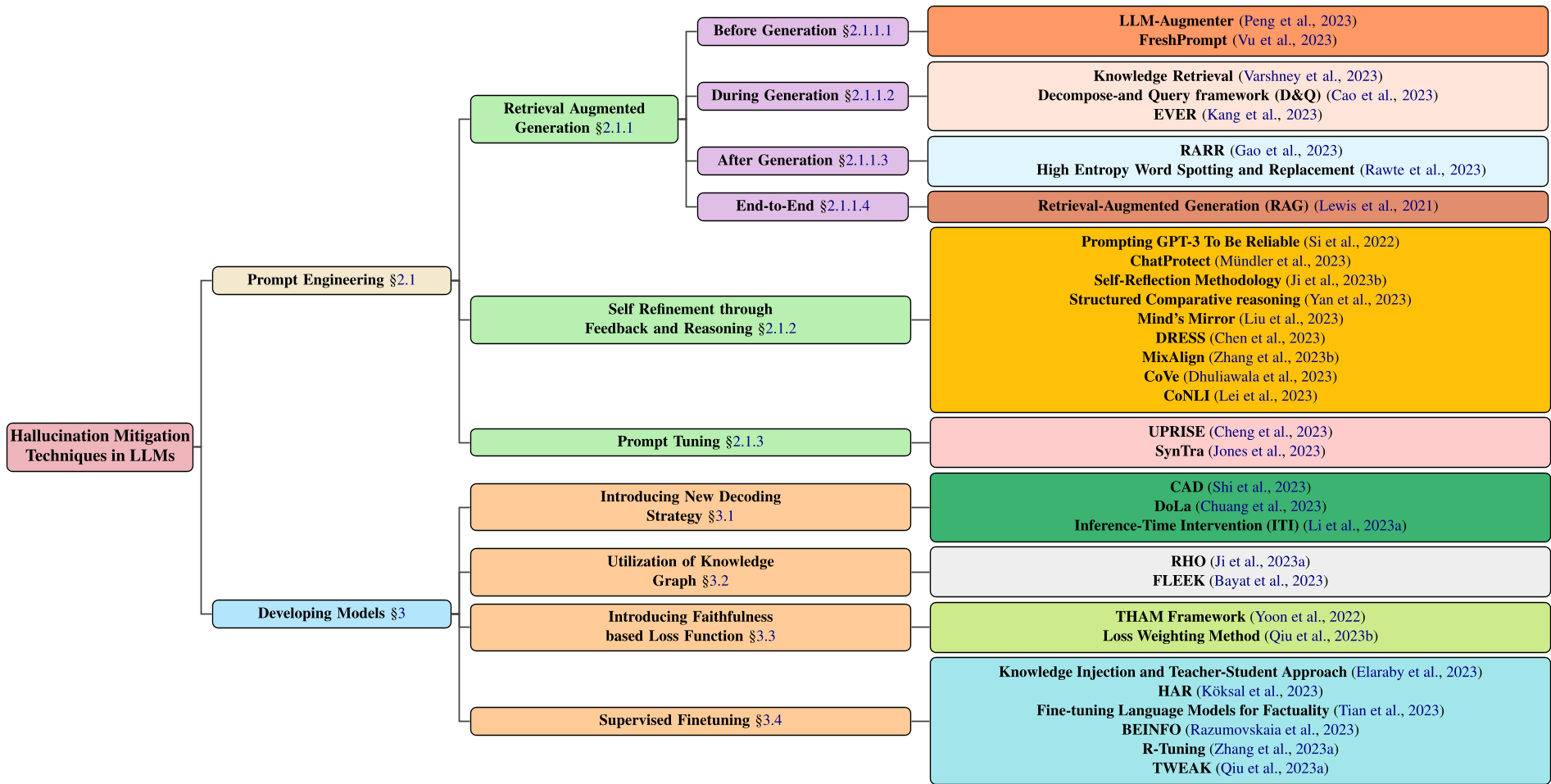 Figure 1: The hierarchical classification of hallucination mitigation, from prompt tuning to architectural loss functions.
Key Performance Gains
The survey provides a comparative look at how these techniques perform:
- Verifiable Accuracy: Frameworks like EVER and D&Q show that breaking down complex questions into "multi-hop" retrieve-and-verify steps significantly boosts F1 scores on benchmarks like HotPotQA.
- Truthfulness: Inference-Time Intervention (ITI) shows that by shifting model activations toward "truth-correlated" directions during the forward pass, we can elicit more honest answers without retraining the model.
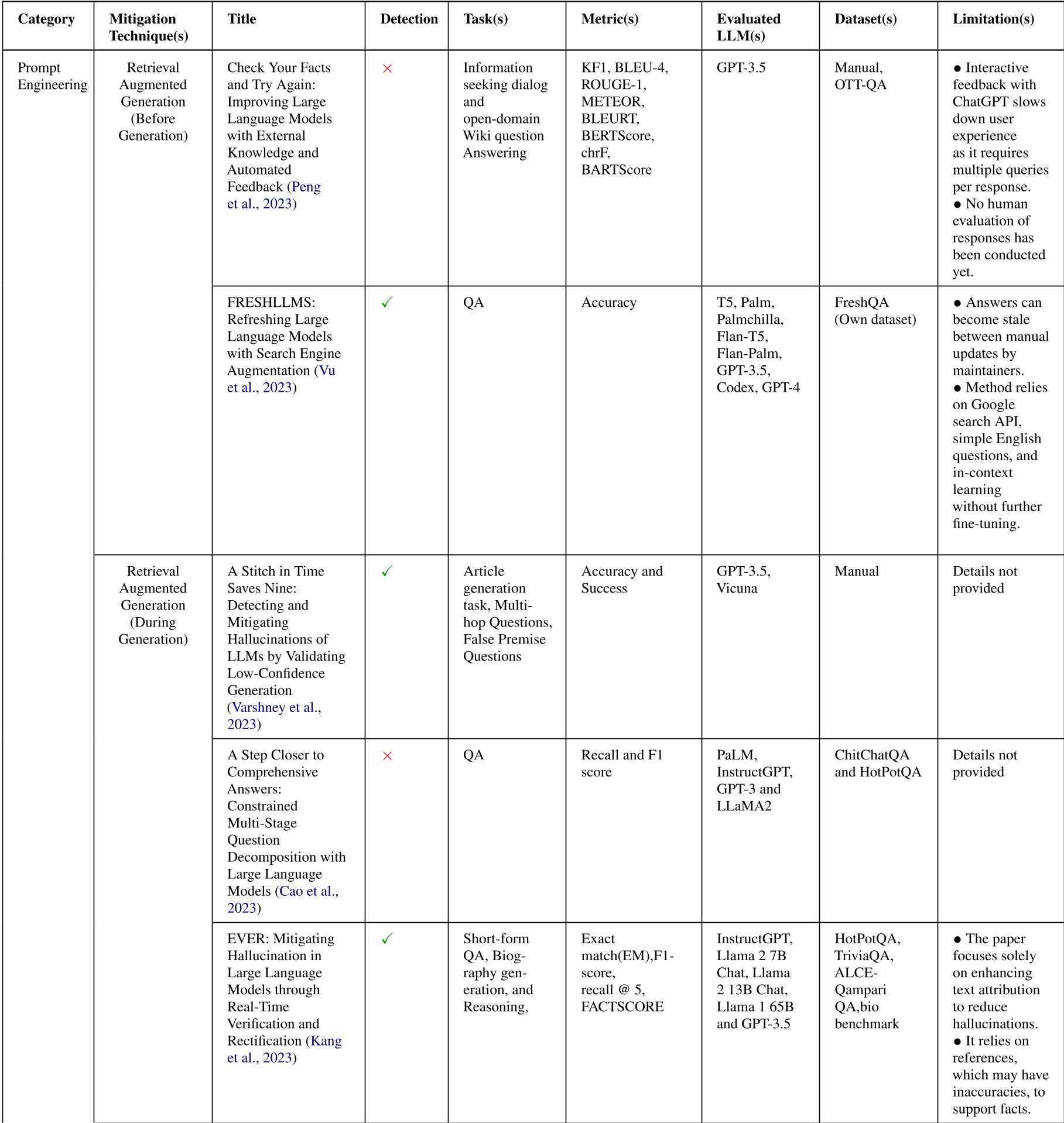 Table 1: A subset of techniques showing the trade-off between detection capability and task-specific metrics.
Critical Insight & Future Outlook
While RAG is the current industry standard, this paper suggests that the future lies in Hybrid Models. We cannot simply "prompt" our way out of hallucinations. We need models that have:
- Refusal Skills: The ability to say "I don't know" when a query falls into a knowledge gap (e.g., R-Tuning).
- Structural Integrity: Loss functions that penalize ungrounded tokens during training, rather than just post-hoc patching.
Limitations: Many current methods, like RARR or CoVe, are computationally expensive—requiring multiple LLM passes for a single query. Scaling these to real-time, low-latency applications remains the next great frontier in AI safety.
Conclusion
The journey to hallucination-free AI is moving from "teaching models to talk" to "teaching models to think and verify." For developers and researchers, this survey is the definitive guide to the tools currently available to build trust in the age of generative AI.