
VLM4HOI: Teaching AI to Understand What Your Hands are Doing in AR
Hoi-ref: Hand-object interaction referral in egocentric vision
The paper introduces HOI-Ref, a novel task for egocentric hand-object interaction referral, and VLM4HOI, a Vision Language Model specifically optimized for this domain. By leveraging a massive new dataset called HOI-QA with 3.9M question-answer pairs, the authors achieve SOTA performance in identifying and localizing hands and manipulated objects from a first-person perspective.
TL;DR
Understanding the world from a first-person perspective is the "holy grail" for AR and robotics. While current AI is great at spotting a dog in a photo, it often fails to realize your left hand is currently holding a specific screwdriver. Researchers from the University of Bristol have released HOI-Ref and VLM4HOI, a system trained on 3.9 million egocentric interactions to finally bridge this gap, boosting first-person referral accuracy by over 27%.
The Problem: The "Egocentric Gap"
Most Vision Language Models (VLMs) are trained on "third-person" datasets—think of Flickr or COCO where the camera is an observer. But in Egocentric Vision (First-Person), the rules change:
- Obsessive Proximity: Objects are often extremely close to the lens, appearing distorted.
- Hand Domination: Hands occupy a huge portion of the frame and frequently occlude the objects they are using.
- Relational Ambiguity: If you are in a kitchen, a standard AI can find "a bottle," but it struggles to find "the object currently being opened by the right hand."
Existing SOTA models like MiniGPT-v2, while powerful, show a massive performance drop when switched to this first-person perspective.
Methodology: HOI-QA & VLM4HOI
The authors realized that the bottleneck wasn't just the model architecture—it was the data. They created HOI-QA, a colossal dataset of 3.9M QA pairs derived from the EPIC-KITCHENS and Ego4D datasets.
The Task Split: HO-Ref vs. I-Ref
To ensure the model truly understands the scene, the tasks were split into two logic streams:
- HO-Ref (Hand & Object Referral): "Where is the bottle?" or "What is in this bounding box?"
- I-Ref (Interaction Referral): "Where is the object being manipulated by the left hand?" This requires the model to understand the link between the hand and the tool.
Model Architecture
VLM4HOI utilizes a frozen EVA Vision Encoder to extract features, which are then projected via a trainable layer into the embedding space of a LLaMA-2-7B (fine-tuned using LoRA).
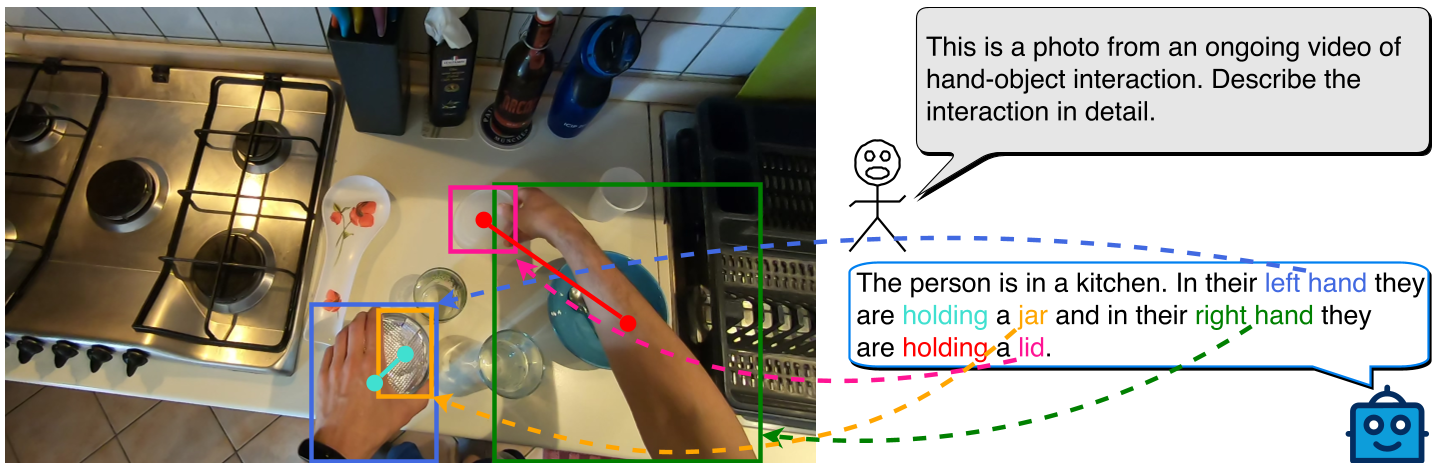 Figure 1: The HOI-Ref task requires the model to identify hands and objects, then associate them through interaction logic.
The model uses Task Tags like [refer] and [identify] to help the LLM backbone switch between outputting text names or spatial coordinates.
Experiments: Proving the Point
The results were stark. VLM4HOI didn't just iterate on previous work; it redefined the baseline for this specific task.
| Model | Noun Accuracy | BBox Accuracy (IoU > 0.5) |
|---|---|---|
| MiniGPT-v2 (Baseline) | 6.70% | 22.46% |
| VLM4HOI (Ours) | 17.78% | 50.26% |
In the Interaction Referral (I-Ref) sub-task—the hardest category—VLM4HOI achieved 37.45% noun accuracy, whereas the random baseline was essentially zero.
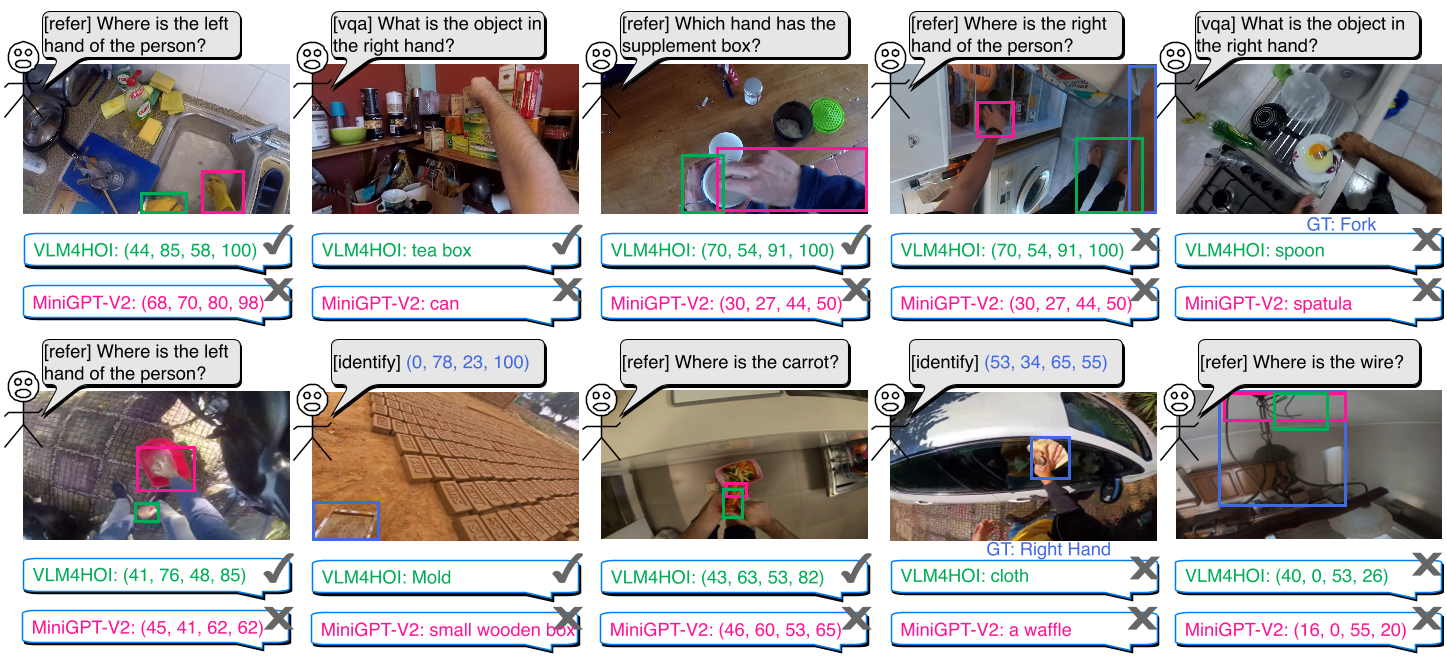 Figure 2: Qualitative comparison showing VLM4HOI successfully identifying objects in-hand where general-purpose VLMs fail.
Critical Insight: Why Does it Work?
An ablation study revealed two critical findings:
- Spatial Supervision is Mandatory: When trained without bounding box data, the model's ability to even name objects dropped. Localizing an object helps the LLM "see" its features more clearly.
- Task Tags Matter: Using specific tags to define the output format (Bounding Box vs. Text) provided a consistent performance boost, helping the LLM navigate its multi-modal weights.
Summary & Future Outlook
HOI-Ref moves VLM research from "Passive Observation" to "Active Interaction." For future AR applications—like a headset that guides a mechanic through a repair—the ability to know exactly what the user is holding is non-negotiable.
Limitations: The model still struggles with motion blur (common in head-mounted cameras) and very small objects (like needles or screws). The authors suggest that moving to multi-frame video inputs instead of single images is the next logical step for the field.