
MPT: Mastering OSN Big Data on a Budget
Handling big data of online social networks on a small machine
The paper introduces the Microblog Processing Toolkit (MPT), a specialized system designed to collect, index, and statistically analyze tens of millions of microblog posts daily using only commodity hardware. It evaluates three backend strategies—MongoDB Regex, Nextword Indexing, and Apache Lucene—to determine the optimal balance between speed, memory efficiency, and accuracy for big data research in resource-constrained environments.
TL;DR
Is big data research exclusive to tech giants with massive clusters? This paper says no. By introducing the Microblog Processing Toolkit (MPT), researchers from the University of Massachusetts demonstrate how to ingest and analyze up to 10 million microblog posts daily using a single commodity PC. The study compares MongoDB, Nextword Indexing, and Lucene, revealing critical trade-offs between speed, memory, and accuracy.
Background: The Resource Barrier
In the era of Online Social Networks (OSNs), the sheer volume of "Big Data" often scares off smaller laboratories. The hardware requirements for high bandwidth and massive storage seem insurmountable. MPT challenges this by focusing on a specific data type—Microblog Posts (MBPs)—and optimizing the indexing-to-analysis pipeline to run on a standard quad-core machine with 16GB RAM.
The "Data Explosion" Problem
The authors initially faced two major hurdles:
- System Crashes: MongoDB's default behavior of loading frequently accessed files into RAM caused the system to collapse as the database grew.
- Query Latency: Using standard Regular Expressions in MongoDB took far too long for real-time social event detection.
To solve the crash issue, the team implemented a temporal partitioning strategy, dividing data into weekly increments. This ensured only the most recent (and active) data files occupied the precious RAM.
Methodology: Three Indexing Contenders
The core of the paper lies in how MPT retrieves and analyzes data. The authors compared three distinct philosophies:
1. The Naive Approach: MongoDB Regex
- Mechanism: Linear scanning using built-in regular expressions.
- The Verdict: Perfect accuracy, but agonizingly slow. It is unusable for real-time applications.
2. The Theoretical Contender: Nextword Indexing
- Mechanism: Stores pairs of consecutive words to speed up phrase searching.
- The Problem: While fast, it suffered from "Memory Blowup." As data volume doubled, the index size ballooned to 5GB of RAM, threatening the stability of a commodity machine.
3. The Practical Champion: Lucene-Based Indexing
- Mechanism: Using Apache Lucene but customizing the index to include a "Key" consisting of [Location + Gender + Time].
- The Innovation: By grouping posts at the indexing stage, MPT can perform statistical analysis by traversing groups rather than individual posts.
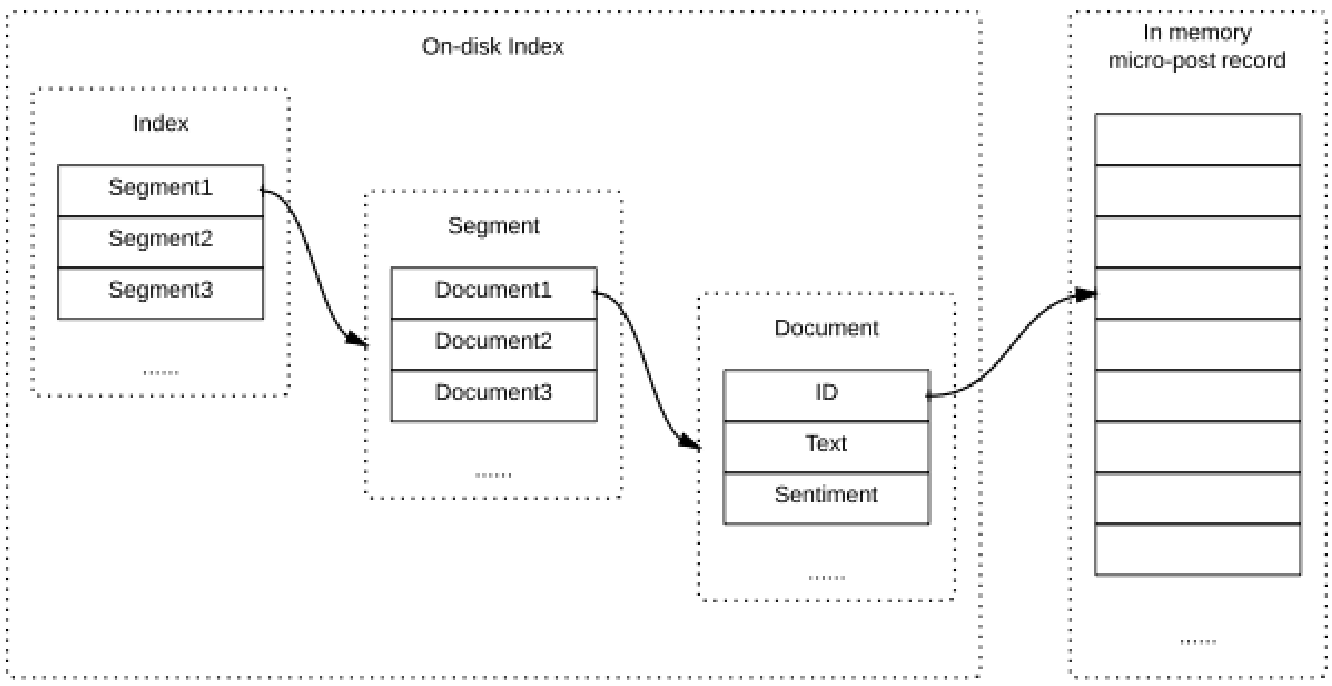 Figure: The structure of the Lucene-based indexing and search server.
Performance vs. Precision: The Great Trade-off
The experimental results highlight a classic engineering dilemma in computer science.
- Speed: Lucene was the clear winner. As keyword frequency increased, Lucene’s response time remained significantly lower and more stable than Nextword or MongoDB.
- Statistical Analysis: Lucene again dominated, finishing analysis in a fraction of the time required by its competitors.
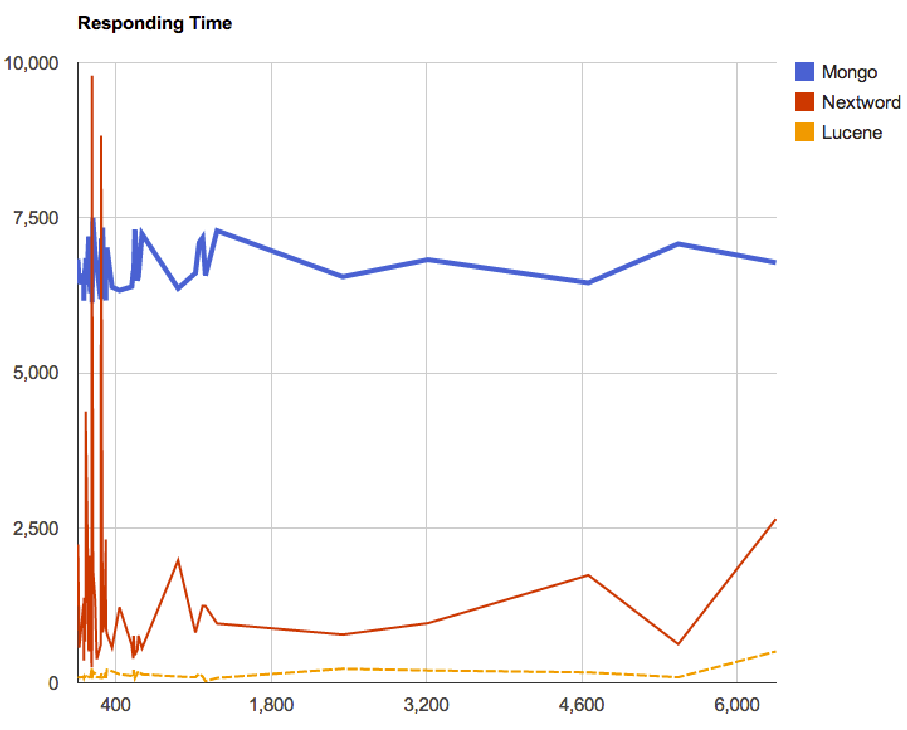
- The Catch (Accuracy): Lucene’s precision dropped to 0.53. This is because Lucene often returns results containing any of the keywords in a phrase (OR logic) rather than the exact phrase. Furthermore, Chinese language segmentation errors—where words have no spaces—led to missing data (lower recall) for the Nextword approach.
| Method | Precision | Recall |
|---|---|---|
| MongoDB | 1.00 | 1.00 |
| Nextword | 1.00 | 0.72 |
| Lucene | 0.53 | 0.81 |
Critical Insight & Conclusion
The study concludes that there is no "perfect" system for a small machine.
- MongoDB is an excellent vault for storage but a poor engine for search.
- Nextword Indexing is superior for high-accuracy analysis on datasets under 3 million records.
- Lucene is the only viable path for true "Big Data" on a single machine, provided the researcher can tolerate an approximation in statistical results.
For the academic community, this work serves as a blueprint: By understanding the underlying indexing mechanisms, we can "algorithmically" compensate for hardware limitations, democratizing big data research for labs worldwide.