
Solving the "Invisible Minority" Problem in Cultural Group Behavior Modeling
Handling Class Imbalance Problem in Cultural Modeling
The paper introduces a specialized solution for the Class Imbalance Problem in cultural modeling using the MAROB benchmark. By combining standard classifiers (NB, SVM, ANN, kNN, DT, RF) with strategic sampling and ROC analysis, the authors achieve significant improvements in minority class identification for group behavior prediction.
TL;DR
Predicting rare but critical group behaviors (e.g., suicide missions in conflict zones) is often hindered by the Class Imbalance Problem, where 90% of data represents the "normal" state. This paper demonstrates that standard machine learning models effectively "ignore" these rare events. The authors propose a human-in-the-loop framework using ROC Analysis and Resampling to boost recall by up to 60%, providing a roadmap for more reliable social computing.
The "Accuracy" Trap in Social Computing
In cultural modeling—the computational study of how cultural factors influence group behavior—we are often searching for the "needle in the haystack." Whether analyzing organizational decisions or ideological shifts, the behaviors of interest (the Positive class) are statistically rare compared to the status quo (the Negative class).
Standard classifiers like Decision Trees or SVMs are designed to maximize Accuracy. If 95% of your data is "Negative," a model that simply predicts "Negative" every single time will achieve 95% accuracy while being 100% useless for prediction. The authors argue that this is the primary reason why existing cultural models like CONVEX, despite reporting high accuracy, suffer from abysmal Recall and AUC.
Methodology: Tuning for the Rare Event
The researchers identified that since cultural datasets (like MAROB) are typically small (often <100 instances), they require a specific approach beyond just "plug-and-play" algorithms.
1. Multi-Classifier Benchmarking
The study utilizes six diverse algorithms to ensure the findings aren't biased toward a specific architecture:
- Probabilistic: Naive Bayesian (NB)
- Geometric: SVM (Polynomial Kernel)
- Connectionist: Artificial Neural Networks (MLP)
- Instance-based: k-Nearest Neighbor (kNN)
- Rule-based: C4.5 Decision Trees and Random Forests
2. The Sampling & ROC Loop
Instead of picking a single sampling rate (e.g., 50/50 split), the authors varied the sampling rates across a wide spectrum to generate ROC Curves. This visualizes the trade-off: How much False Positive noise are we willing to accept to gain a 10% increase in True Positive identification?
 Table 1: The Confusion Matrix utilized to shift focus from Accuracy to Recall/FPrate.
Experimental Insights: Why C4.5 and Undersampling Win
Testing on the Fatah organization dataset (Middle East MAROB data), the researchers found that Undersampling—discarding some majority samples—was surprisingly more effective than Oversampling. This is likely because the "Status Quo" in cultural data is often redundant, and reducing its dominance allows the model to find the elusive decision boundaries for rare behaviors.
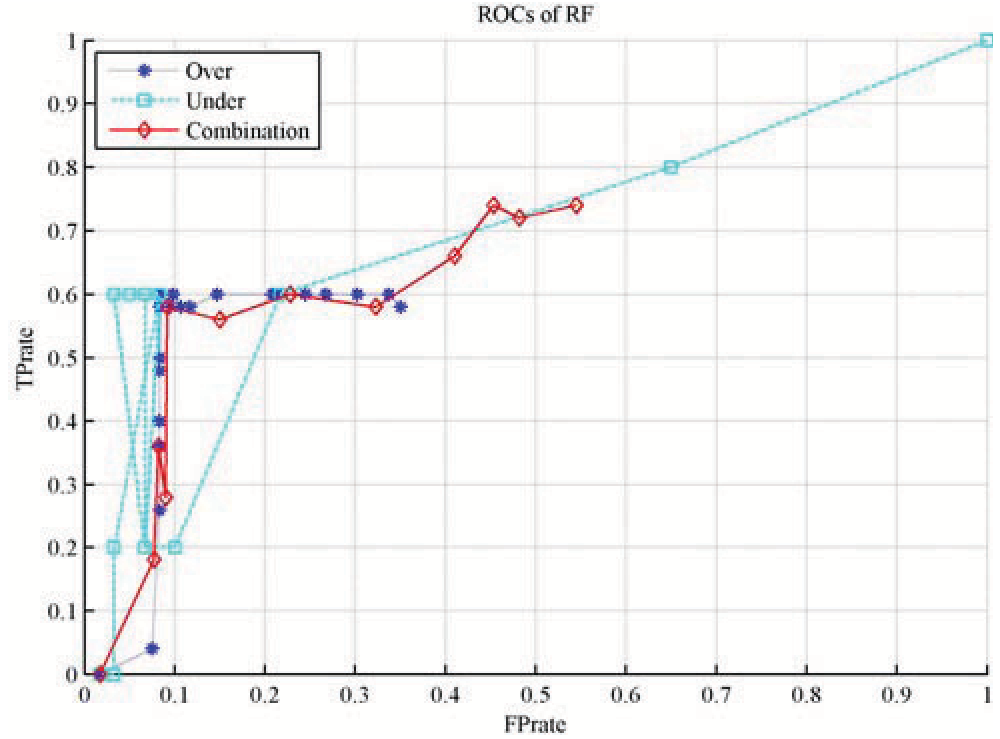 Figure 5: ROC Curves for C4.5. Note how undersampling (solid line) allows the Recall to jump from 0% to 60% with minimal impact on False Positives.
Key Findings:
- C4.5 (Decision Trees) emerged as the champion for this domain, dominating other classifiers when the False Positive rate was kept under 0.6.
- Human-in-the-loop: Because misclassification costs vary (e.g., missing a potential threat vs. a false alarm), the researchers argue that a User Involved Process—where a domain expert picks the point on the ROC curve—is superior to an automated scalar optimization.
Critical Perspective: Beyond Simple Ratios
While this work provides a robust framework for handling current cultural data, it highlights a deeper challenge: Data Scarcity. In cultural modeling, because we deal with historical socio-political events, we cannot simply "collect more data."
The author's admission that SMOTE (Synthetic Minority Over-sampling Technique) failed because the attributes are "Nominal" (categorical) points to a significant future research direction: we need better synthetic data generation for discrete, categorical cultural variables.
Final Takeaway
If you are building models for social change, security, or group dynamics, stop optimizing for accuracy. This paper proves that by integrating ROC analysis with aggressive undersampling, we can transform "blind" models into sensitive tools capable of spotting rare cultural patterns that truly matter.