
Beyond the Empty Profile: Solving POI Cold-Start via Cross-Platform Crowdsourcing
Handling cold-start scenarios in point-of-interest recommendations through crowdsourcing
This paper introduces a novel crowdsourcing-based approach to solve the Point-of-Interest (POI) cold-start problem by fusing data across multiple Location-Based Social Networks (LBSNs). The method employs sentiment analysis on cross-platform reviews to extract features for new POIs, significantly outperforming traditional USG and CRCF models in recommendation accuracy.
TL;DR
The "Cold-Start" problem remains one of the most stubborn hurdles in Recommendation Systems. When a new restaurant or shop opens, it has no history, no ratings, and therefore, no visibility. This paper presents a pragmatic solution: if one platform doesn't have the data, "crowdsource" it from others. By fusing data across social networks and using sentiment analysis to infer ratings, the authors achieved an 88% success rate in identifying new venues and vastly improved recommendation recall.
The "New Venue" Ghost Town
Modern LBSNs (Location-Based Social Networks) like Yelp and TripAdvisor are excellent at suggesting established places. However, they suffer from a "rich-get-richer" bias. Because the algorithm relies on historical features, a brand-new POI is essentially a ghost in the system.
The authors identify two fatal flaws in existing work:
- Feature Blindness: Many models (like USG) focus on spatial links but ignore what people actually like about a place (e.g., "crispy crust" or "quiet atmosphere").
- Platform Silos: Most systems only look at their own internal database, ignoring that a "new" venue on Yelp might already have a 5-star reputation on Google or Foursquare.
Methodology: The Fusion Engine
The proposed framework operates via a four-stage pipeline: Discovery, Feature Extraction, Preference Learning, and Recommendation.
1. Cross-Platform Discovery
The researchers treated Yelp as the "target." To find "cold-start" POIs, they strategically queried external APIs (Google, Foursquare) within specific geographical radiuses. By identifying venues present on other platforms but missing on Yelp, they effectively "pre-filled" the ecosystem.
2. Sentiment-to-Rating Inference
How do you rate a place that has no stars? The authors used a NLP-based sentiment analysis approach. They extracted nouns (Implicit Features) and adjectives (Sentiments) from reviews found elsewhere. Using SentiWordNet, they converted these linguistic descriptors into numerical polarities.
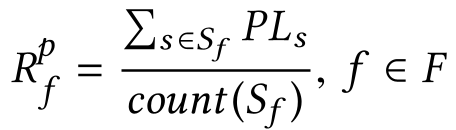
The formula (1) shown above aggregates these polarities to estimate an inferred rating () for every specific feature of a new POI.
Experiments: Proving the Gains
The study utilized a massive Yelp dataset (Arizona and Nevada) consisting of over 53,000 POIs and 1.7 million reviews.
Key Breakthroughs:
- Identification Success: The model successfully re-identified up to 88% of missing/new POIs.
- Accuracy (Recall): As shown in the performance charts, the proposed method significantly outperforms USG and CRCF, especially when historical data is scarce (the 10%-20% training data range).
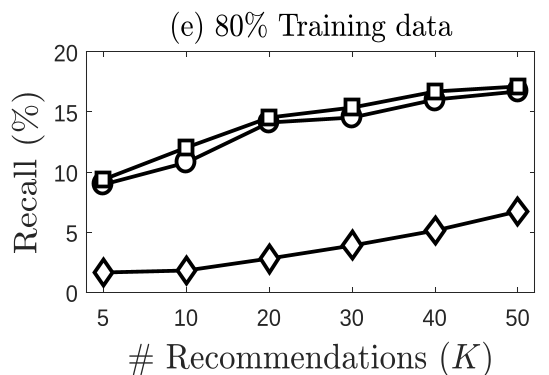 Note: The Recall improvement remains consistent as the data volume increases, maintaining a lead over traditional collaborative filtering.
Critical Insight: The "Spam" Challenge
While this methodology is robust, the authors conclude with an honest reflection on a rising threat: Review Spam. If we are crowdsourcing data to solve cold-starts, we are also susceptible to purchased or fake reviews. Business owners often resort to "gaslighting" the system with fake positivity to jumpstart their growth.
Future research in this lineage must integrate Spam Detection as a primary layer, ensuring that the "crowdsourced wisdom" used to fill the cold-start gap is actually authentic.
Conclusion
This paper serves as a blueprint for "Platform Agnostic" recommendations. By breaking down the walls between social networks and treating the web as a single, unified source of truth, we can ensure that "new" doesn't have to mean "invisible."