
SNA Hexagon: Solving the Incomplete Data Puzzle in Semantic Application Monitoring
Handling incomplete data using semantic logging based social network analysis hexagon for effective application monitoring and management
The paper introduces a "Social Network Analysis (SNA) Hexagon" framework combined with Semantic Logging to address incomplete execution data in large-scale applications. It utilizes graph theory and matrix multiplication to infer missing log values, achieving high precision in automated fault detection and predictive monitoring.
TL;DR
Monitoring large-scale Service-Oriented Systems (SOS) is often hampered by "silent" failures and incomplete logs. This paper proposes a dual-layer approach: first, Semantic Logging to give logs structure, and second, a Social Network Analysis (SNA) Hexagon to mathematically infer missing data via graph theory. By treating system components and events as "social actors," the framework recovers lost information and predicts faults with up to 88% precision.
The "Broken Link" in Application Logs
The fundamental problem with modern DevOps is that logs are mostly syntactic—they tell us what text was output, but not why it relates to a specific user, component, or non-functional requirement. When a log entry is missing due to a network timeout or a crash, we lose the thread of execution.
The authors argue that existing tools like Splunk or RDF-based loggers provide structure but lack the inferential power to handle incomplete data. Their insight? System components interact much like people in a social network; if we know the relationships between A-B and B-C, we can mathematically predict the state of A-C.
Methodology: The SNA Hexagon
The heart of the paper is the Social Network Analysis Hexagon, which links six key semantic entities:
- Users (U)
- Log Events (LE)
- Components (C)
- Problem Space (PS)
- Functional Properties (FP)
- Non-Functional Properties (NFP)
The Logic of Matrix Inference
By modeling these entities as a graph, the authors represent relationships as matrices. For instance, if you have a matrix representing (Component Functional Property) and matrix representing (Component Non-Functional Property), you can derive the relationship between Functional and Non-Functional properties even if that data was never logged.
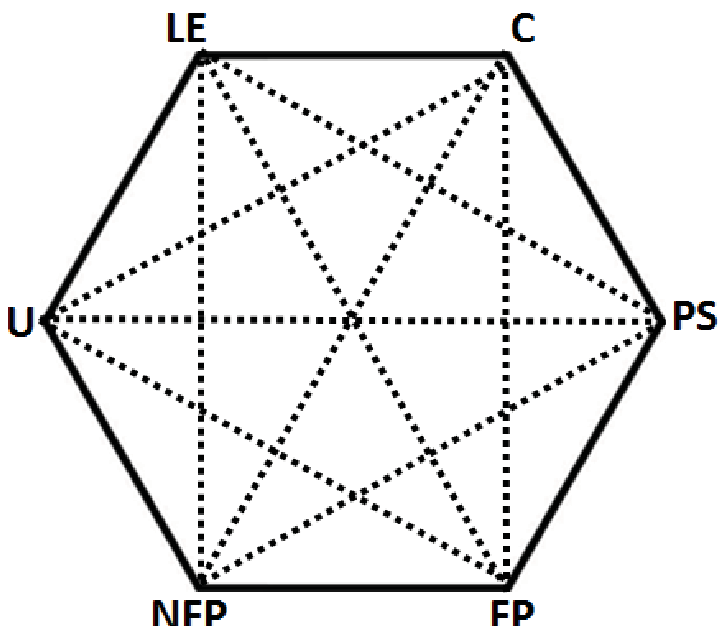
The paper specifically highlights Triangle 1 (C, FP, NFP). Using the formula: The system "calculates" the missing edge of the triangle, filling in the gaps of the execution footprint.
Experiments: Banking Case Study
The authors tested this on a banking application (Transaction/Database/Communication managers). By combining this recovered data with a Bayesian Classifier, they monitored the system for 8 common problem types, including database connectivity and timeout issues.
Performance Metrics
- Classification Accuracy: Achieved a Mean Average Precision (MAP) of 88%.
- Predictive Power: The system was able to predict faults before they became critical with 71% precision.
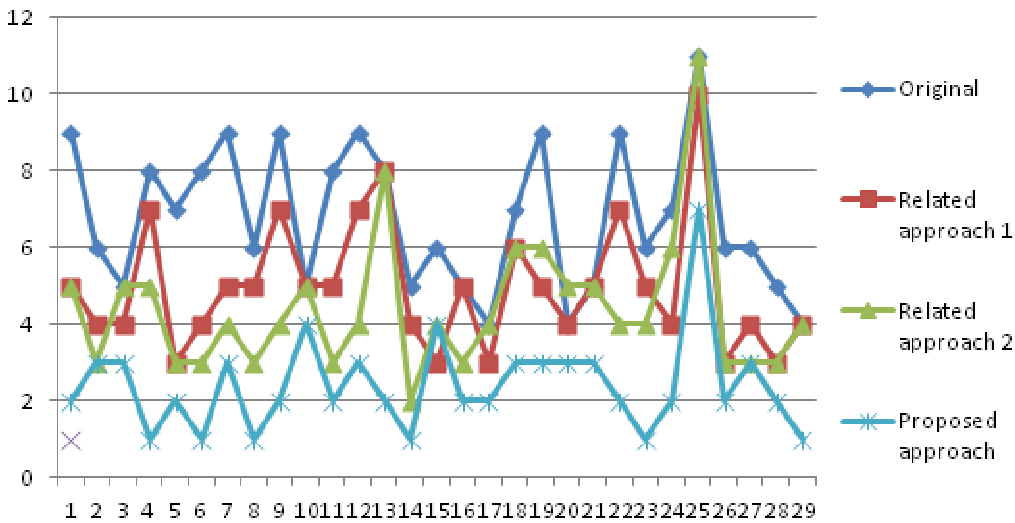
- Efficiency: As shown in the graph below, the number of steps required for an administrator to detect a problem was significantly lower than traditional methods.
Critical Insight & Perspectives
What makes this work stand out is moving beyond "Pattern Matching" (which tools like Splunk do) and moving toward "Semantic Reasoning."
Strengths:
- Mathematical Rigor: Using matrix multiplication for social network inference provides a deterministic way to handle missing data.
- Reduced Noise: By filtering logs through a semantic model, the "Problem Space" is drastically narrowed for human operators.
Limitations:
- Ontology Overhead: The effectiveness relies on a well-defined initial ontology. If the semantic definitions of "Components" or "Problems" are too broad, the matrix calculations lose precision.
- Computational Cost: While matrix multiplication is efficient, generating and maintaining a high-fidelity social network of millions of events in real-time may require significant resources.
Conclusion
This paper bridges the gap between Software Engineering and Social Network Science. By treating logs not as text lines, but as nodes in a relational graph, it provides a robust mathematical framework for AIOps (Artificial Intelligence for IT Operations) to handle the inevitable "messiness" of real-world application data.