
Bridging the Gap: Handling Multi-word Expressions via Learning Pathway Templates
Handling Multi-word Expressions without Explicit Linguistic Rules in an MT System
The paper introduces a hybrid framework for Multi-word Expression (MWE) translation that combines a rule-based Machine Translation (MT) system with a dynamic learning mechanism. By utilizing "Learning Pathway Templates," the system allows non-linguist bilinguals to provide MWE translations through simple patterns, which are then automatically integrated into the formal linguistic processing pipeline.
TL;DR
Multi-word expressions (MWEs) like "kick the bucket" or "simmer with anger" are the "pain in the neck" of machine translation. This paper presents a framework that allows ordinary bilinguals (non-linguists) to input MWE patterns, which the system then automatically "elevates" into complex linguistic rules. By using Learning Pathway Templates, the system handles morphological variations and word insertions that standard dictionary lookups cannot.
Background Positioning
In the landscape of Machine Translation, this work represents a strategic hybrid approach. It sits between Pure Rule-Based MT (RBMT), which is linguistically precise but data-poor, and Example-Based/Statistical MT, which is data-rich but often lacks structural rigor. It introduces a mechanism to "learn" the linguistic behavior of MWEs from simple user-provided examples.
The Problem: The "Non-Compositional" Paradox
The fundamental challenge of MWEs is their dual nature:
- Semantically Atomic: The meaning of "simmer with anger" cannot be calculated by adding "simmer" + "anger".
- Syntactically Flexible: Unlike fixed strings, they undergo changes—"simmered with quiet anger," "is simmering," etc.
Prior works often treated MWEs as static strings or required experts to manually code every possible variation. The authors identify that bilingual non-experts are an untapped resource, but their lack of linguistic training (POS tags, case markers) makes their input unusable for traditional rule-based engines.
Methodology: Learning Pathway Templates
The core innovation is the Learning Pathway Template (LPT). Think of it as a "bridge" between a layman's pattern and a linguist's grammar.
1. The Input Pattern
A bilingual editor provides:
- Example: "Godhra is simmering with anger" -> "Godhraa krodha se bhabhak rahaa hei"
- Pattern:
Simmering with anger*1where*1is a variable (anger, pain, etc.).
2. The Compilation Process
The system takes this simple pattern and uses a POS tagger and Chunker to analyze the example sentence. It then matches it against an LPT.
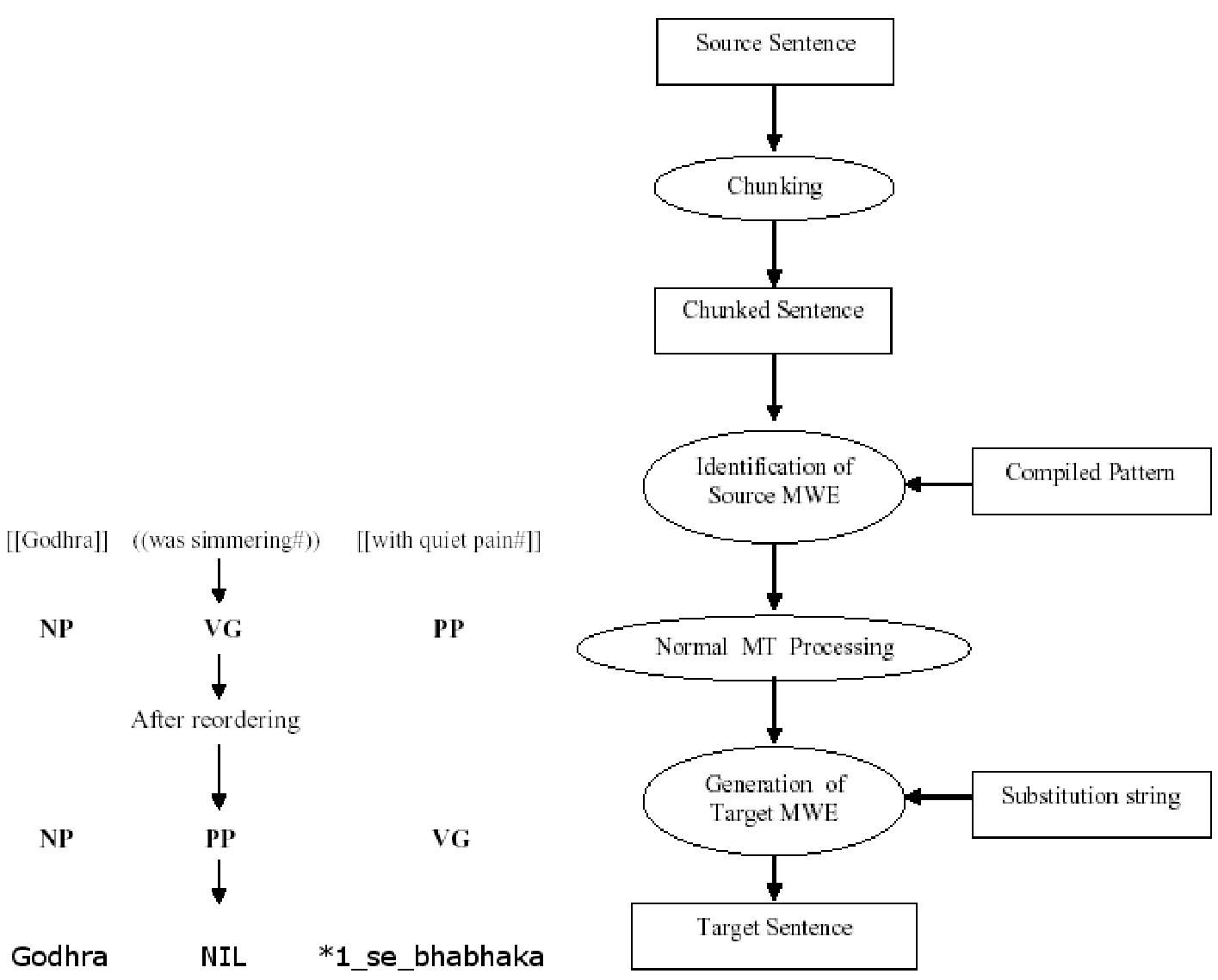 Figure: The data flow from user patterns to compiled linguistic rules.
3. Generalization Power
Because the pattern is linked to a template, the system "understands" that:
Simmeris the head verb (it should take the tense/aspect of the sentence).Withis a preposition that maps to a specific case marker (e.g.,sein Hindi).- Other words (adjectives/adverbs) can be inserted within the chunks without breaking the match.
Experiments and Results: Does it Work?
The authors evaluated the system using an English-to-Hindi MT pipeline on 230 sentences from the BNC corpus.
| Metric | Count | Percentage |
|---|---|---|
| Improved Translation | 139 | 60.4% |
| No Change/Baseline | 12 | 5.2% |
| Chunker Failures | 61 | 26.5% |
| Incorrect Translation | 18 | 7.9% |
The results prove that when the Chunker (the tool that groups words into phrases) works correctly, the system significantly improves translation quality by correctly handling word order and inflections in idioms.
Critical Insight: The "Chunking" Bottleneck
As noted in the Limitations, the system's biggest weakness is its reliance on pre-processing. If the Chunker incorrectly separates "put pen to paper" into disparate parts, the MWE pattern fails to trigger. This highlights a classic "cascading error" problem in NLP: a mistake in an early layer (parsing/chunking) invalidates all downstream logic.
Conclusion & Future Outlook
This paper offers a compelling blueprint for human-in-the-loop AI. By creating a specific "pathway" for data to enter a structured system, the authors show that you don't need a PhD in Linguistics to help build a better MT engine.
For future work, the integration of such templates into Neural Machine Translation (NMT) could provide the "hard constraints" or "lexical guidance" that modern LLMs often lack when dealing with rare or culturally specific idioms.
Takeaway: The "Pathways" approach bridges the gap between the intuition of a bilingual human and the formal requirements of a machine, making the "pain in the neck" of MWEs a little more manageable.