
EGF-SVM: Elevating Emotion Recognition through Geometric Intuition
Happy-Sad Expression Recognition Using Emotion Geometry Feature and Support Vector Machine
The paper introduces a facial expression recognition system specifically for "Happy" and "Sad" emotions using a novel "Emotion Geometry Feature" (EGF). It combines Active Shape Models (ASM) for precise landmark localization with Support Vector Machines (SVM) for robust binary classification.
TL;DR
The paper presents a high-precision approach for recognizing "Happy" and "Sad" expressions by extracting a novel Emotion Geometry Feature (EGF). By utilizing Active Shape Models (ASM) for feature point localization and Support Vector Machines (SVM) for classification, the authors achieved a 97.3% accuracy rate on the JAFFE database, offering a robust solution for medical robotics and human-computer interaction.
Problem & Motivation: Beyond Rigid Face Modeling
While facial expression recognition has been studied for decades, the "non-rigidity" of the human face remains a significant hurdle. Many prior methods relied on template matching or appearance-based features that are easily confounded by individual identity differences or lighting.
The authors realized that the core of an emotion lies in the geometry of movement—specifically how the mouth deforms relative to rigid anchor points like the nose. Traditional ASM landmarks are useful for face tracking but often lack the specific "emotional signal" needed for high-accuracy classification.
Methodology: The Power of Emotion Geometry (EGF)
The core contribution is the Emotion Geometry Feature (EGF). Instead of feeding raw coordinates into a classifier, the authors derive intuitive geometric relationships:
- The Mouth-Corner Angle: Using the nose tip () and the two mouth corners () as vertices, they calculate the angle . This captures the horizontal expansion of a smile versus the contraction of a sad face.
- Lip Vertical Distance: A measurement of the gap between the upper and lower lips, distinguishing between open-mouthed joy and closed-mouth sorrow.
- Landmark Positioning: Utilizing 66 points tracked via ASM to provide context for eyes, eyebrows, and nose.
The Pipeline
The workflow is elegant in its simplicity:
- Modeling: Train an ASM to recognize the general "shape" of a face.
- Localization: Fit the ASM to a new image to find coordinates.
- Feature Extraction: Transform these coordinates into EGF (angles and distances).
- Classification: Use an SVM with a Radial Basis Function (RBF) kernel to draw the decision boundary.
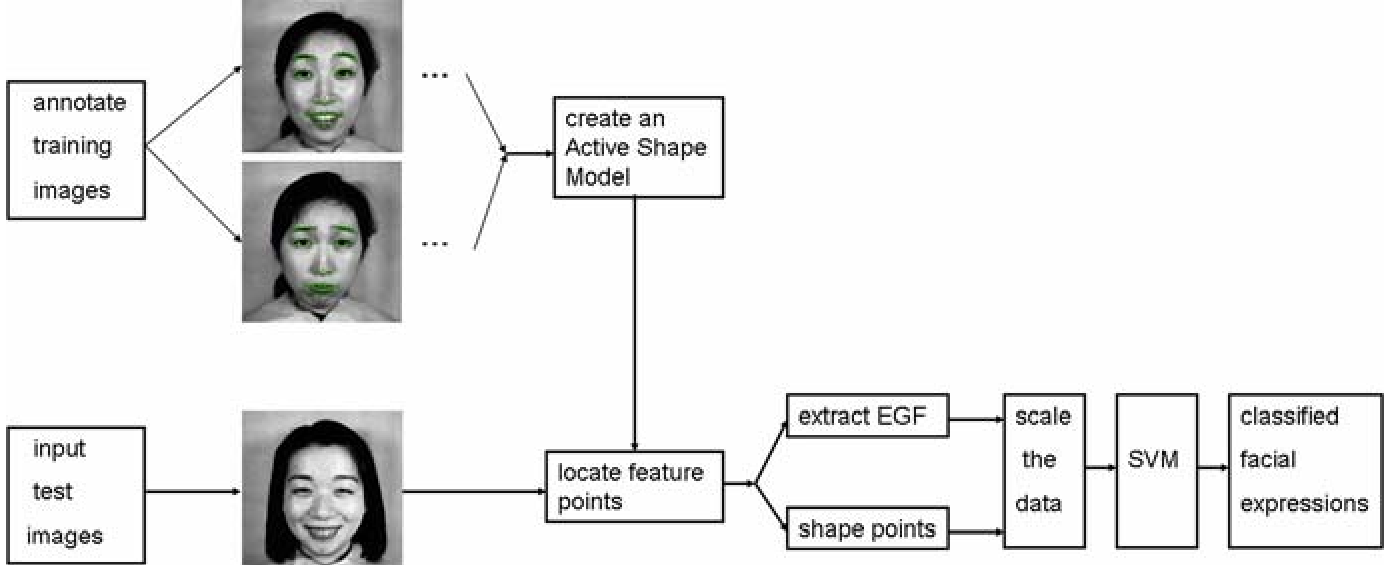 Figure: The geometric landmarks used to calculate EGF.
Experiments: Setting a New Standard on JAFFE
The study utilized the Japanese Female Facial Expression (JAFFE) database. By focusing on the binary classification of Happy vs. Sad, the model demonstrated remarkable stability.
- Accuracy: 97.3% average.
- Happiness Sensitivity: 98.5%.
- Sadness Sensitivity: 96.1%.
A key insight from their Ablation/Sample Study showed that once the training set size reaches 80% of the total data, the accuracy plateaus at a very high level, suggesting the EGF is highly representative of the underlying emotional states.
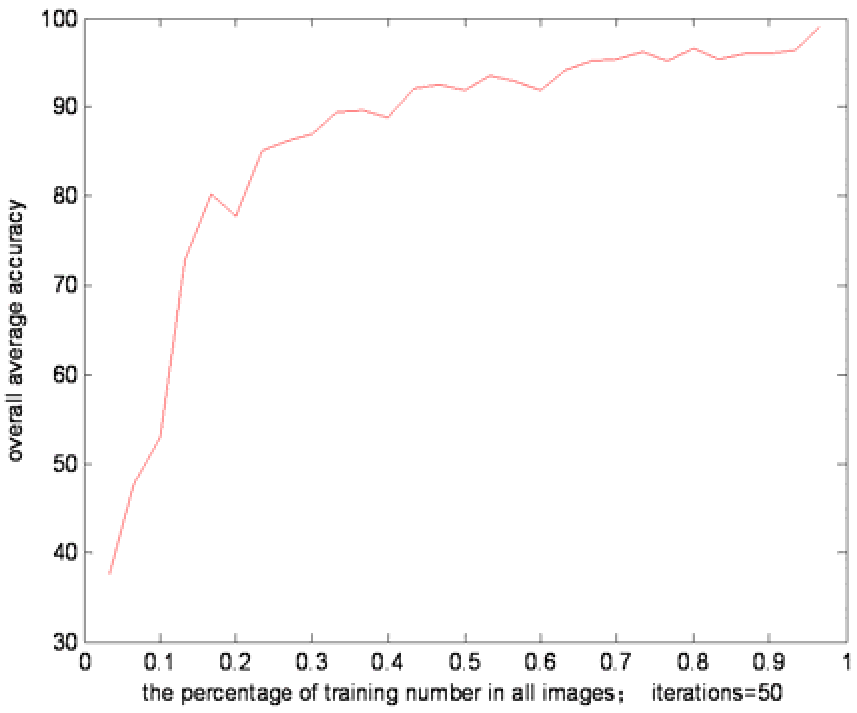 Figure: Performance stabilizes significantly as the training sample size increases.
Critical Analysis & Conclusion
The beauty of this work lies in its interpretability. Unlike modern "black-box" Deep Learning models, we can see exactly why the model thinks a patient is happy (e.g., the widening of angle ).
Limitations & Future Work
- Scope: The current study only addresses two emotions. Expanding this to the full suite of six basic emotions (anger, fear, etc.) is the next logical step.
- Data Diversity: The JAFFE database is specific to Japanese females; testing on a more ethnically diverse "in-the-wild" dataset would be necessary to prove generalizability.
Overall, this paper serves as a potent reminder that in the world of computer vision, a well-engineered feature grounded in physical intuition can often outperform more complex, brute-force approaches.