
Beyond the Screen: How Haptic Robots are Rewriting Handwriting Therapy for Children
Haptic Guidance to Support Handwriting for Children With Cognitive and Fine Motor Delays
This paper introduces a haptic-based handwriting training platform designed for children with cognitive and fine motor delays. Through a 9-week longitudinal study, the researchers utilized the Novint Falcon device to provide full haptic guidance, demonstrating that the system significantly improves handwriting quality specifically for tasks that are visually familiar but haptically complex.
TL;DR
Handwriting is a gateway to cognitive development, yet for children with motor delays, it is a formidable barrier. This longitudinal study reveals that robotic haptic guidance—physically guiding a child's hand through a stylus—significantly improves handwriting, but only when the child is already familiar with the shape's visual form.
Background: The Hidden Complexity of the Pen
We often take the act of writing for granted, but it is a "symphony" of cognitive, visual-motor, and linguistic abilities. For children with cognitive and fine motor delays, the bottleneck isn't just knowing what a "B" looks like; it's the kinesthetic execution. While existing apps offer visual cues, they ignore the "muscle memory" component. This research explores whether a robot can effectively "teach" the hand what the eye already sees.
The "Why": Task Difficulty and the Challenge Point
The researchers hypothesized that the effectiveness of haptic guidance isn't uniform. They categorized 32 tasks (letters, numbers, shapes) based on:
- Visual Familiarity: Does the child recognize the shape?
- Haptic Complexity: How difficult are the curves and strokes to execute?
This distinction is crucial. If a task is too easy, the child becomes passive; if it's too hard (visually unfamiliar and haptically complex), the cognitive load is too high for learning to occur.
Methodology: The Robotic Tutor
The study utilized the Novint Falcon, a high-fidelity haptic device retrofitted with a custom stylus grip.
The Haptic Loop
The system uses a Full Haptic Guidance algorithm. Once the child starts, the robot takes the "lead," calculating the force () required to keep the stylus on the ideal trajectory. It essentially creates a physical "tunnel" for the hand to move through.
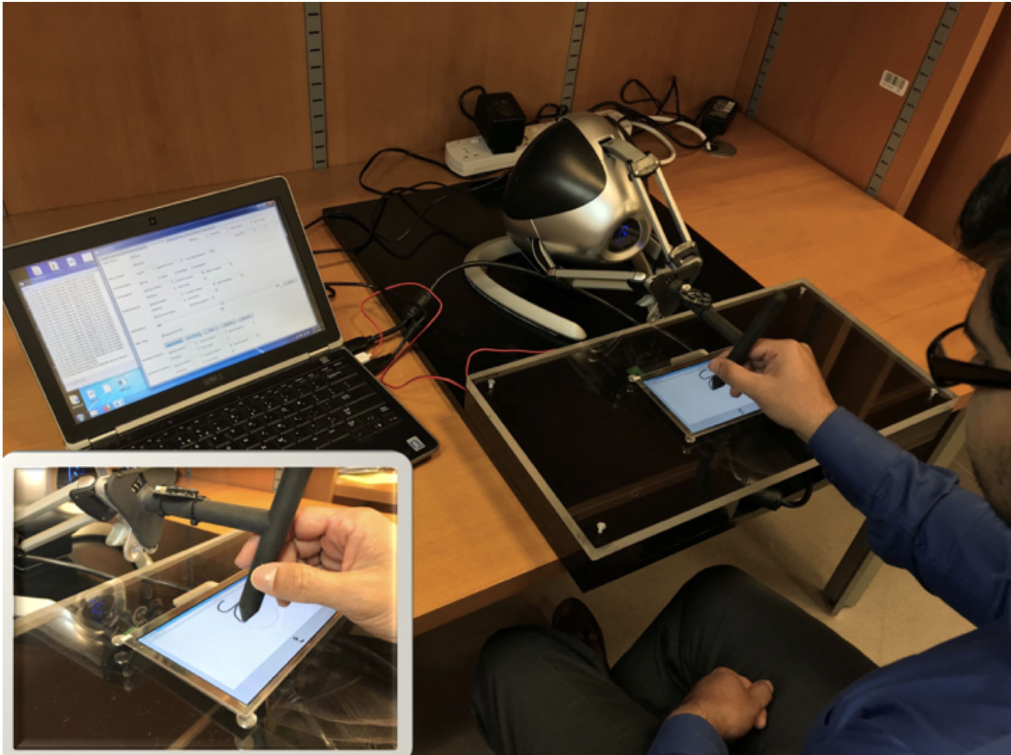 Fig 1: The experimental setup featuring the Novint Falcon haptic device and the custom stylus interface.
Experiments and Breakthroughs
Over 9 weeks, researchers tracked two groups of children with mild IQ and motor delays.
Key Findings:
- Familiarity Matters: The "Target Group" showed the most dramatic improvement in the VFHH (Visually Familiar, Haptically High) category.
- The Goldilocks Zone: For simple tasks, haptic guidance added little value. For "Visually Unfamiliar" tasks, the children failed to improve significantly because they couldn't map the robot's movement to a known mental image.
- Skill Transfer: Crucially, the children didn't just learn specific shapes; their performance on untrained tasks improved as well (), suggesting a genuine development of general motor control.
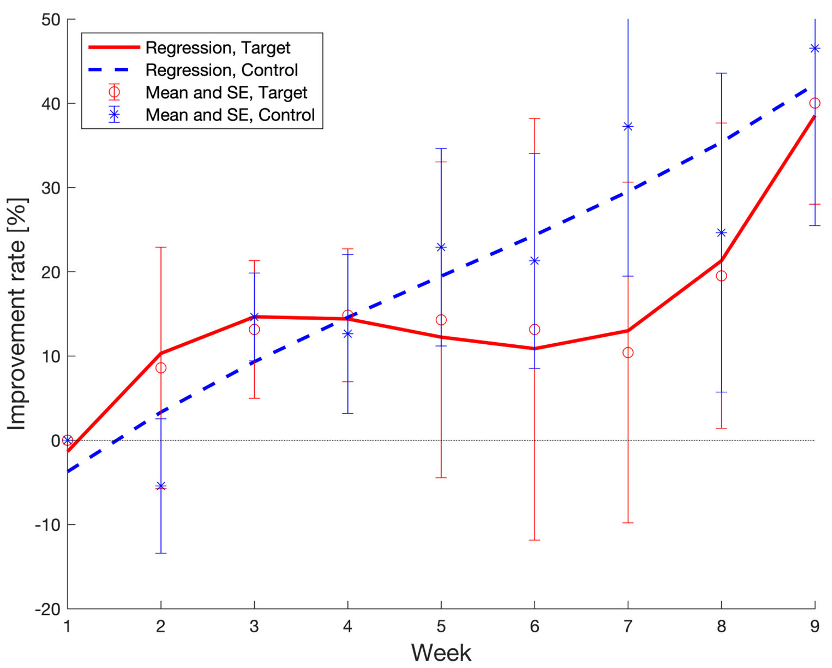 Fig 2: Learning curves showing that the haptic group (solid lines) outperformed the control group specifically in haptically difficult tasks.
Critical Insight: The "Passive Learning" Trap
An interesting outlier in the data showed that for medium-difficulty tasks, the control group sometimes outperformed the haptic group. The authors suggest a "Passive Learning" effect: when the robot provides too much help for a manageable task, the child "tunes out" and lets the machine do the work, preventing the brain from forming new neural pathways.
Conclusion and Future Outlook
This work proves that haptic interfaces are not just gadgets; they are precision tools for clinical intervention. The takeaway for educators and therapists is clear: Haptic guidance is most effective when it bridges the gap between recognition and execution.
Limitations & Next Steps
- Small Sample Size: The final analysis included 12 children, which is small for broad generalizations.
- Specific Disorders: Future work should isolate specific conditions like Dysgraphia to see if haptic guidance can be tailored to specific pathophysiological needs.
The study serves as a foundational step toward a future where robotic-assisted pens are a standard fixture in special education classrooms, providing the personalized, one-on-one "hand-holding" that human teachers cannot always provide.