
Feeling Emotion: Can We Sense Facial Expressions Through Our Fingertips?
Haptic Processing of Facial Expressions of Emotion in 2D Raised-Line Drawings.
This study investigates the haptic perception of universal Facial Expressions of Emotion (FEEs) using 2.5D raised-line drawings. By employing a face-inversion paradigm and feature-scrambling, the researchers demonstrate that touch can accurately classify emotions (54%–59% accuracy) through a combination of local feature processing and global configural integration.
Executive Summary
TL;DR: This breakthrough study by Lederman et al. discovers that the human sense of touch (haptics) is capable of recognizing universal facial emotions from simple 2D raised-line drawings. By demonstrating a "face-inversion effect" in touch, the research proves that our brains process tactile faces using global shapes (configuration), not just individual lines (features), though vision remains the dominant modality for emotional impact.
Context: This work occupies a unique niche in Psychophysics and Social Communication, moving beyond "what" we feel to "how" touch can interpret complex social signals usually reserved for the eyes.
Motivation: The Mystery of the Upside-Down Face
Humans are evolutionary experts at face reading. Vision science has long known about the Face-Inversion Effect: we recognize upright faces with ease, but our performance plummets when they are turned upside down. This happens because our brains don't just see "two eyes and a mouth"; we see the distance and relationship between them—a process called Configural Processing.
The authors asked: Does the hand work like the eye? If you "feel" a face in 2D, do you also rely on it being upright? Does a scrambled face (where eyes and mouth are in the wrong place) confuse the skin as much as it does the retina?
Methodology: Mapping the Tactile Face
The researchers used Swell paper—a specialized material that creates raised black lines—to depict six universal emotions: anger, disgust, fear, happiness, sadness, and surprise.
The Core Experiment Layout
The study was structured into three critical tests:
- Haptic vs. Visual: Comparing identification rates for upright and inverted faces.
- The Scramble Test: Features were moved to random spots (e.g., the mouth where the forehead should be) to see if the "global map" mattered.
- Valence and Intensity: Judging if the face felt "happy" or "sad" and how strongly.
 Figure 1: Displays used in the study, showing the transformation from a standard face to inverted and scrambled versions.
Key Insights and Results
1. The Haptic Inversion Effect
Surprisingly, participants successfully identified emotions by touch at levels far above chance. More importantly, accuracy dropped significantly when the drawings were upside down. This confirms that touch, like vision, has a "canonical orientation"—the brain expects a certain layout to trigger emotional recognition.
2. Configural vs. Featural Processing
In Experiment 2, it was found that scrambled faces were classified as poorly as inverted faces. This is a crucial finding: it means that simply having "the features" (a smile line, an eyebrow) isn't enough. The brain needs the arrangement of those features to truly "see" the emotion through the fingers.
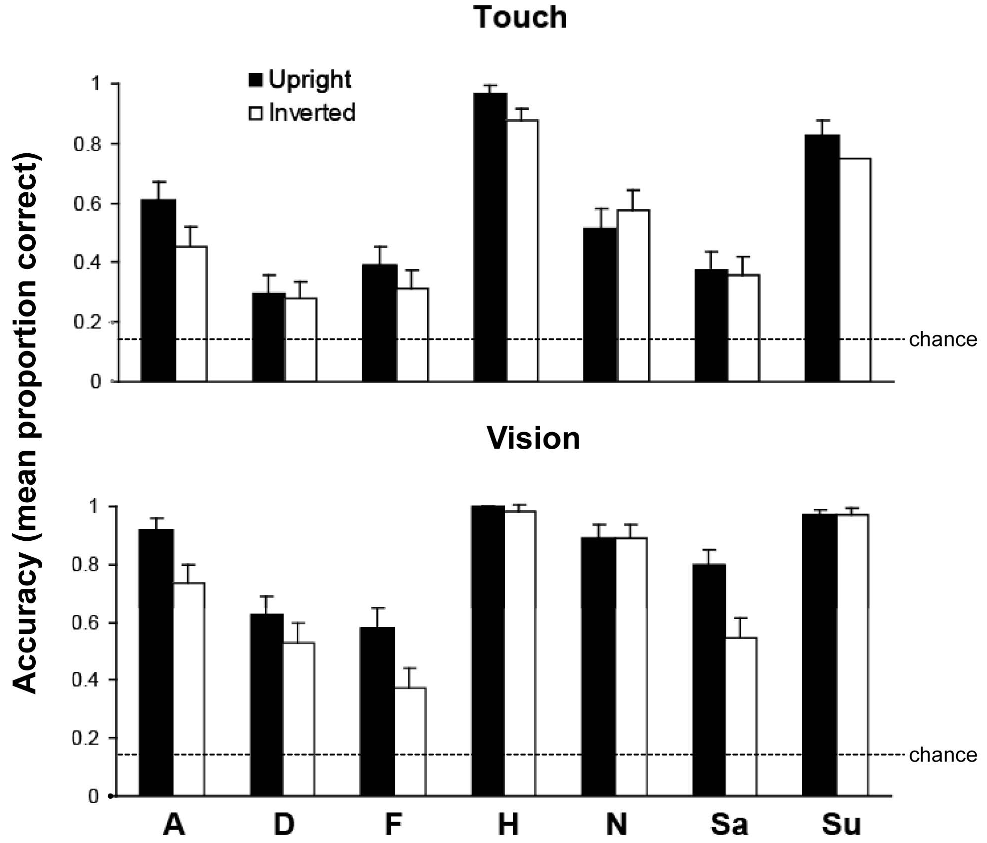 Figure 2: Comparison of Visual vs. Haptic performance across various emotions. Happiness and Surprise were the "Tactile Superstars" due to distinct mouth shapes.
3. Emotional Impact (Valence)
While participants could tell how intense an emotion was by touch, they struggled to consistently identify whether an emotion was "positive" or "negative" compared to visual groups. This suggests that while touch can extract the geometry of an emotion, the affective "hit" (the feeling of the emotion) is more visceral in vision.
Critical Analysis & Conclusion
Takeaways
- Bimodal Evolution: Face processing is likely a high-level cognitive function that can accept input from multiple senses, not just a "visual-only" module.
- Tactile Literacy: The study shows that even people with no previous training can decode complex 2D spatial information through touch.
Limitations
The study used "closed-ended" responses (choosing from a list). It remains unclear if a person would "feel" anger spontaneously without being prompted. Additionally, the spatial resolution of skin is much lower than the retina, limiting the nuance of "micro-expressions."
Future Outlook: From Swell Paper to Haptic VR
This research provides the scientific foundation for Tactile Emoticons. Imagine a blind user reading a message on a refreshable braille display and being able to "feel" a smile or a look of surprise. It also suggests that future VR gloves could use these "configural cues" to convey social presence in digital environments for the visually impaired.
Professional Note: This work reframes our understanding of haptics from a "material sensor" (roughness, temperature) to a "social sensor" capable of decoding the complex geometry of human feeling.