
Visualizing the Invisible: Mastering 5D Underwater Uncertainty
the use of haptics for information representations
This paper presents a comprehensive framework for "Multidimensional Visual Representations" to display underwater environmental uncertainty and target state estimations. By leveraging Virtual Reality (VR) and multivariate glyph techniques, the authors achieve 3D, 4D, and 5D visualization of acoustic and bathymetric data, providing critical decision support for naval operations.
TL;DR
Naval Research Laboratory researchers have developed a sophisticated VR visualization framework to handle the "fog of war" beneath the ocean. By transforming complex Bayesian probability distributions into 3D surfaces and multidimensional glyphs, they've turned abstract acoustic uncertainty into actionable tactical data.
Positioning: This work represents a significant leap from traditional "engineering displays" to "tactical decision environments," moving beyond flat 2D maps into immersive, multi-sensory data spaces.
The "Deep" Problem: Why Underwater Tracking is Hard
Predicting a submarine's position isn't just about sonar; it's about the medium. Changes in water temperature and salinity bend acoustic rays, while uncertain sea-bottom topography (bathymetry) creates "data gaps." This results in a target state prediction process that spans at least four dimensions: latitude, longitude, depth, and signal strength.
Prior work often simplified this into 2D heatmaps. However, heatmaps lose the "why" behind the probability—is a target likely because of a strong signal or because the environment is too noisy to prove otherwise?
Methodology: From 1D Glyphs to 5D Surfaces
The core innovation lies in how the authors map data dimensions to visual and sensory channels.
1. Representing Bathmetric Uncertainty (1D to 3D)
To visualize sea-bottom errors, the authors moved away from simple color-coding. They discovered that Sphere Glyphs were superior for viewpoint independence, but Box Glyphs placed on an elevated planar surface provided better "cross-correlation" for comparing error magnitudes across different geographical points.
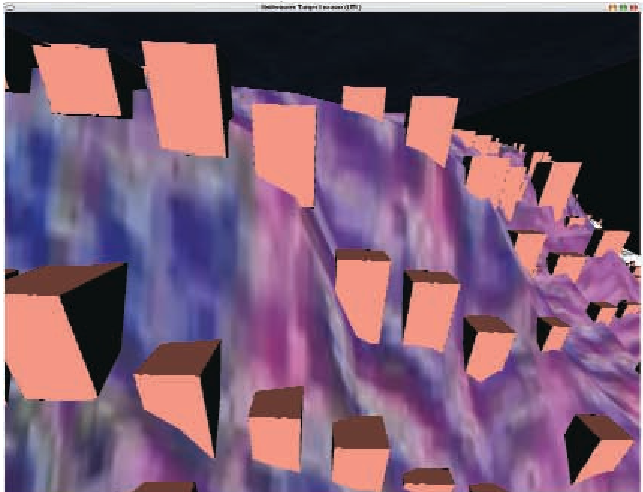 Figure: Elevating Box Glyphs onto a plane reduces occlusion and enhances the comparison of depth uncertainty.
2. High-Dimensional State Estimation (4D & 5D)
When tracking a target, the state space evolves into: , where is heading and is signal excess error.
- Primary Cue: A "Color-Height Surface" represents the Maximum Likelihood Ratio. The "warmth" of the color and the peak of the height both signal a high probability of a target.
- Secondary Cue: Sphere-Arrow Glyphs. The sphere's size represents the environmental error (), while the arrow's direction and color-segmented length show the target's heading and the difference between "Mean" and "Maximum" likelihood.
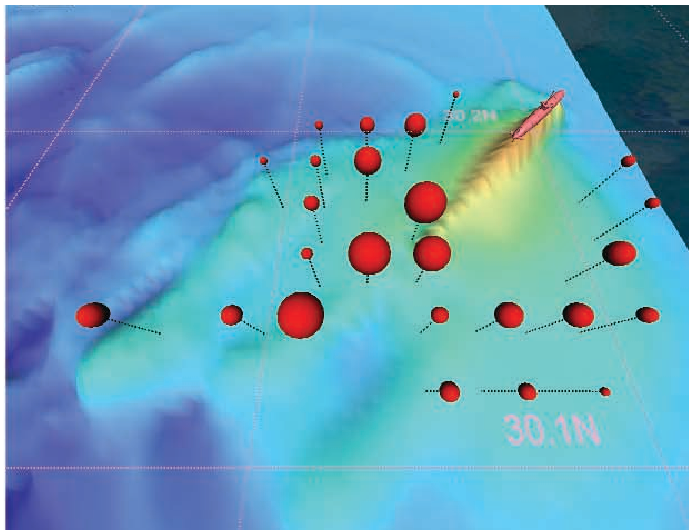 Figure: The 5D state space representation using complex glyphs to visualize statistical variance alongside position and heading.
Experiments & Visual Evidence
The researchers tested their methods in a four-wall immersive VR room using an eight-node graphics cluster.
Key findings from domain experts included:
- Redundancy is Good: Mapping likelihood to both color (warm/cool) and height (peaks) allowed operators to identify targets faster and with higher confidence.
- Haptics as a Filter: Using a CyberGrasp exoskeleton allowed users to "feel" uncertainty. By mapping uncertainty to stiffness, users could perform "arm-sweeping motions" to find areas of high noise without even looking, though the fidelity was lower (distinguishing only 3-5 levels of error) compared to visual cues.
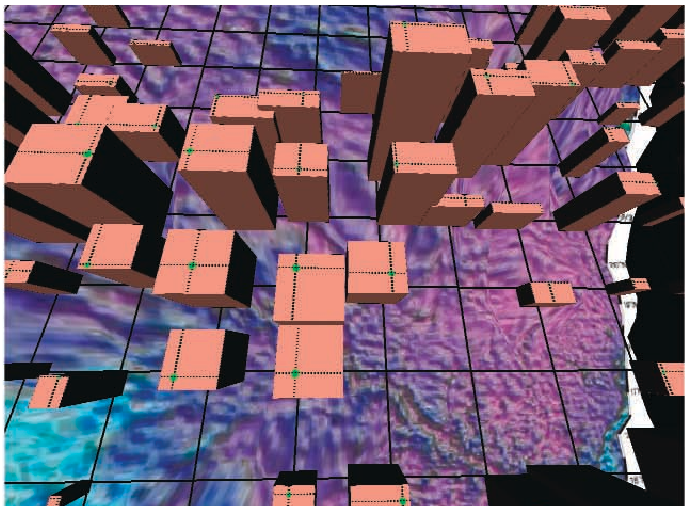 Figure: A user interacting with the 4D data set via a haptic exoskeleton, "feeling" the stiffness of uncertain data points.
Critical Analysis & Takeaways
The strength of this work is its pragmatic approach to occlusion. In 3D visualization, "clutter" is the enemy. By introducing threshold filtering—only showing glyphs where uncertainty exceeds a certain level—the authors keep the display tactically relevant.
Limitations:
- Learning Curve: The 5D sphere-arrow glyph is information-dense and requires significant training to interpret at a glance.
- Hardware Dependence: The most effective modes (haptics and immersive VR) require specialized equipment currently unavailable in standard fleet operations.
Future Outlook: As compute power on naval vessels increases, shifting from static 2D charts to dynamic, 5D Bayesian visualizations will likely become the standard for ASW (Anti-Submarine Warfare). This paper provides the foundational "Visual Grammar" for that transition.