
Hard or Soft Sell? Decrypting the Persuasive DNA of B2B White Papers
Hard or Soft Sell? Understanding White Papers as Content Marketing
2020-01-23
Summary
Problem
Method
Results
Takeaways
Abstract
This research article investigates the persuasive strategies used in high-tech B2B white papers by applying a multidimensional model of "hard-sell" and "soft-sell" advertising appeals. Analyzing a corpus of 96 documents from TechRepublic, the study identifies that while hard-sell dimensions (logic and facts) predominate, white papers successfully integrate soft-sell elements (implicitness) to balance promotion with technical objectivity.
## TL;DR
For years, technical writers have struggled with the "double orientation" of white papers: they must provide objective technical value while driving sales leads. This study moves beyond the binary "Hard vs. Soft Sell" debate, proving that the most successful white papers are **multidimensional**. By analyzing nearly 100 industry documents, researchers found that while logic and facts rule, the "soft" art of implicitness is what allows a white paper to sell without being perceived as a "sales pitch."
## The Great Marketing Paradox
In high-tech industries, the white paper is often called the "King of Content." However, its crown is heavy. If it’s too "hard-sell" (aggressive, brand-heavy), readers—primarily skeptical engineers—dismiss it as marketing fluff. If it’s too "soft-sell" (purely educational), it fails its corporate mission to generate leads and sales.
The authors argue that the conflict in previous guidance arises because we've been looking at it wrong. It’s not an *either/or* choice; it’s a chemical reaction between logical thinking and implicit persuasion.
## Methodology: Measuring the Immeasurable
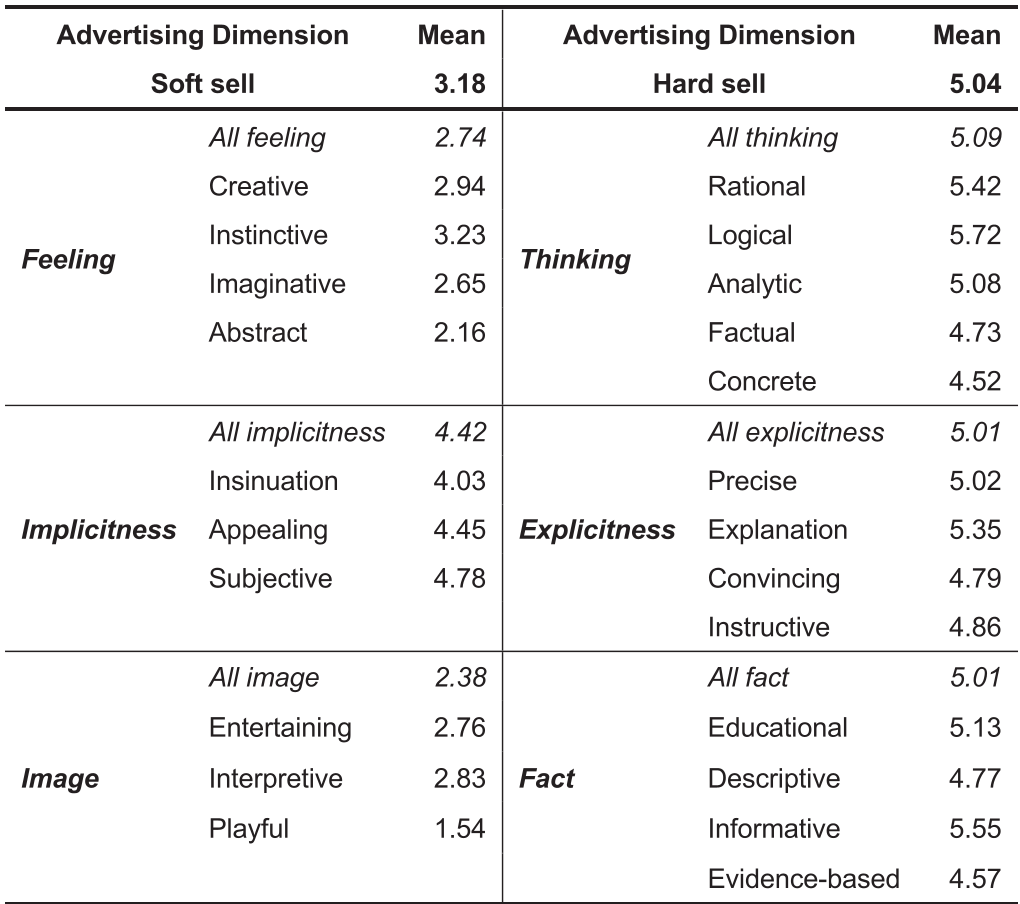
To quantify "persuasion," the researchers utilized a corpus of 96 white papers from tech giants like IBM, Dell, and Cisco. They evaluated these documents against 23 dimensions based on the Okazaki model, which categorizes appeals into:
* **Hard Sell**: Thinking (Rational/Logical), Explicitness (Precise/Persuasive), and Fact (Informative/Evidence-based).
* **Soft Sell**: Feeling (Creative/Imaginative), Implicitness (Subjective/Insinuation), and Image (Entertaining/Playful).
## Key Insights: Why "Logical" Subjectivity Works
The results reveal a fascinating hybrid structure:
### 1. The Primacy of "Thinking"
The most prevalent dimension was **Logical**. B2B buyers require a cognitive "payoff." Unlike consumer ads that appeal to instinct, white papers must induce rational thinking. If a white paper isn't logical, it isn't a white paper—it's a brochure.
### 2. Subjective Precision
An outlier analysis showed that documents could be both **Subjective** (Soft Sell) and **Precise** (Hard Sell). For instance, a Dell white paper (#48) compared its product to Oracle’s. It was "precise" in technical specs but "subjective" in its framing. This "subjective precision" is the secret sauce of presales technical communication.

### 3. The Evidence Threshold
The study highlighted the critical role of being **Evidence-based**. Documents that utilized quantitative data and external citations (like white paper #1) scored massively higher on credibility. Conversely, documents that lacked stats were often misclassified as "non-white papers" or low-quality marketing.
## Strategic Guidance for Technical Communicators
Based on the data, the authors provide a blueprint for the "Ideal" white paper:
* **Focus on 'Thinking' over 'Feeling'**: High-tech design (creativity) is useless without deep, informative content.
* **The 5-Page Rule**: Documents under 4 pages are rarely viewed as white papers. You need space to establish the problem-solution logic.
* **Be Explicit about Problems, Implicit about Goals**: Be blunt about industry pain points, but use "subjectivity" to gently steer the reader toward your specific solution.
* **Kill the Playfulness**: The dimension of "Playful" was the lowest-rated across the entire corpus. In B2B tech, humor or "light" content often erodes professional trust.
## Conclusion: The New Genre Ecology
The study confirms that white papers inhabit a unique "genre ecology" where they must facilitate both technical transfer and marketing conversion. By treating "hard" and "soft" selling as complementary dimensions, writers can build documents that are at once highly informative and powerfully persuasive.
**Takeaway**: To master the white paper, don't stop selling—just start selling through the medium of evidence and logic.