
Hardware Collective Intelligence: Beyond Software-Defined Agents
A Hardware Collective Intelligence Agent
This paper proposes a hardware-based Collective Intelligence (CI) agent implemented on FPGAs to replace traditional software-driven models. By leveraging reconfigurable hardware, the authors achieve significant speedup in CI tasks such as similarity measures and Principal Component Analysis (PCA) while maintaining a small physical footprint.
TL;DR
Researchers have moved Collective Intelligence (CI) from the realm of slow software simulations to high-performance hardware. By using FPGA (Field Programmable Gate Arrays) and Dynamic Partial Reconfiguration, this study achieves up to a 92x speedup in core operations, allowing complex agents to fit into the small footprint of handheld devices while handling massive distributed datasets.
The Performance Wall in Collective Intelligence
Collective Intelligence (CI) powers everything from Wikipedia and social networks to complex business modeling. However, as the systems grow, the "software tax" becomes prohibitive. Traditional CI agents running on microcontrollers or CPUs are bound by sequential instruction cycles and inefficient compilers.
When researchers try to simulate large-scale CI systems (1000+ nodes), software simulators often resort to simplifications that mask real-world behaviors. The authors argue that to truly understand or deploy CI, we need the raw speed and deterministic timing of hardware.
Methodology: The Hierarchical Hardware Approach
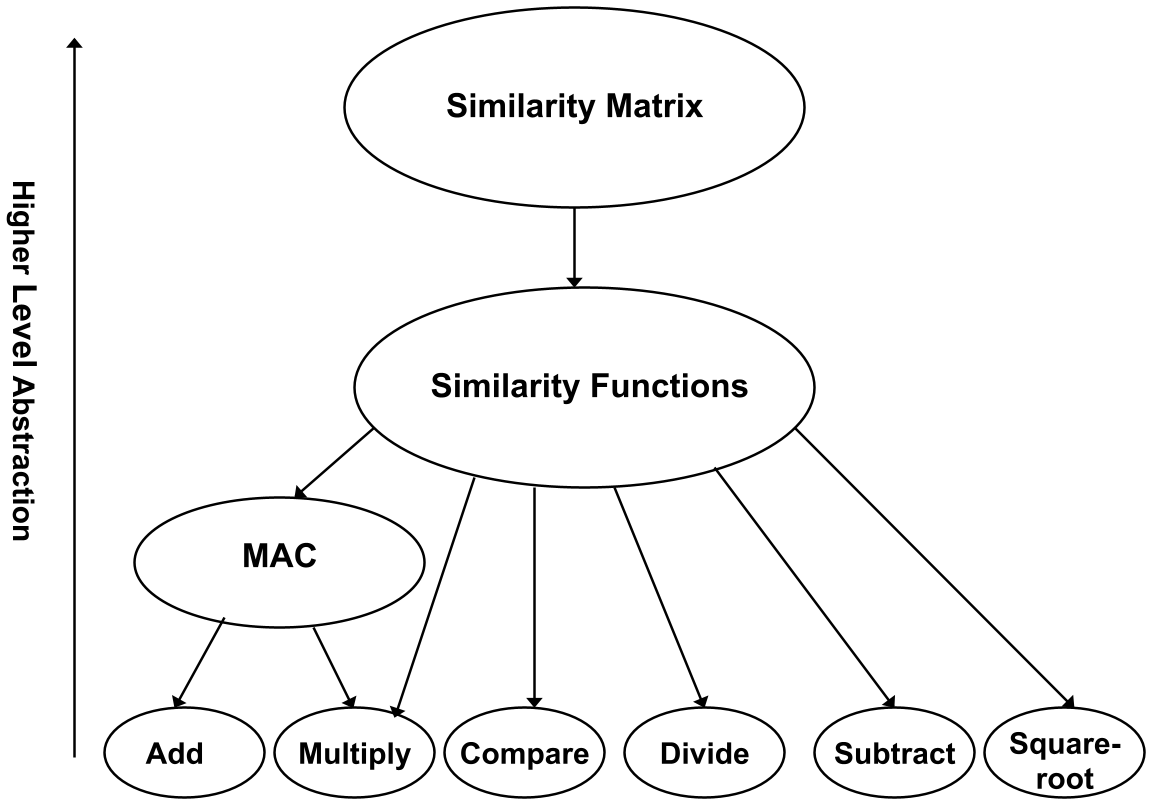
The authors adopted a Platform-Based Design hierarchy. Instead of building monolithic blocks, they developed a library of reusable operators that scale from simple arithmetic to complex functional modules.
1. Pipelining & Parallelism
In software, a For Loop is sequential. In hardware, the authors implemented Multiply-and-Accumulate (MAC) units using a pipeline. Once the pipeline is full, it outputs a result every single clock cycle (12.5ns), regardless of vector length. For similarity measures like the Extended Jaccard, they exploited the mathematical independence of dot products to process them in parallel—a feat impossible for a standard uniprocessor.
2. Dynamic Partial Reconfiguration (DPR)
This is the "secret sauce" for scalability. For complex tasks like Principal Component Analysis (PCA), the entire logic might not fit on one chip. Using DPR, the FPGA can:
- Load the "Mean" computation module.
- Process the data.
- Reconfigure a portion of itself to become a "Covariance Matrix" module while the rest of the chip stays active. This saved 30% of the chip area with a reconfiguration time (515ms) that becomes negligible as data sizes increase.
Experimental Results: Software vs. Hardware
The performance gains were not just incremental; they were transformative.
| Operator | Hardware (ns) | Software (ns) | Speedup |
|---|---|---|---|
| Adder | 12.5 | 225.0 | 18x |
| Multiplier | 12.5 | 250.0 | 20x |
| Divider | 12.5 | 587.5 | 47x |
When moving to high-level functional modules, the efficiency of hardware became even more apparent.

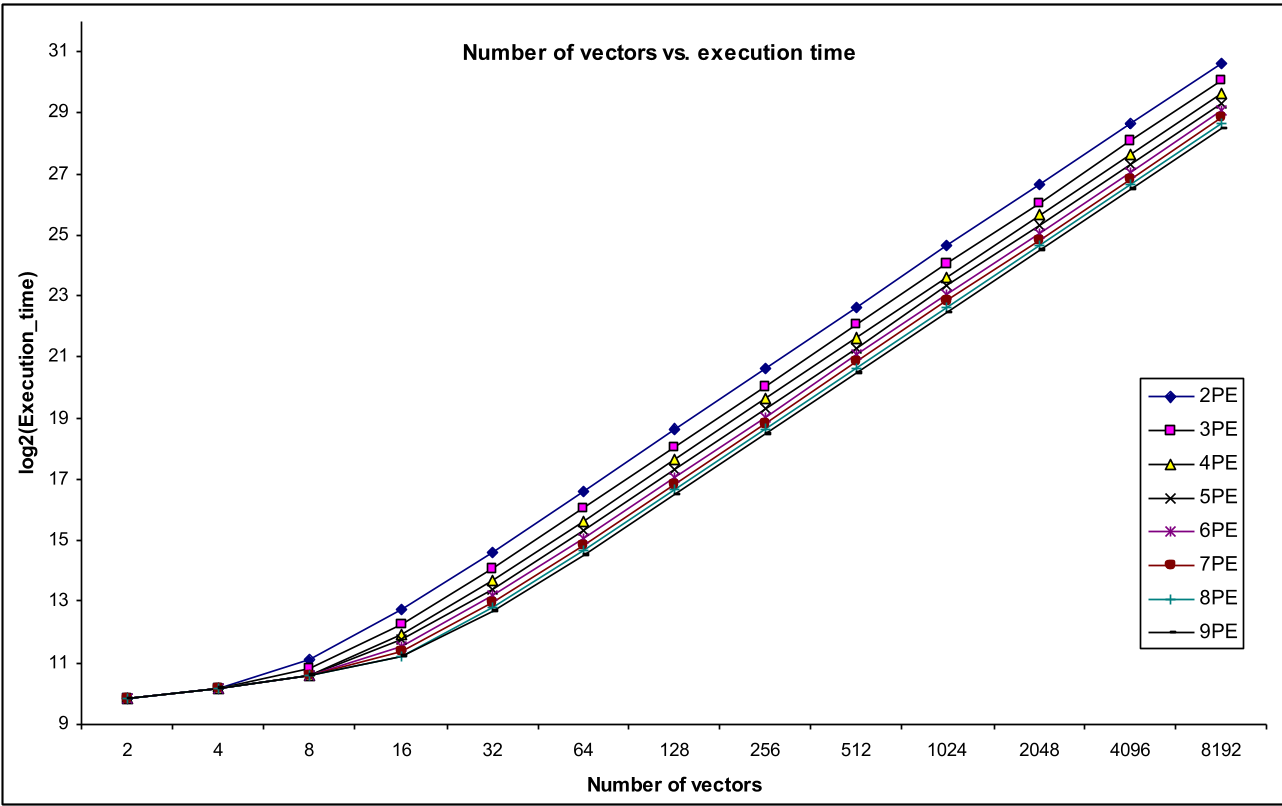
The Processor Array performance (using SIMD architecture) showed perfect linearity. As the number of vectors grew to 8192, the hardware maintained predictable, scalable execution times, proving it can handle the "Big Data" requirements of modern CI applications.
Critical Insight & Future Outlook
The shift to hardware CI agents solves the "footprint vs. power" paradox. By using FPGAs, we can put the intelligence of a server cluster into a fingerprint scanner or a mobile drone.
Takeaway: The "Hardware CI Agent" is more than just a faster version of software; it is a fundamental architectural shift. The ability to reconfigure hardware on-the-fly (DPR) allows agents to physically adapt their "brains" to the task at hand—Mean computation now, Covariance calculation next.
Limitations: While performance is high, the development cost in VHDL remains significantly higher than writing C or Python code. The next frontier will likely be High-Level Synthesis (HLS) to allow software engineers to bridge this gap without needing deep VLSI knowledge.