
The IQ+EQ Paradigm: Why Emotional Intelligence is the Missing Link in Industry 4.0 Success
An Intelligent Combination: Assessing the Impact of harmonized Emotional and Artificial Intelligence for the Success of Industry 4.0
This paper investigates the synergistic effect of Emotional Intelligence (EI) and Artificial Intelligence (AI) on the success of Industry 4.0. Using focus group data and regression analysis, the study proposes that the integration of human-centric emotional traits with machine-driven analytical power is the definitive "recipe" for industrial transformation.
TL;DR
While the world obsesses over the "Intelligence" in Artificial Intelligence, a critical oversight is stalling the Fourth Industrial Revolution: the "analog" human factor. This study demonstrates that integrating Emotional Intelligence (EI) with AI increases the success rate of Industry 4.0 initiatives from 55% to 72%. The takeaway is clear: technology is a two-way street, and our machines must learn to relate to us as much as we learn to use them.
The Motivation: Beyond the One-Way Road
Historically, technological change has been a unidirectional process: humans adapt to the machine's rigid rules. However, in the era of Industry 4.0—characterized by IoT, cloud computing, and autonomous systems—this model is failing. The researchers argue that the "hardest part of a digital transformation is us." Organizations are currently stuck in a "pilot purgatory" because they develop sophisticated algorithms but fail to account for human contradictions, biases, and emotional disruptions.
Methodology: Quantifying the "Human Feel"
The study broke down Emotional Intelligence into five core pillars to test their impact on industrial success:
- Self-awareness: Recognizing one's own capabilities.
- Self-regulation: Managing emotional reactions to technological shifts.
- Motivation: Driving adoption through purposeful design.
- Empathy: Understanding the human context of automated decisions.
- Social Skills: Facilitating collaboration in digital-physical frameworks.
The Success Model
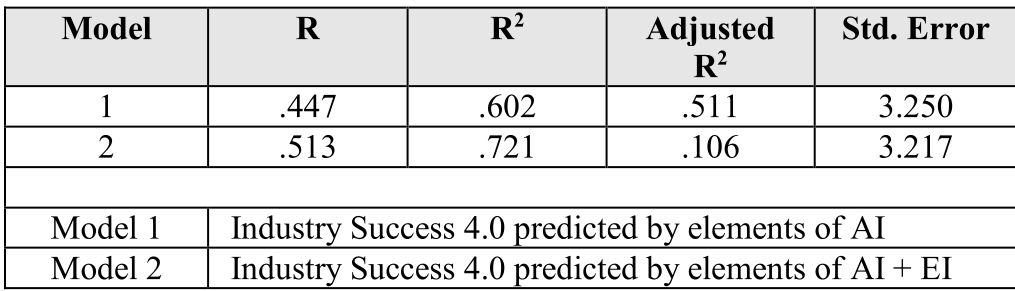
The authors compared two regression models:
- Model 1: Success predicted solely by AI components.
- Model 2: Success predicted by the combination of AI and EI elements.
Core Insights: The "72%" Breakthrough
The findings provide empirical evidence for what many practitioners have long suspected: Emotional Intelligence is a strong predictor of success.
- The Power of Social Skills: With a correlation coefficient of 0.850, social skills emerged as the most critical factor. This suggests that the ability of a system (or the team managing it) to facilitate human-to-human interaction within a digital workflow is paramount.
- The Variance Jump: By adding EI to the model, the R-squared value jumped to 0.721. This means 72% of the success of Industry 4.0 can be explained when we treat emotional competence as a core technical requirement.
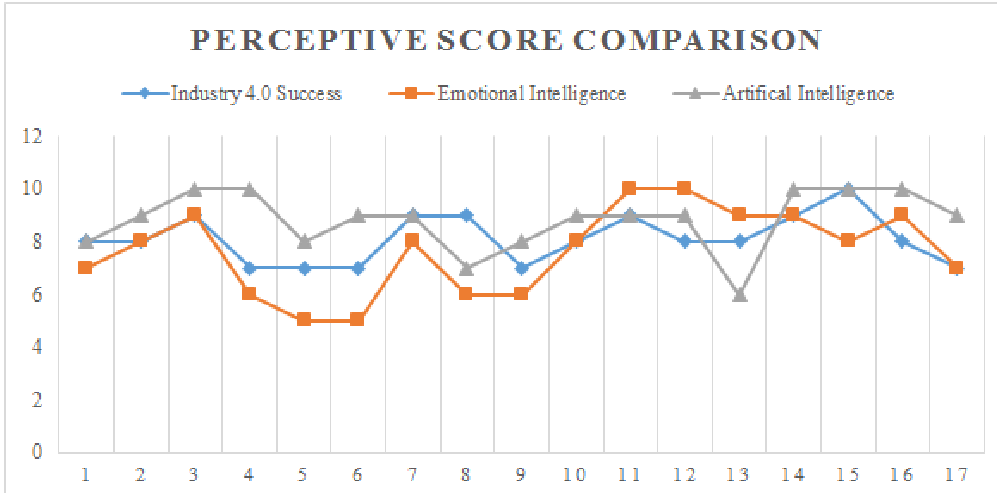
- Symmetrical Evolution: Perceptive scores from industry experts showed that AI and EI follow similar importance patterns (Perceptive mean scores of 7.5 and 6.5, respectively), indicating that experts view them as two sides of the same coin.
Critical Analysis & Future Outlook
The paper highlights a shift from "Brain-based" success (IQ) to a "Collaboration-based" success (EQ). However, it also raises a warning about Technological Unemployment. As Industry 4.0 optimizes efficiency, less-demanding jobs will vanish. The study suggests that the only way to remain relevant is to "invest in developing your EI"—focusing on complex problem solving, leadership, and emotional influence—tasks that machines still struggle to replicate.
Limitations
The sample size (N=28) is relatively small for a broad industrial generalization, and the data is heavily focused on the Dubai innovation ecosystem. Future research should explore how these EI-AI correlations hold across different cultural work ethics (e.g., Western vs. East Asian manufacturing cultures).
Conclusion
The path to Industry 4.0 is not paved with better code alone; it is paved with better human-machine empathy. As the study concludes: "IQ + EQ must go hand-in-hand." For developers and industry leaders, the message is simple: if your AI doesn't understand human emotional cues, it isn't truly intelligent yet.