
Harnessing the Crowd: Distilling Wisdom from Bidding Dynamics in P2P Lending
Harnessing Collective Intelligence in P2P Lending
This paper introduces a framework to harness the "wisdom of crowds" for predicting long-term loan repayment in Peer-to-Peer (P2P) lending. By analyzing bidding dynamics on Prosper.com, the authors developed interpretable classification models that successfully identify signals of collective intelligence, achieving an AUC of 0.707 and outperforming baseline models that rely solely on static borrower data.
TL;DR
Is the crowd following blindly, or do they know something we don't? This study analyzes 28,935 loans from Prosper.com to prove that the dynamic behavior of lenders—how fast they bid, their level of experience, and their collective "herd" patterns—can predict loan defaults with surprising accuracy (AUC 0.707). Crucially, these behavioral signals can substitute for sensitive credit information, offering a new frontier for risk management in decentralized finance.
Motivation: The Information Asymmetry Gap
In the world of P2P lending, individual lenders are effectively "mini-banks" but without the sophisticated tools of institutional giants. They face a massive Information Asymmetry: borrowers know their own creditworthiness, but lenders only see a snippet of data. If a loan defaults, the lender loses everything.
While previous research focused on the "funding" stage (why some projects get more money), this paper asks a more critical question: Can we predict who will actually pay the loan back by watching how the crowd reacts?
Methodology: Decoding the "Wisdom of Crowds"
The authors categorize determinants of long-term success into three buckets:
- Loan Determinants: Interest rates, amount, and description length.
- Borrower Determinants: Traditional credit scores, homeownership, and platform age.
- Lending Dynamics (The "Wisdom" Signals): This is the core innovation. Features include:
- Coefficient of Herding: Measuring the correlation between consecutive bid amounts to see if lenders are influencing each other.
- Bid Amount Per Second: Capturing the "momentum" or speed of capital accumulation.
- Lender Experience: Aggregating the past success of every individual bid participant.
Model Architecture
The researchers utilized various interpretable classifiers (Random Forests, Logistic Regression, etc.) to ensure that the "why" behind the prediction remained clear.
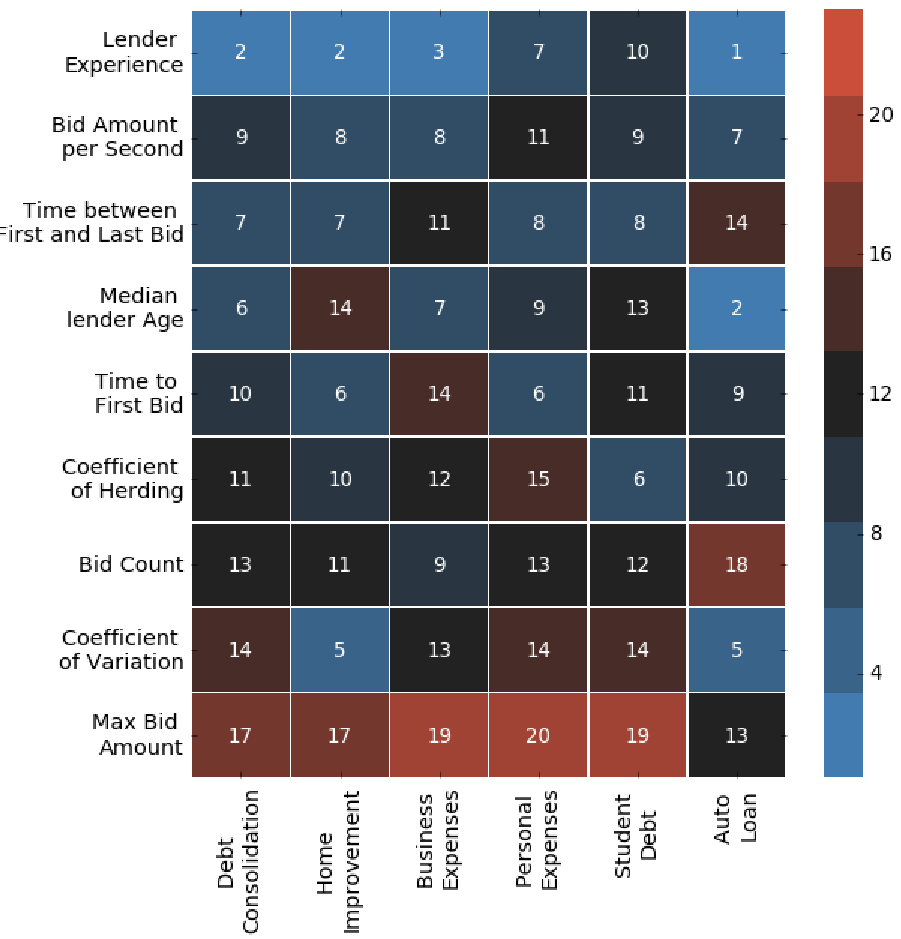
 The image above illustrates how lender dynamics (in rank) vary across different loan categories, showing that "Experience" is a near-universal predictor.
Key Insights & Results
1. The Crowd as a "Credit Score Proxy"
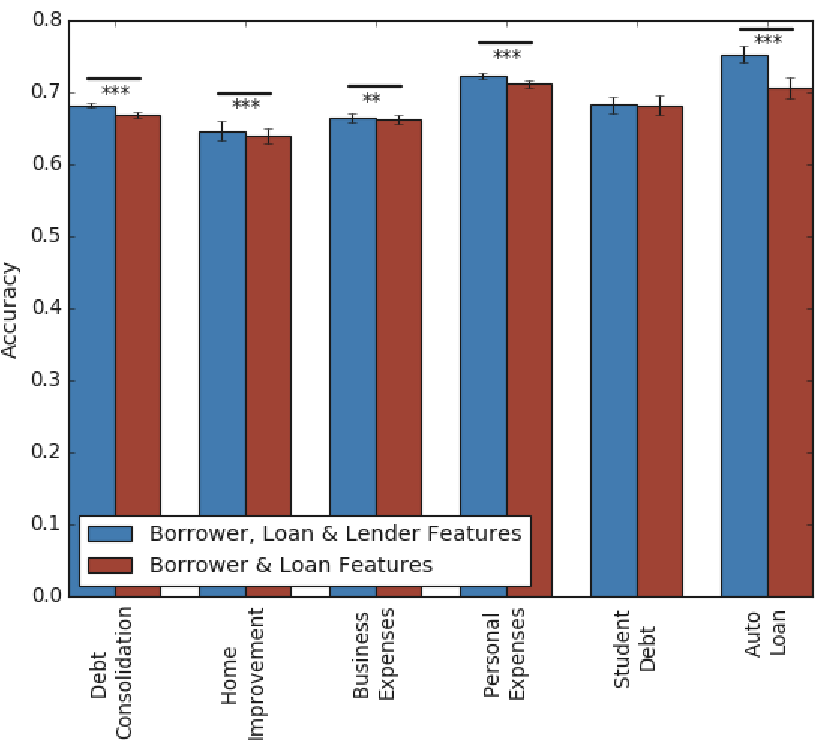
One of the most striking findings is that lending dynamics features picked up nearly all the signal from sensitive borrower information. When the researchers removed sensitive credit data (like debt-to-income ratios), the model performance barely dropped if lending dynamics were included. The crowd, as a collective, "decodes" the hidden risk.
2. Not All Crowds are Equally Wise
The "wisdom" isn't a flat constant. It varies by context:
- Auto Loans: The crowd is exceptionally wise. Lenders likely have personal experience with car financing, making them better judges of these requests.
- Student Debt: The crown is least reliable here, likely due to the high uncertainty of post-graduation employment.
 This chart shows the performance gain (AUC) when adding lending dynamics to traditional models across loan types.
3. Feature Importance
While interest rates remain the #1 predictor (), Lender Experience and Time between First and Last Bid ranked higher than many traditional metrics like "Amount Requested" or "Total Debt."
Critical Analysis & Conclusion
Takeaway
This research moves the conversation from "herding is bad/irrational" to "herding is a signal." For P2P platforms, this suggests that the way a loan is funded is just as important as what is in the loan application.
Limitations
- Historical Context: The data is from 2005-2008. While the logic holds, modern P2P markets have different regulatory landscapes.
- The "Black Box" of Intuition: We know the crowd is wise, but we still don't fully understand which informal signals (e.g., nuances in the text description) the lenders are actually responding to.
Future Outlook
By integrating these "collective intelligence" signals into automated risk-scoring algorithms, platforms could potentially provide better protection for novice lenders and ensure more efficient capital allocation for borrowers who are traditionally "unscorable."