
DA-SC: Breaking Domain Barriers in Marketing Intelligence via Co-Training
Harnessing consumer reviews for marketing intelligence: a domain-adapted sentiment classification approach
The paper introduces a Domain-Adapted Sentiment Classification (DA-SC) technique designed to extract marketing intelligence from consumer reviews. It combines a domain-independent base classifier, trained on expanded WordNet glosses, with a co-training mechanism to adapt to specific target domains like cars or electronics.
TL;DR
The explosion of Web 2.0 has made consumer reviews a goldmine for marketing intelligence, yet machines struggle to understand "good" in a car review versus "good" in a movie review without massive labeled data. This paper presents DA-SC (Domain-Adapted Sentiment Classification), a method that uses dictionary definitions and a co-training strategy to adapt to new domains with zero manual labeling for the target category. It achieves superior accuracy over traditional methods by bridging general semantics with domain-specific nuances.
Problem & Motivation: The Context Crisis
Sentiment is notoriously domain-dependent and context-sensitive. A word like "compact" is praise for a camera but potentially a criticism for a family SUV.
Previous SOTA (State of the Art) involved training classifiers on specific labeled datasets. However:
- High Cost: Labeling thousands of reviews for every new product category is unfeasible.
- Heterogeneity Gap: A classifier trained on "Notebooks" works okay for "Digital Cameras" but fails miserably for "Cars" due to differing vocabularies and emotional expressions.
The authors’ insight was to decouple general sentiment (obtained from a dictionary) from domain-specific sentiment (learned iteratively from unlabeled data).
Methodology: From Glosses to Domain Expertise
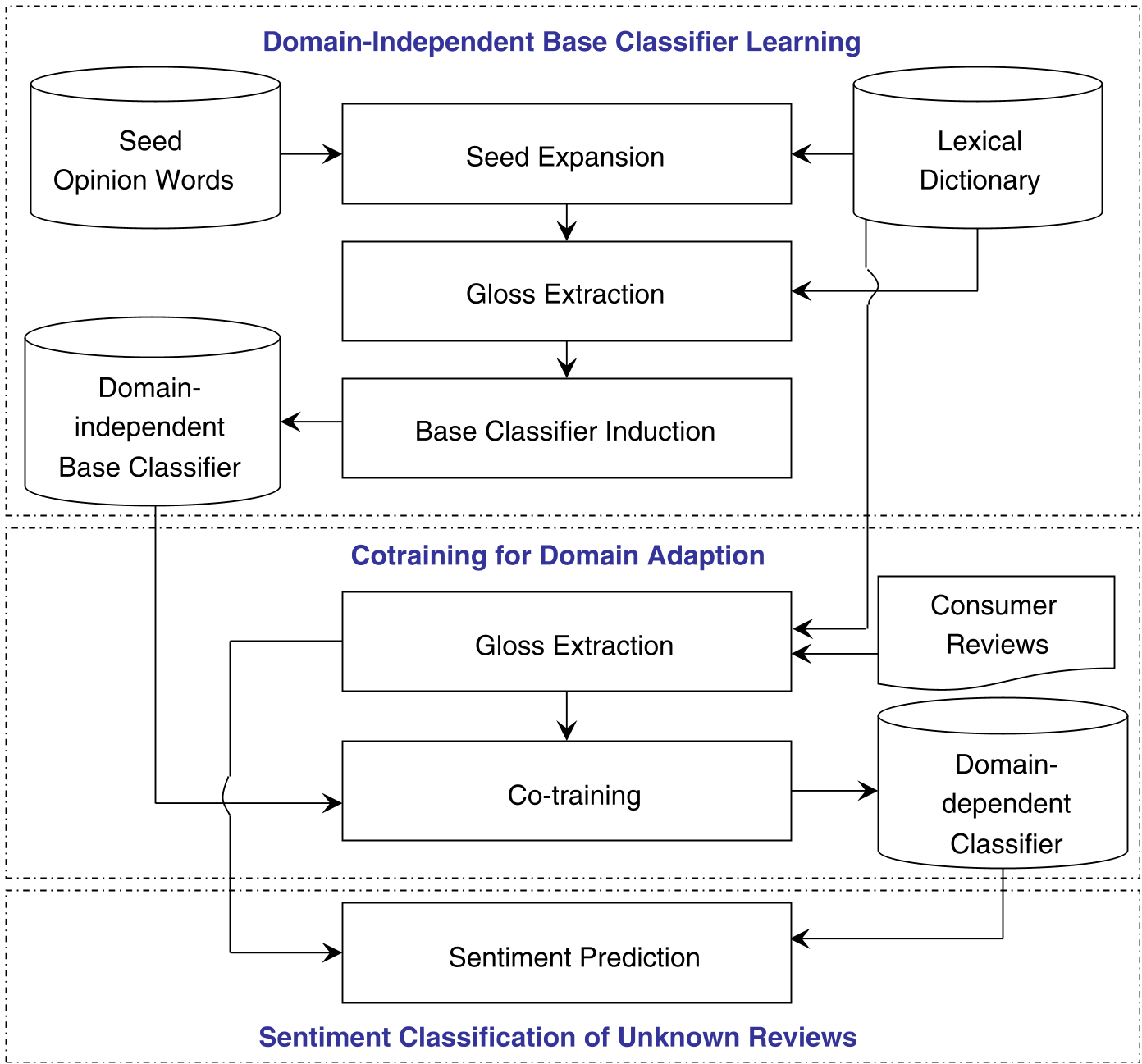
The DA-SC workflow is a three-phase pipeline designed to eliminate the need for manual target-domain labels.
1. Learning the Domain-Independent Base Classifier
Instead of human-labeled reviews, the authors used WordNet.
- Seed Expansion: Starting with 14 domain-neutral seeds (e.g., excellent, poor), they used synonym/antonym branching to build a large lexicon.
- Gloss Extraction: For each word, they extracted its "Gloss" (dictionary definition). These definitions serve as the training "content," while the word's polar orientation serves as the label.
- Induction: An SVM (Support Vector Machine) learns to recognize sentiment based on how words are defined.
2. Co-Training for Domain Adaptation
This is the "engine" of the paper. The model takes a pool of unlabeled reviews from a specific domain (e.g., Cars).
- The base classifier predicts sentiments for these reviews.
- It selects the highest-confidence positive and negative examples to use as "pseudo-training data."
- The model re-trains itself on this new specialized data, effectively "learning" the domain-specific jargon and style.
Experiments & Results: Proving Robustness
The authors tested DA-SC across three distinct domains: Cars, Computers, and Digital Cameras.
SOTA Comparison
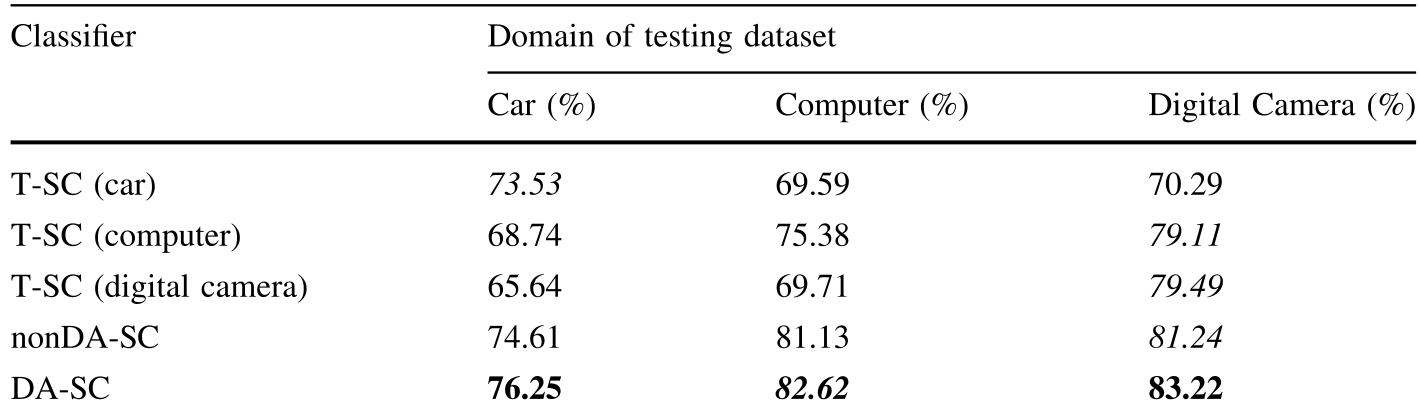
DA-SC was compared against T-SC (Traditional Sentiment Classification), which represents the standard supervised learning approach.
| Domain | T-SC (Intradomain) Accuracy | DA-SC Accuracy |
|---|---|---|
| Car | 73.53% | 76.25% |
| Computer | 75.38% | 82.62% |
| Digital Camera | 79.49% | 83.22% |
As the table shows, DA-SC doesn't just match human-labeled models; it exceeds them. This is likely because the co-training mechanism captures a broader range of unlabeled data than a small human-labeled set can provide.
Detailed Metrics
The researchers used F1-measures to ensure that the model wasn't just guessing the majority class (usually "Positive" in review sites).
Critical Analysis & Conclusion
The beauty of DA-SC lies in its minimalism. It requires only a dictionary and a few seed words to start.
Takeaways:
- General-to-Specific works: Dictionary definitions are a powerful, underutilized source for "warm-starting" NLP models.
- Co-training is robust: Even if the initial base classifier is weak, the iterative high-confidence selection effectively filters noise.
Limitations:
- Negative Sentiment Recall: The F1 scores for negative reviews remain lower than positive ones, largely due to the "imbalanced data" problem (people tend to write more positive reviews or use sarcasm when negative).
- Context Blindness: The model still treats reviews largely as "bags of words," missing the nuance of complex sentence structures or sarcasm.
Future Outlook: Integrating this domain-adaptation logic into modern Transformer architectures (like BERT or GPT) could potentially solve the remaining context-dependency issues while retaining the paper's efficient adaptation approach.