
Harnessing the Duality: Bridging Government Platforms and Social Media via SSI
Harnessing the duality of e-participation: social software infrastructure design
The paper proposes a novel Social Software Infrastructure (SSI) design to harness the "Duality of e-Participation", integrating traditional government-led platforms with spontaneous citizen-led deliberations on social media. Utilizing Social Semantic Web and Linked Data technologies, it establishes a framework for technical interoperability between informal online discussions and formal policy-making.
TL;DR
Modern digital democracy is split: governments host formal "consultation portals" that few visit, while millions engage in rich political debate on social media. This paper introduces the Social Software Infrastructure (SSI), a technical framework designed to bridge this gap. By utilizing the Social Semantic Web, the authors provide a blueprint for governments to "listen" to social media and "act" on those insights within formal policy-making channels.
Contextual Framework: The Governance Gap
Current e-Participation suffers from a fundamental dichotomy. On one side, we have Government-Led e-Participation (GLeP)—highly structured but often ignored by the masses. On the other, we have Citizen-Led e-Participation (CLeP)—vibrant, ubiquitous, yet messy and disconnected from the halls of power.
The authors argue that this is not a choice between two systems, but a duality. To harness this, governments need more than just a Facebook page; they need an infrastructure capable of absorbing, processing, and responding to the decentralized intelligence of the web.
The Problem: Why "Listening" is Hard
The paper identifies three critical "Dynamic Capabilities" where current governments fail:
- Adaptive: The inability to redistribute resources or change rules based on public input.
- Absorptive: The failure to monitor and "shaping" discussions effectively due to information overload.
- Innovative: A reluctance to adopt technology-agnostic participation tools (mobile, social media widgets).
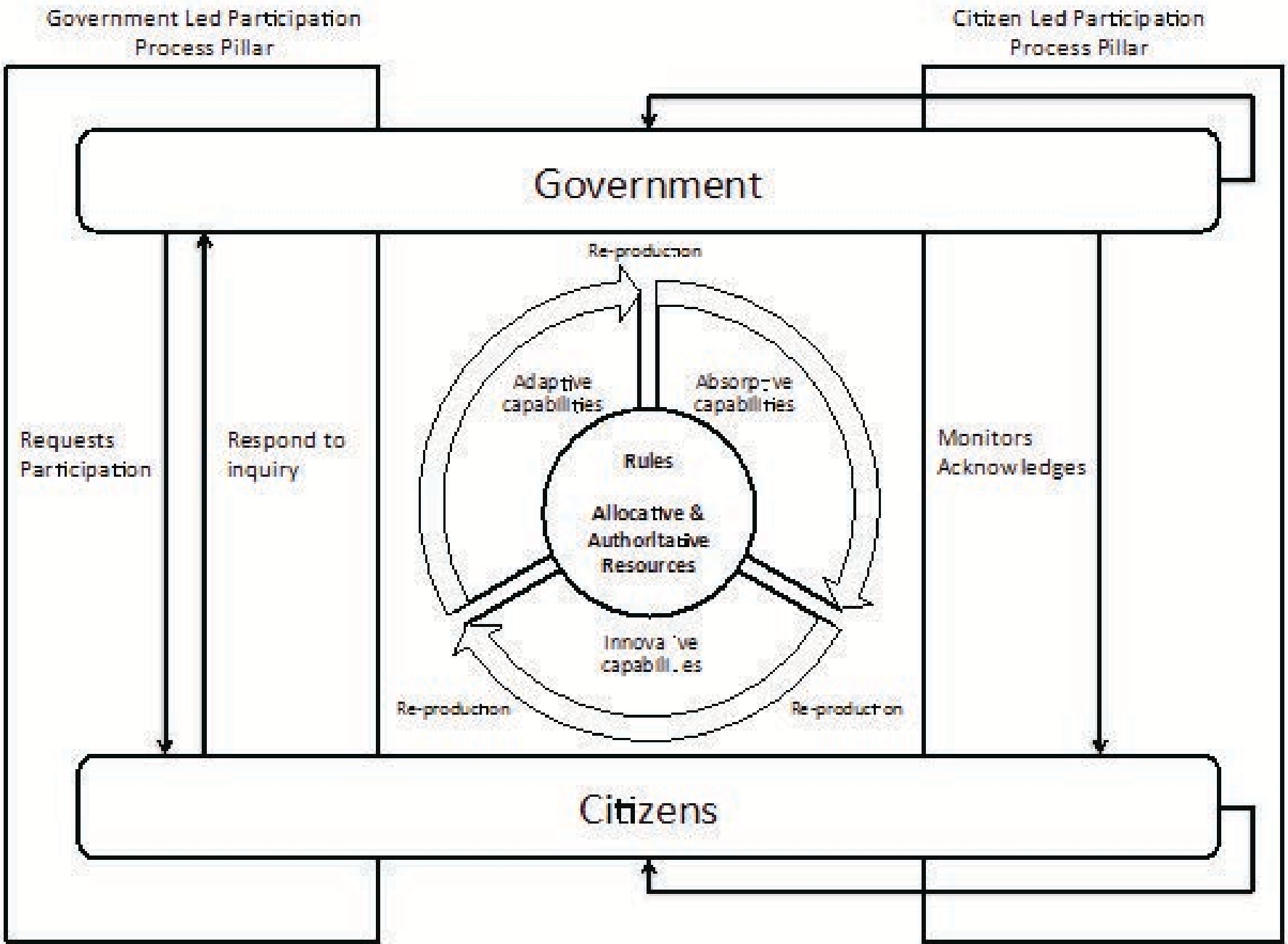 In the integrated model above, GLeP and CLeP act as two pillars supporting a unified policy-making cycle.
Methodology: The Social Software Infrastructure (SSI)
The proposed SSI is not a single app, but an ecosystem of tools. At its heart lies the Knowledge Extraction & Management (KEM) unit.
Core Technical Components:
- Multi-source Mining: Scraping data from both dedicated forums and social media (X, Facebook, blogs).
- Semantic Structuring: Using the SIOC (Semantically-Interlinked Online Communities) Ontology to turn unstructured posts into a "Knowledge Graph." This allows a tweet and a formal forum post about the same policy to be linked technically.
- NLP and Summarization: Utilizing tools like NLTK or Stanford CoreNLP to summarize thousands of comments, effectively solving the "information overload" problem for busy decision-makers.
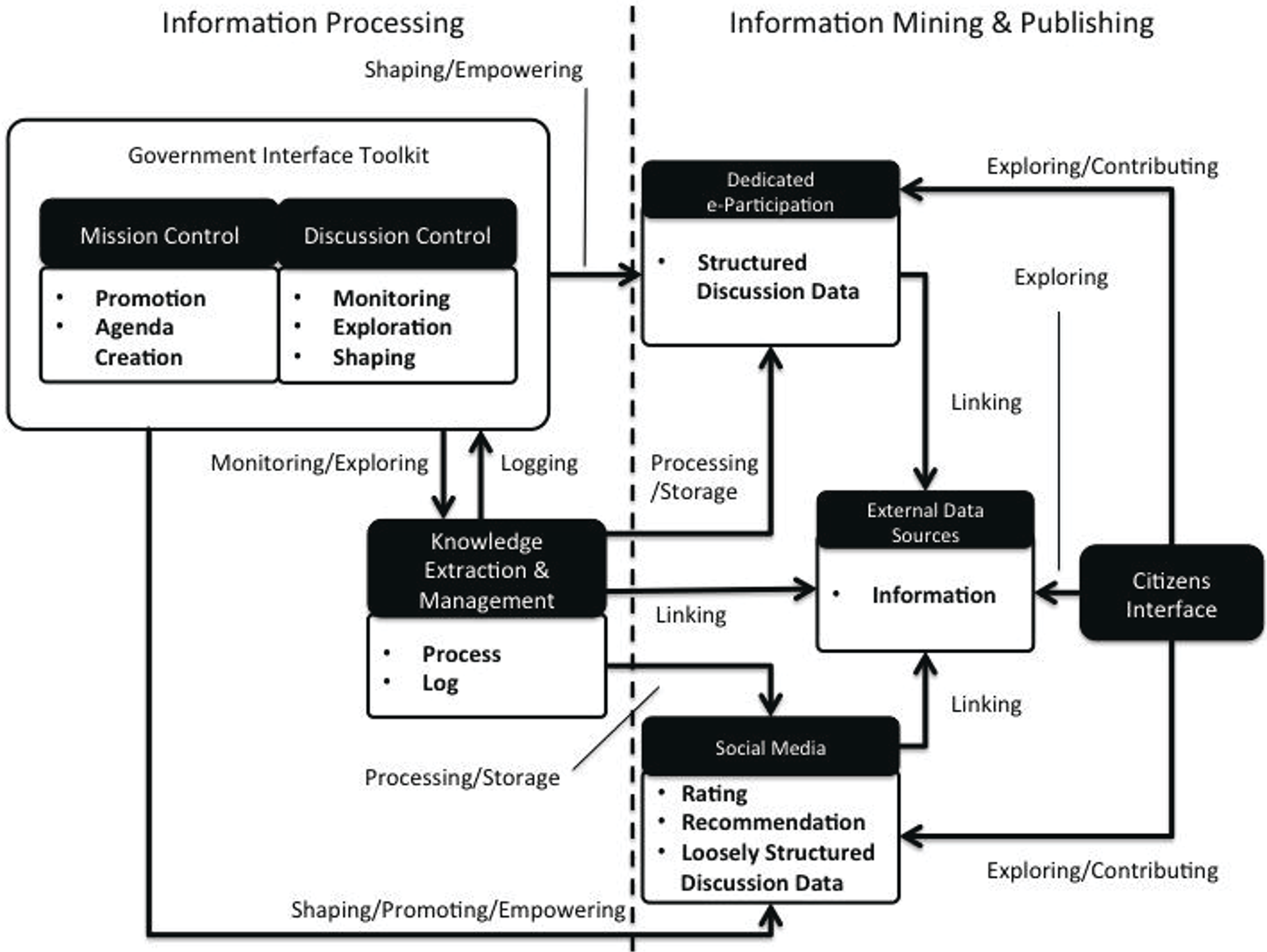 The Basic Design illustrates the flow from informal Social Media mining to formal Mission and Discussion control.
Analysis of the State of the Art
The authors performed an extensive "Gap Analysis" of existing e-Participation projects (like WEGOV and Puzzled by Policy). Their findings were stark:
- Heavy Manual Effort: Most governments still process citizen feedback manually.
- Passive Participation: Governments rarely "shaping" the debate; they simply post and wait for comments.
- Technological Gaps: A massive lack of tools for targeted dissemination and knowledge linking.
Critical Insight: From Host to Facilitator
The true value of this paper lies in its shift of the government's role. Instead of being a host that demands citizens come to their platform, the government becomes a facilitator that goes to where the citizens are. By using Linked Data and SPARQL endpoints, the policy agenda remains transparent and grounded in real-world public sentiment.
Conclusion & Future Outlook
While this 2013 paper predates the current AI revolution (LLMs like GPT-4), its structural logic remains highly relevant. The "Duality of e-Participation" is more pronounced today than ever. The next logical step for this research would be the integration of Generative AI to automate the "Shaping" and "Response" roles, allowing for real-time, personalized interaction between government agencies and citizen-led communities.
Takeaway: The technical infrastructure for democracy must be as dynamic as the social networks it seeks to govern.