
SRGRA: Solving Data Sparsity via Grey Relational Analysis in Heterogeneous Social Networks
Harnessing heterogeneous social networks for better recommendations: A grey relational analysis approach
This paper proposes SRGRA, a social recommendation algorithm that harnesses heterogeneous social networks (HSN) and Grey Relational Analysis (GRA). By integrating user attributes and social structures into a Matrix Factorization (MF) framework, it achieves SOTA performance in rating prediction accuracy and ranking precision on the MovieLens dataset.
TL;DR
The recommendation bottleneck often lies in "missing links"—users who share tastes but aren't connected. This paper introduces SRGRA, a hybrid model that uses Grey Relational Analysis (GRA) to mine implicit relationships from heterogeneous social networks (HSN). By quantifying user profiles and injecting these hidden social ties into Matrix Factorization, it significantly reduces prediction error (MAE/RMSE) and accelerates computation compared to existing SOTA social-aware methods.
Problem & Motivation: The "Silence" of Explicit Networks
Traditional social recommendation systems are built on "Explicit" networks (e.g., u1 follows u2). However, social data is notoriously sparse. Many users provide ratings but have no recorded social connections.
The authors identify three main limitations in current research:
- Homogeneity Bias: Prior works treat social networks as simple graphs, ignoring the rich metadata (user attributes) that form a Heterogeneous Social Network (HSN).
- Implicit Neglect: If two users are both "Lawyers" and like the same niche legal thrillers but aren't "friends," traditional models miss this similarity.
- Mathematical Rigidity: Standard correlation coefficients (Cosine, Pearson) are sensitive to data size and noise.
Methodology: The Grey Relational Insight
The core innovation is viewing a recommender system as a "Grey System"—one where information is partially known and partially unknown (noise).
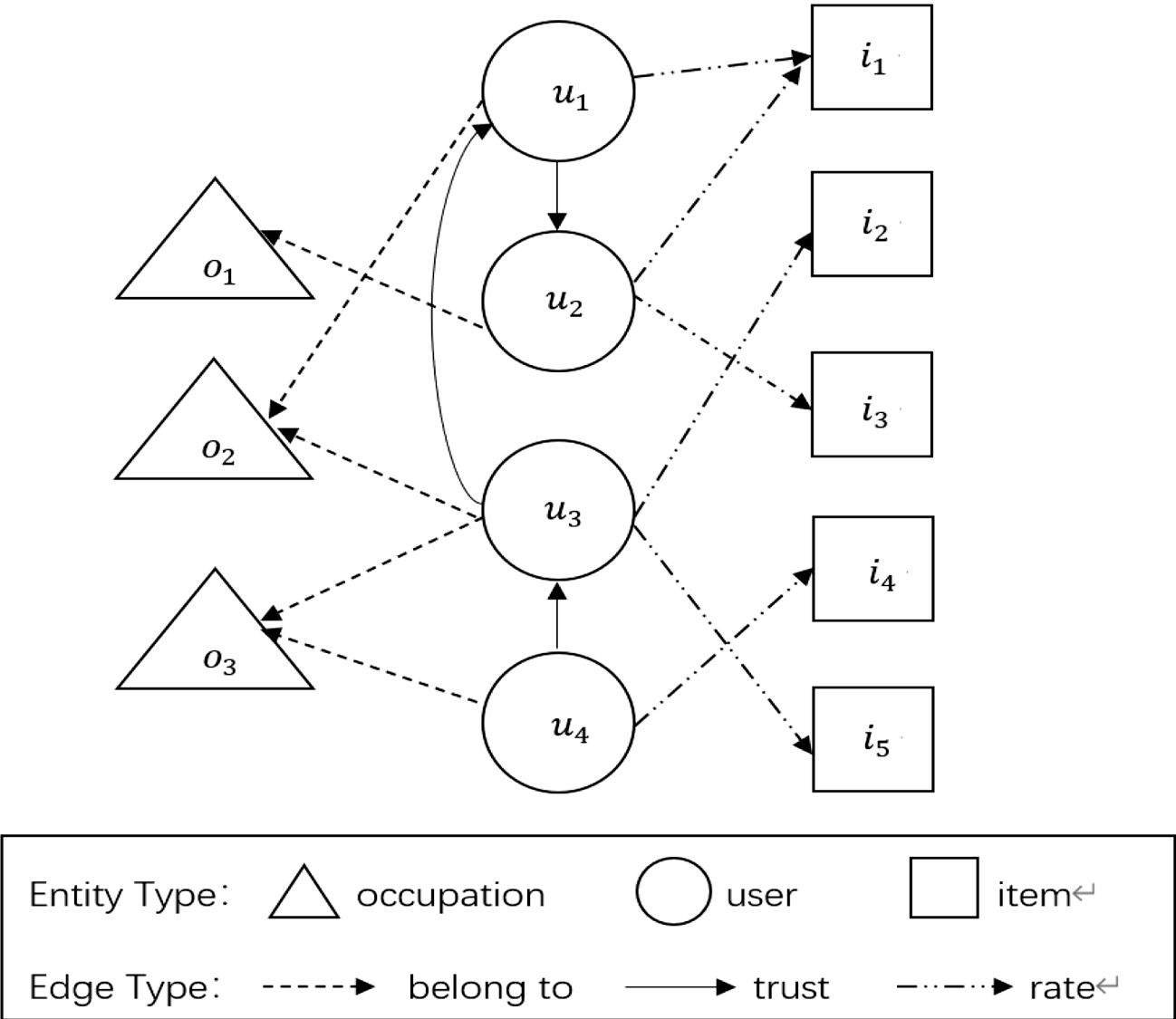
1. Constructing the HSN
The model integrates three distinct layers:
- User-Item Bipartite Graph: Conventional rating data.
- User Social Network: Explicit connections.
- User-Attribute Bipartite Graph: Demographic links (Age, Occupation, etc.).
2. Identifying Implicit Ties with GRA
Unlike Pearson correlation which requires large datasets, Grey Relational Analysis is non-parametric and works exceptionally well with limited or noisy data. The process involves:
- Quantification: Converting categorical data (like Zipcodes and Occupations) into numerical sequences.
- Relational Degree: Calculating how closely two user attribute sequences track each other.
- Thresholding: If the relational degree exceeds (optimized at 0.85), an implicit social link is created.
3. Socially Regularized Matrix Factorization
These implicit links () are used to constrain the latent space of the MF model. The objective function seeks to ensure that if user and have a high relational degree, their latent feature vectors and are forced to be similar:
Experiments & Results
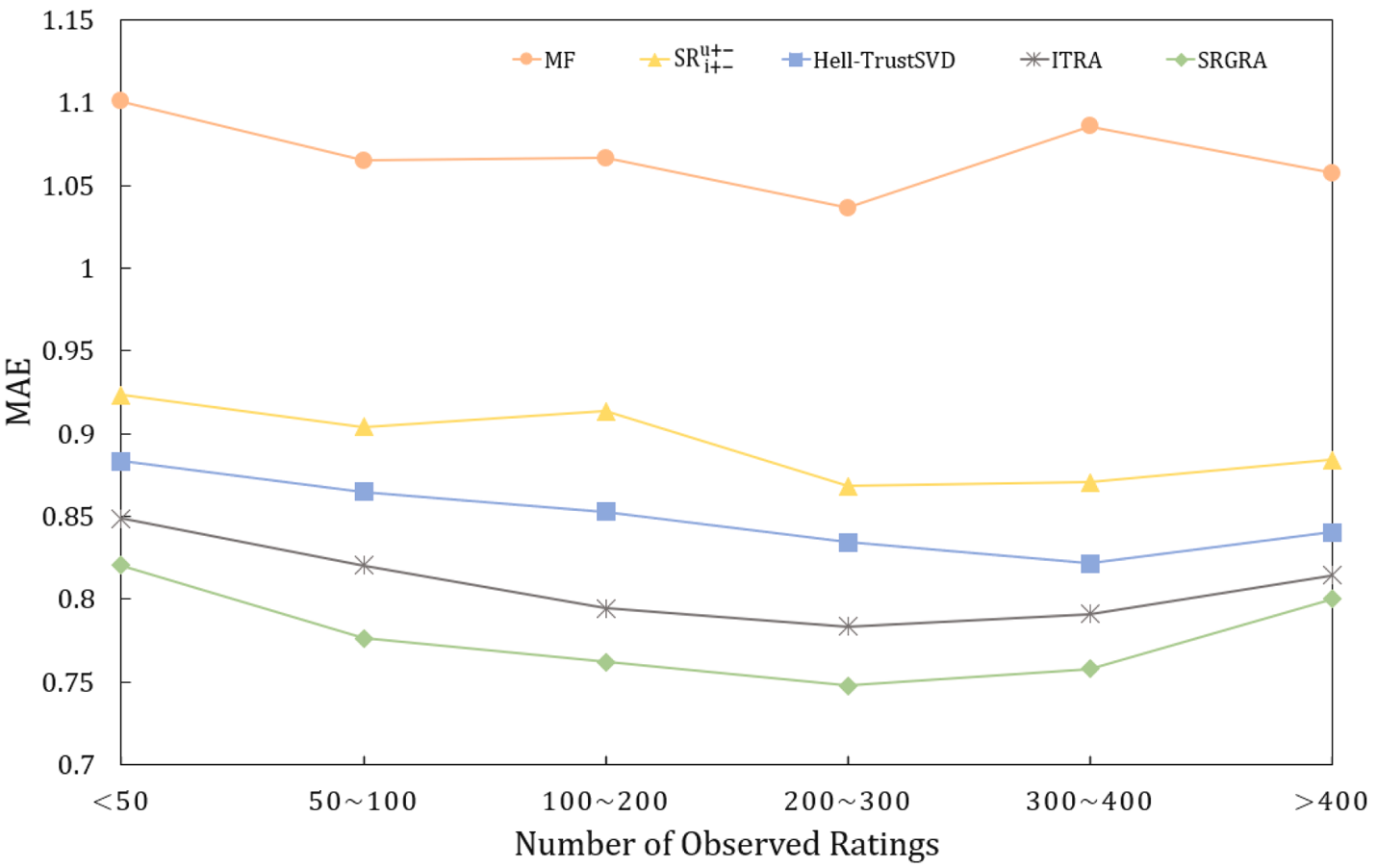
The authors validated SRGRA against four baselines: MF, SRu+-, Hell-TrustSVD, and ITRA.
Key Findings:
- Superior Accuracy: SRGRA consistently achieved the lowest MAE and RMSE across all latent factor dimensions (5, 10, 20).
- Robustness to Sparsity: In the "Cold Start" scenario (users with <50 ratings), SRGRA's performance gain was most pronounced, proving that user profiles can compensate for missing rating history.
- Efficiency: Despite handling more complex information, SRGRA was faster than other compared social algorithms because GRA simplifies the identification of implicit neighbors.
Deep Insight & Conclusion
The true value of this work lies in its methodological shift. By treating the recommendation problem as a "Grey" system, the authors move away from the data-hungry nature of traditional Collaborative Filtering.
Takeaways for Practitioners:
- Metadata is Gold: Don't just look at ratings; use demographics to bridge the gap for new users.
- Implicit > Explicit: Implicit relationships captured through GRA often provide a cleaner signal than "noisy" explicit social links.
Limitations: The current model is static. Future iterations should explore Dynamic Social Networks to account for how user interests and "social circles" evolve over time.
Summary Context: This paper marks a significant step in applying Grey System Theory—traditionally used in engineering and economics—to the high-dimensional, noisy world of modern social media recommendation.