Turning Tweets into Instant Answers: Mining the Wisdom of the Crowds for Opinion Lists
Harnessing Twitter for Answering Opinion List Queries
This paper introduces a novel end-to-end system for answering Opinion List (OL) queries (e.g., "valentines day gift ideas") by leveraging Twitter data. It combines a recall-optimized classifier for "OL-hashtags," regex-based item extraction, a Learning to Rank (L2R) framework, and a cluster-based augmentation method for sparse tail lists.
TL;DR
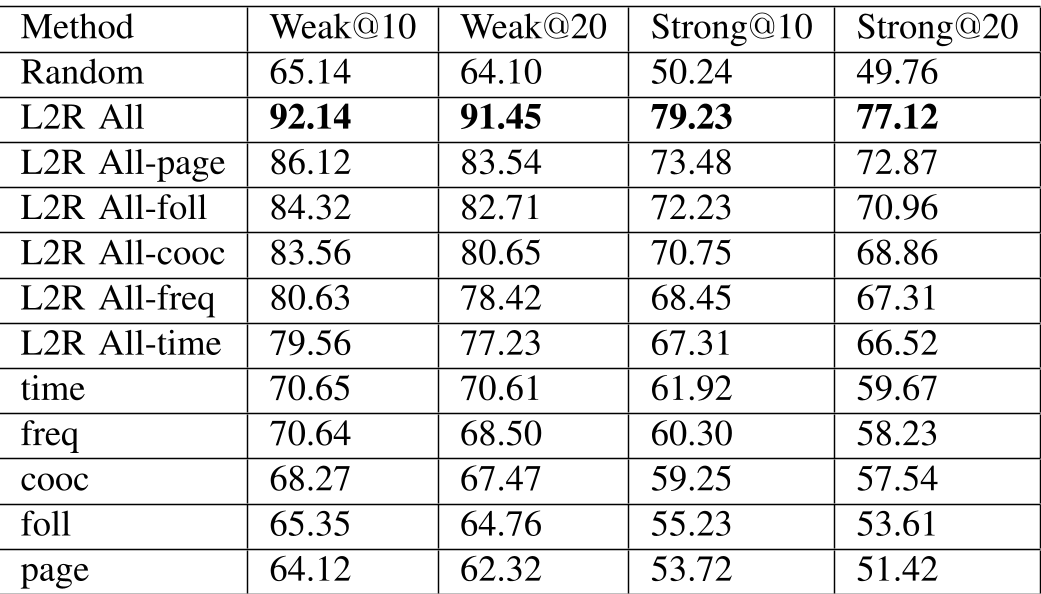
While search engines are masters of facts (e.g., "What is the capital of France?"), they struggle with subjective queries like "8th grade memories." This paper presents the first comprehensive system to mine Twitter for Opinion Lists (OLs). By identifying specific "OL-hashtags" and using a Learning to Rank (L2R) framework, the researchers transformed noisy tweets into structured, high-accuracy list answers, achieving a Precision@10 of over 91%.
The "Subjective Search" Gap
Search behavior is shifting. Users no longer just want facts; they want experiences, suggestions, and social wisdom. Queries like "fun events in Miami" or "innovative marketing ideas" have increased by over 25% year-over-year.
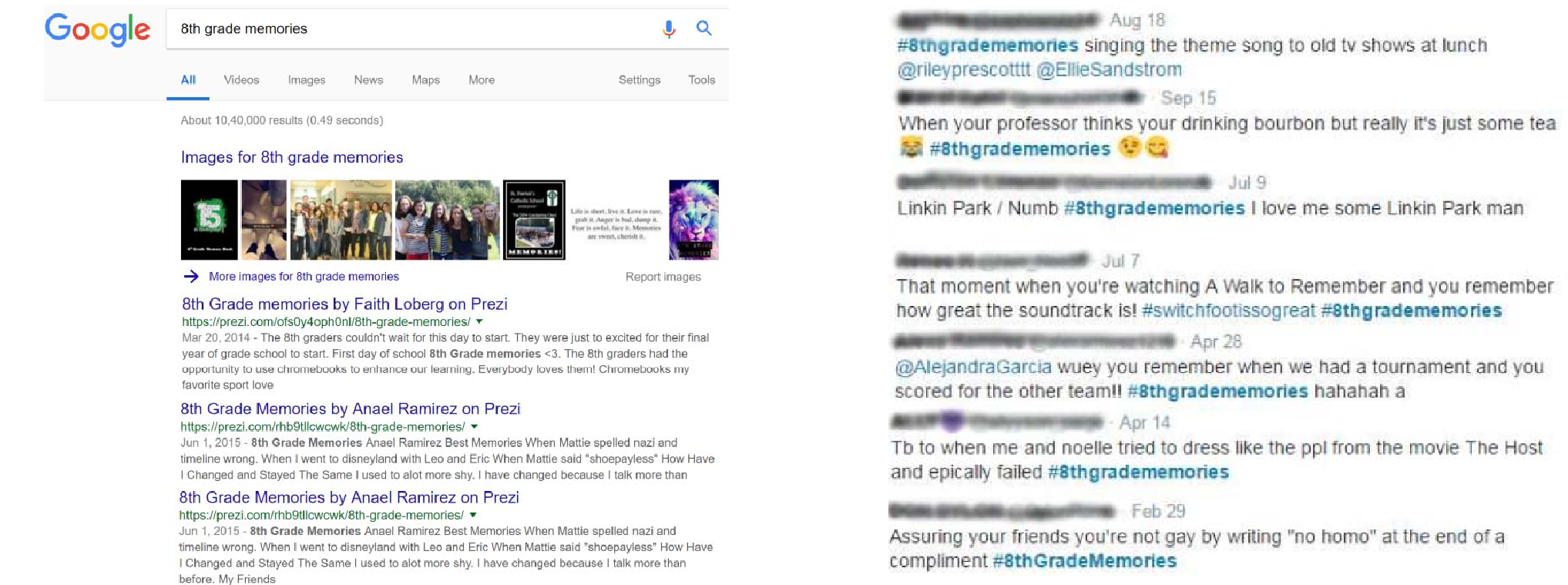
The problem? Most search engines return links to blog posts or videos, requiring users to dig through content. The information exists on Twitter, but it's buried under millions of hashtags and noisy, fragmented tweets.
Methodology: From Hashtags to Ranked Lists
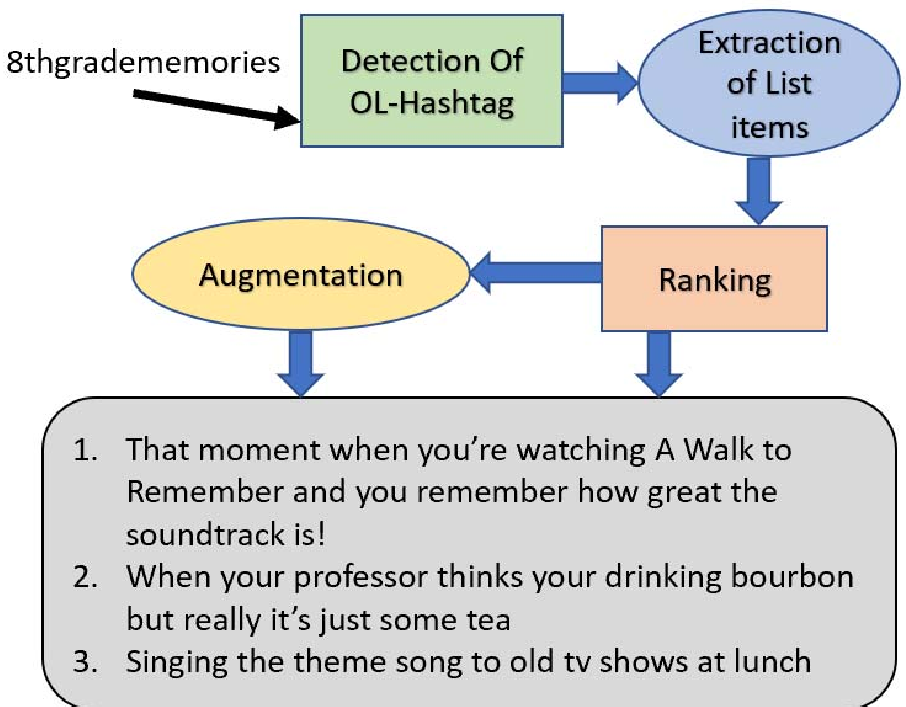
The authors' pipeline (shown below) is a masterclass in handling social media noise through a multi-layered filter.
1. Identifying the "Needle in the Haystack"
Out of 4 million hashtags, only a fraction are "OL-hashtags" (e.g., #tipsforinteriordesign). The authors trained a classifier using:
- Linguistic Features: Plurality, superlative adjectives, and POS tag entropy.
- Search Features: Checking if the hashtag appears in search engine titles with different "cardinalities" (e.g., "10 gift ideas" vs. "20 gift ideas").
- Tweet Features: Popularity duration and co-occurrence patterns.
2. Extracting the Signal
Tweets are messy. The authors used carefully designed Regular Expressions to detect whether a tweet contained multiple items (objective lists) or single opinions (subjective lists). They also scraped URLs within tweets to extract items from e-commerce and social pages.
3. Learning to Rank (L2R)
Not all tweets are equal. To ensure the "best" answers rise to the top, the system uses a regression-based model with five key features:
- Frequency: Popularity of the item.
- Influencer Score: Follower counts of the users posting the item.
- Recency: Keeping the list fresh.
- Co-occurrence: Items that appear together often rank higher.
- PageRank: Constructing a similarity graph of items to find the most "central" opinions.
Solving the "Tail" Problem: List Augmentation
What happens when a hashtag like #moviesthatmakeyoucrysobad only has 3 tweets? The authors introduced a Tail Augmentation strategy. By clustering similar hashtags (e.g., grouping "primary school memories" with "childhood memories"), the system can "borrow" high-quality items from popular lists to populate sparse ones. This use of semantic similarity (via word2vec and DSSM) ensures that even niche queries receive robust answers.
Critical Insights & Future Outlook
The "aha!" moment of this research is the realization that social lists are fundamentally different from factual lists.
- Temporality: Opinions on "best mobile plans" change monthly. Twitter captures this volatility better than static web pages.
- Subjectivity: The system identifies that 75% of Twitter lists are social and subjective, reflecting human experience rather than hard facts.
Limitations: The system still struggles with abstract hashtags (e.g., #getabetterwatch) and occasionally ranks "spammy" retweets too high if they come from high-follower accounts.
Conclusion: This work lays the foundation for a more "human" search engine—one that doesn't just give you a link, but gives you a consensus of voices. As we move into the era of LLMs, the features identified here (influencer weight, clustering, and temporal freshness) remain the gold standard for verifying and ranking the "wisdom of the crowd."