
Harvest-Then-Cooperate: Solving the Energy Bottleneck in Wireless Networks
Harvest-Then-Cooperate: Wireless-Powered Cooperative Communications
The paper introduces a "Harvest-Then-Cooperate" (HTC) protocol for wireless-powered cooperative communication networks (WPCCNs) where a source and relay(s) harvest energy from a hybrid Access Point (AP) in the downlink to power their uplink information transmission. It provides closed-form throughput expressions for single and multi-relay scenarios using opportunistic and partial relay selection schemes.
TL;DR
This paper presents the Harvest-Then-Cooperate (HTC) protocol for Wireless-Powered Cooperative Communication Networks (WPCCN). Unlike traditional networks where nodes have batteries, here the source and relay are entirely "parasitic," extracting energy from the Hybrid Access Point's (AP) RF signals to fuel cooperative uplink data transmission. By combining energy harvesting with cooperative diversity, the authors demonstrate a massive throughput boost over non-cooperative baselines.
Background & Positioning
In the landscape of 5G and IoT, energy autonomy is the "holy grail." While Wireless Power Transfer (WPT) is a known quantity, its integration into Cooperative Communications (where nodes help each other) is a relatively new frontier. This paper sits at the intersection of Green Communications and Information Theory, moving beyond simple "Harvest-Then-Transmit" (HTT) models to a sophisticated multi-node coordination system.
The Problem: The Double-Near-Far Dilemma
In a standard Wireless-Powered Communication Network (WPCN), a source far from the AP faces a double disadvantage:
- It harvests very little energy because the downlink signal is weak.
- It needs more energy to send data back because the uplink path loss is high.
Existing protocols often ignore the potential of Relays to bridge this gap, or they assume relays have their own power source. The challenge here is that the relay itself is energy-constrained and must also harvest energy from the same AP.
Methodology: The HTC Protocol
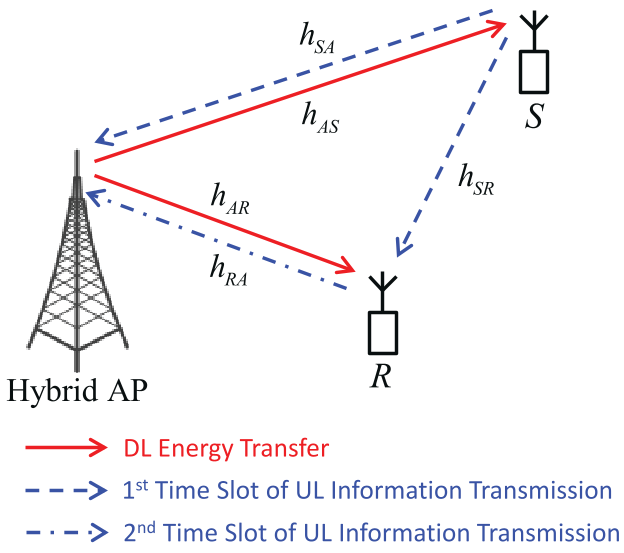
The authors propose a three-phase time-switching architecture within a single transmission block :
- Downlink (DL) Phase: The AP broadcasts energy. Both Source () and Relay () harvest energy proportional to their respective channel gains ( and ).
- Uplink (UL) Phase 1: The source uses its harvested energy to send a signal to the AP.
- Uplink (UL) Phase 2: The relay uses its harvested energy to amplify and forward (AF) the source's signal to the AP.
The Mathematical "Twist"
Unlike conventional cooperative networks, the SNR of the direct link and the relay link are correlated because they both depend on the same random downlink energy harvesting event. This prevents the use of standard independent probability tools and requires the authors to employ the Modified Bessel Function of the second kind () to derive approximate closed-form throughput.
Multi-Relay Extension: Selection Schemes
The paper extends the logic to relays using three strategies:
- Opportunistic Relaying (OR): Picks the best relay based on both hops.
- Partial Relay Selection I (PRS-I): Picks the relay based only on the Source-Relay link.
- Partial Relay Selection II (PRS-II): Picks the relay based only on the Relay-AP link.
Experimental Insights & SOTA Comparison
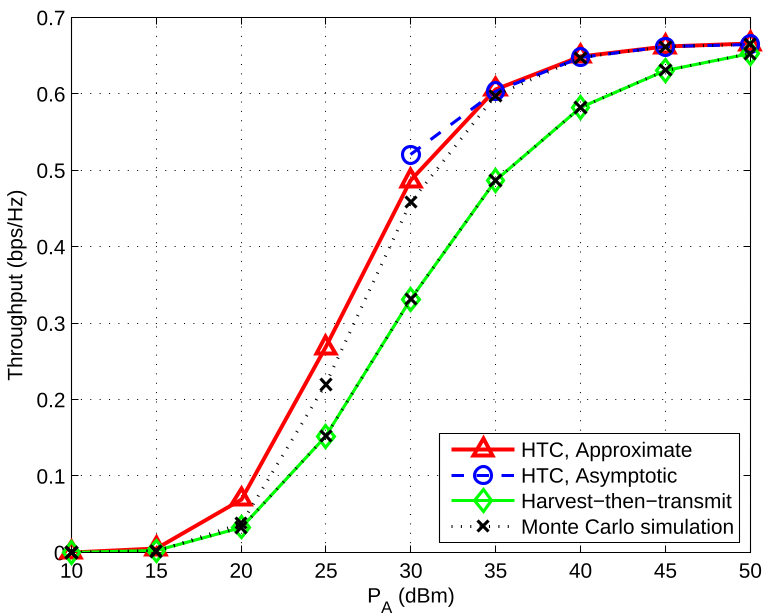
The results confirm that cooperative diversity is a "force multiplier" for energy-harvesting nodes.
Key Findings:
- The Optimal : There is a "Goldilocks zone" for the energy-harvesting time . Too little time, and nodes lack power; too much time, and there isn't enough time left for data transmission.
- Relay Placement: Throughput is maximized when the relay is positioned closer to the source. This ensures the source-relay link is robust even when the source has limited energy.
- OR Efficiency: The Opportunistic Relaying scheme consistently provides the highest throughput but requires more Channel State Information (CSI) overhead.
Critical Analysis & Conclusion
Takeaway
The HTC protocol proves that cooperation isn't just a luxury—it's a necessity for wireless-powered systems. By spreading the energy harvesting burden across multiple nodes, the system achieves a spatial diversity gain that offsets the inherent inefficiencies of RF energy harvesting.
Limitations
- Half-Duplex Constraint: The nodes cannot harvest and transmit at the same time. Full-duplex hardware could theoretically double the throughput but would introduce massive Self-Interference (SI) issues.
- Static Positioning: The paper assumes a linear topology. In real-world urban environments, shadowing and multi-path effects might be more chaotic.
Future Outlook
This work lays the foundation for "zero-battery" IoT. The next logical step would be integrating Energy Accumulation, where nodes store energy across multiple blocks rather than exhausting it in one go—potentially enabling higher-order modulation and longer-range communications.