
Beyond Single Labels: Harvesting Bi-Concepts for Complex Visual Search
Harvesting Social Images for Bi-Concept Search
This paper introduces the concept of Bi-Concepts (co-occurrence of two visual concepts) for complex image search. It proposes a multimedia framework that harvests de-noised positive and informative negative training examples from social-tagged images (e.g., Flickr) to directly learn bi-concept detectors without manual annotation.
TL;DR
Searching for "a horse next to a car" is fundamentally different from searching for "a horse" and "a car" separately. This paper challenges the traditional "fusion-of-detectors" paradigm by introducing Bi-Concepts: unified detectors for pairs of co-occurring visual concepts learned directly from social media data. By using a multi-modal de-noising strategy and adaptive hard-negative mining, the authors achieve a 100% improvement over standard fusion methods without any expert manual labeling.
The "Independence" Fallacy in Visual Search
Most computer vision systems assume that if you can detect Object A and Object B, you can find the pair by simply multiplying their scores. The authors argue this is a fallacy.
Individual detectors are trained on "prototypical" examples (e.g., a car on a road, a horse on grass). However, when they co-occur, their visual appearance often shifts—the background changes, the scale varies, and the semantic context becomes a "scene" of its own. As illustrated in the paper, combining two accurate single-concept detectors often fails to retrieve these complex interactions.
Methodology: High-Order Semantics for Free
The core challenge is the "Quadratic Explosion." If you have 5,000 concepts, you have 12.5 million potential bi-concepts. Manual labeling is impossible. The solution? Harvesting social images.
1. Multi-modal Positive Harvesting
The authors don't trust Flickr tags blindly. They use two filters:
- Semantic Consistency: Using WordNet and Normalized Google Distance to see if an image's other tags support the bi-concept.
- Visual Neighbor Voting: Looking at the visual neighbors of an image; if many neighbors share the tags, the labels are likely genuine.
These are combined using Borda Count fusion to select the most reliable training images.
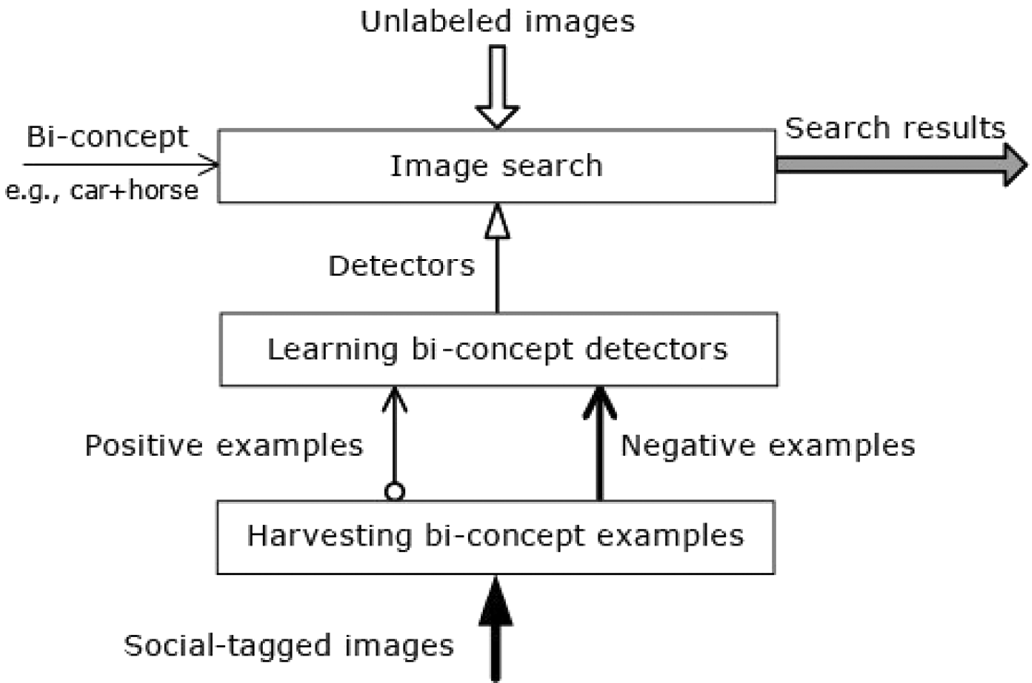 Fig 1. The conceptual diagram of the bi-concept search engine, showing the pipeline from social harvesting to unlabeled image search.
2. Social Negative Bootstrapping
A detector is only as good as the "hard" examples it fails on. Instead of random negatives, the system uses Social Negative Bootstrapping:
- Train an initial detector.
- Run it on millions of images.
- Identify "hard negatives" (images that look like the bi-concept but aren't tagged as such).
- Iteratively retrain the model to distinguish these subtle differences.
Experimental Breakthroughs
The team tested 15 bi-concepts (e.g., "beach boat," "cat snow," "girl horse") against a test set of 10,000 unlabeled images.
Key Findings:
- De-noising is Mandatory: Raw social tagging for bi-concepts is significantly noisier than for single concepts. The proposed multi-modal method doubled the precision of the training sets.
- Direct Learning > Oracle Fusion: Even if you knew the perfect weights to combine a "bird" detector and a "flower" detector, the "bird-flower" bi-concept detector still wins by a landslide.
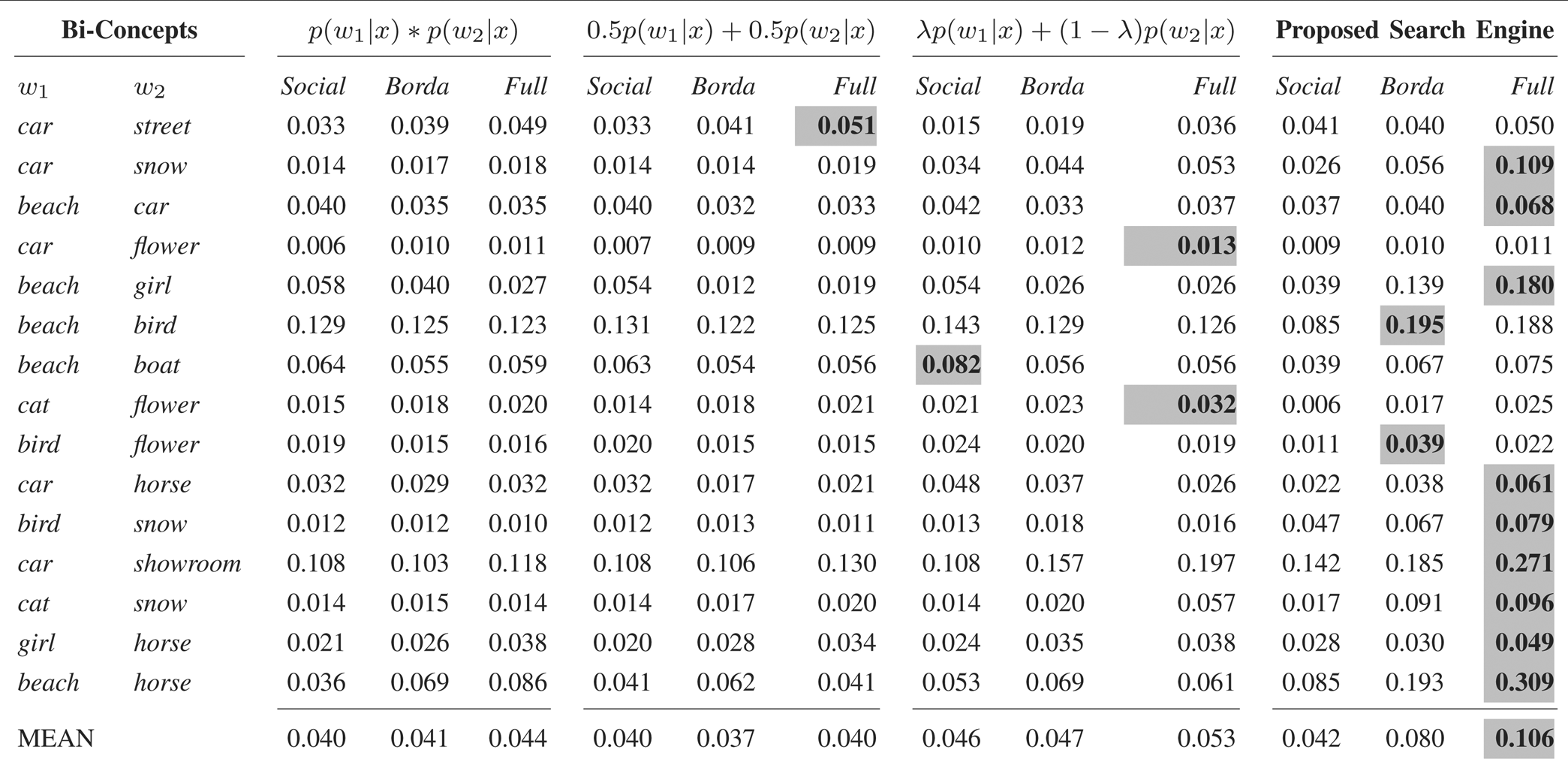 Table 1. Detailed comparison showing the Proposed Full Setup consistently outperforming Product Rules and Linear Fusion.
Critical Insight & Future Outlook
This work marks a shift from Atomic Vision (detecting things) to Relational Vision (detecting interactions). While this paper focused on pre-defined bi-concepts, it lays the theoretical groundwork for modern "on-the-fly" visual reasoning.
Limitations: The current method relies on the "global" appearance of the scene. For very small objects (like a tiny flower next to a car), global features struggle. Future iterations would benefit from local region proposals or attention-based architectures to pinpoint these micro-interactions.
Conclusion: By leveraging the "wisdom of the crowd" in social media and applying rigorous multimedia de-noising, we can move closer to answering complex human queries without the "tax" of manual annotation.