
Harvesting with SONAR: Why Aggregated Social Intelligence Trumps Data Silos
Harvesting with SONAR: the value of aggregating social network information
This paper introduces SONAR, a REST-based API and architecture designed to aggregate social network (SN) information from diverse public and private data sources. It demonstrates that combining disparate signals—such as email, blogs, bookmarks, and organizational charts—creates a significantly more comprehensive and useful "social map" for organizational expertise location and communication.
TL;DR
In the complex ecosystem of a modern enterprise, no single application—be it email, Slack, or a corporate blog—holds the complete picture of who knows whom. This paper presents SONAR, an architecture that harvests social signals from multiple platforms and aggregates them into a unified API. By blending public activity (like social bookmarking) with private interactions (like chat logs), SONAR provides a high-fidelity map of organizational connections that single-source tools simply cannot match.
The Problem: The "Siloed" Social Network
In 2008, the "Enterprise 2.0" revolution was in full swing. IBM researchers noticed a recurring problem: users were interacting across a dozen different tools. One colleague might be a "friend" on a social tagging site, another might share similar interests on a bookmarking site (Dogear), and a third might be a frequent email contact.
Prior work in Social Network Analysis (SNA) often focused on one specific medium—usually email. However, the authors argue that "much important social information exists outside the inbox." Relying solely on email ignores "similarity-based" connections (people who read the same things) or formal "structural" connections (the organizational chart).
Methodology: The SONAR Architecture
The genius of SONAR lies in its simplicity. It treats every social application as a Provider. These providers translate their internal metrics into a standardized "Strength of Connection" (a float between 0.0 and 1.0).
1. The Power of Weighted Aggregation
Instead of complex graph merging, SONAR uses a Weighted Average aggregator. This allows users to tune their "Social View" based on their current needs.
- Looking for a collaborator? Crank up the Social Bookmarking weight.
- Looking for a quick answer? Focus on Instant Messaging history.
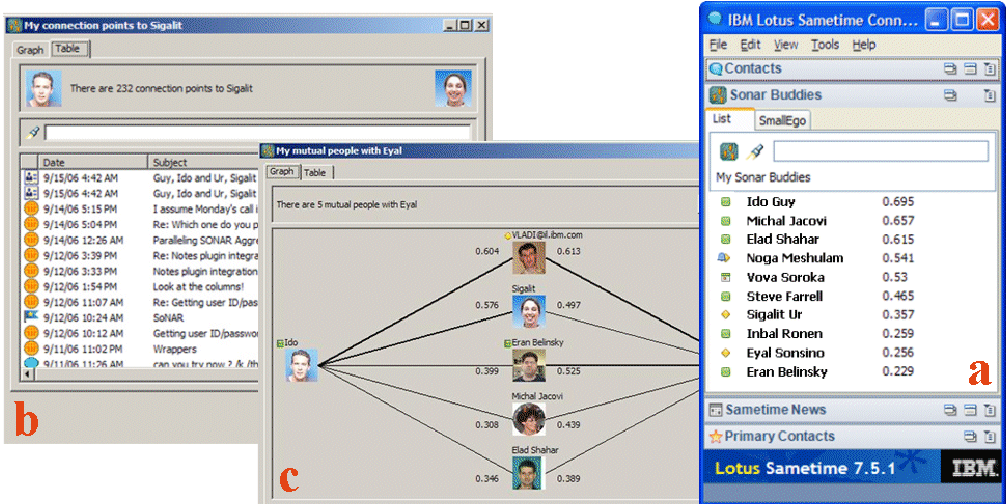 Figure 1: The SONARBuddies interface, showing how aggregated data manifests as a prioritized contact list.
2. Privacy vs. Utility
SONAR solves the privacy paradox by dividing sources into Public (Blogs, Org Charts, Tagging) and Personal (Email, Chat). Only the owner of the personal data can see lists generated from those sources. However, the study uncovered a surprising insight: when participants saw the value of the aggregated list, most were willing to share their "private-based" buddy lists with the rest of the company to facilitate better networking.
Experimental Insights: Evidence of Diversity
The researchers conducted a deep dive into the "Early Adopters" at IBM. The data proved their hypothesis: Social networks are not redundant.
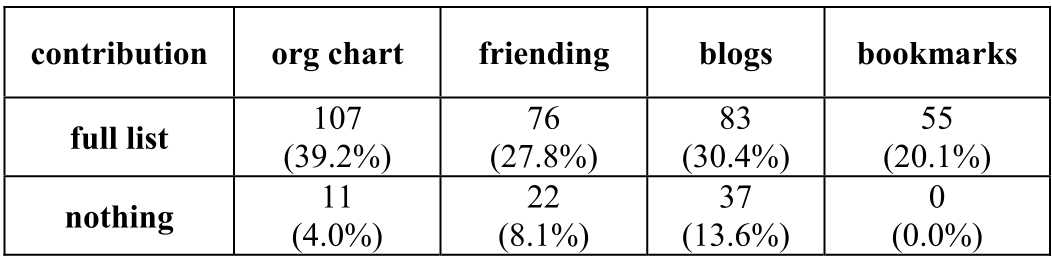 Figure 2: Diversity of public sources. Note that for a significant percentage of users, the Org Chart and Social Bookmarking tools provided completely non-overlapping sets of contacts.
Key Findings:
- Low Overlap: For nearly 40% of users, the organizational chart had no intersection with their social tagging or bookmarking circles.
- Aggregation Wins: Users consistently rated "Aggregated" buddy lists (combinations of 4+ sources) as more accurate than those derived from any single source like the Org Chart alone.
- The "Similarity" Factor: Sources like Dogear (bookmarking) were praised for finding "strangers with expertise," a critical function that email logs could never fulfill.
Critical Analysis & Conclusion
Takeaway
SONAR demonstrated that Social Tie Strength is a multi-dimensional construct. By building an API that treats "bookmarks" and "emails" as different lenses for the same relationship, IBM created a tool that mirrors the complexity of human collaboration.
Limitations
The primary challenge identified was the absence of a "Universal Default Weight." Because users' needs fluctuate (efficiency vs. discovery), a static weighting scheme usually fails. The study suggests that context-aware weighting (e.g., "Find me an expert in Java") is the necessary next step.
Future Impact
This work laid the groundwork for modern "Social Graphs" used in enterprise search. Today, when you see "Suggested Contacts" in Microsoft 365 or Google Workspace, you are seeing the legacy of SONAR’s philosophy: the value of the network is in the aggregation, not the individual interaction.