
Decoding the Power of the Pound Sign: Why Some Hashtags Go Viral While Others Vanish
Hashtag Popularity on Twitter: Analyzing Co-occurrence of Multiple Hashtags
This study investigates the drivers of hashtag popularity on Twitter, specifically focusing on the phenomenon of hashtag co-occurrence. Using a massive dataset from the 2011 Great Eastern Japan Earthquake, the authors analyze how the semantic similarity of co-appearing hashtags and the presence of URLs influence user adoption and retweetability.
TL;DR
Why do some hashtags become cultural touchstones while others stay buried in the noise? This research reveals that the secret isn't just in the hashtag itself, but in the company it keeps. By analyzing millions of tweets from the 2011 Japan Earthquake, researchers found that pairing similar hashtags boosts popularity, but pairing "clashing" (dissimilar) hashtags only works if you provide a URL to bridge the mental gap.
Background: The Economy of Attention
In the fast-paced world of Twitter, hashtags serve as the primary indexing mechanism. While we know they increase reach, we often ignore a critical fact: hashtags rarely travel alone. About 50% of hashtags appear in groups. In an environment of "bounded attention," hashtags compete for our limited cognitive resources. This study positions hashtag adoption as a result of metacognitive experience—the ease or difficulty with which our brains process information.
The Problem: The Complexity of Co-occurrence
Prior research focused heavily on "network effects" (who is tweeting) or simple content features (how long the tag is). However, they missed the logic of the "hashtag group." Does adding more hashtags help or hurt? Does it matter if the hashtags are about the same topic? The authors argue that previous models were incomplete because they didn't account for the cognitive load placed on a user when they see a string of hashtags.
Methodology: Looking Inside the Tweet
The researchers scrutinized a dataset of 362 million tweets and developed a multi-level regression model.
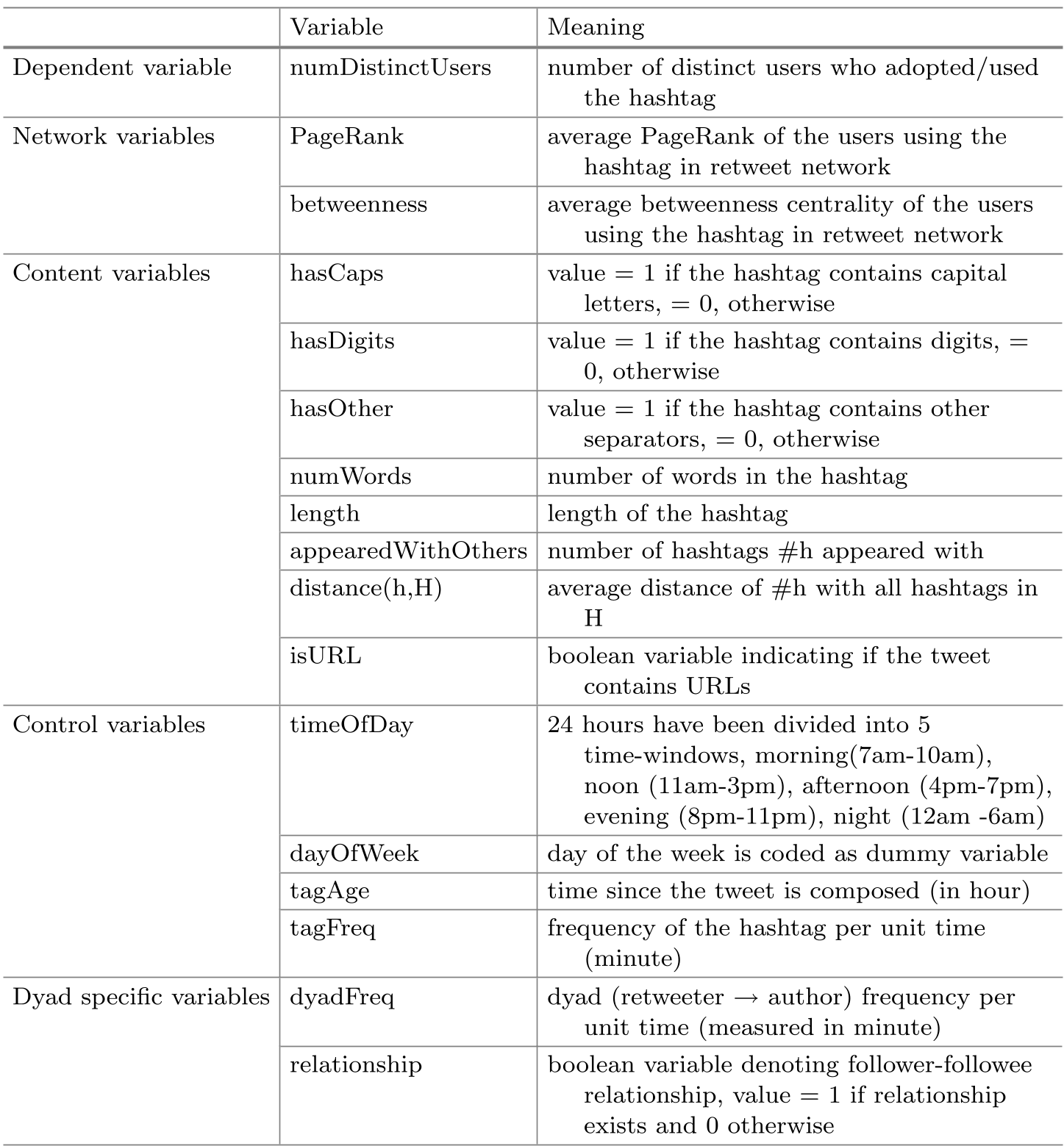
1. Key Variables
- Similarity (Distance): Measured using Levenshtein distance to see how closely co-occurring hashtags relate.
- Content Features: Length, use of capital letters, digits, and the number of words within the tag.
- Structural Variables: PageRank and Betweenness Centrality of the author and retweeter.
- Contextual Variables: The presence of URLs and the timing (Pre-, During-, and Post-Earthquake).
2. The Model Architecture
The study shifts from a high-level hashtag analysis to a dyad-level analysis (the specific relationship between a sender and a receiver), allowing for a more granular look at social influence.
Core Insights: Fluency vs. Surprise
The Similarity Boost
The data confirms that similar hashtags increase popularity. When hashtags are semantically related, they create "processing fluency." The brain finds it easy to categorize the tweet, leading to higher engagement.
The "URL-Surprise" Effect
The most fascinating finding involves dissimilar hashtags. Usually, having unrelated hashtags in a tweet confuses the user (metacognitive difficulty) and reduces popularity. However, when a URL is present, this effect reverses.
The URL provides the necessary context to resolve the contradiction between dissimilar tags. This makes the tweet feel "surprising" and "informative" rather than just confusing.
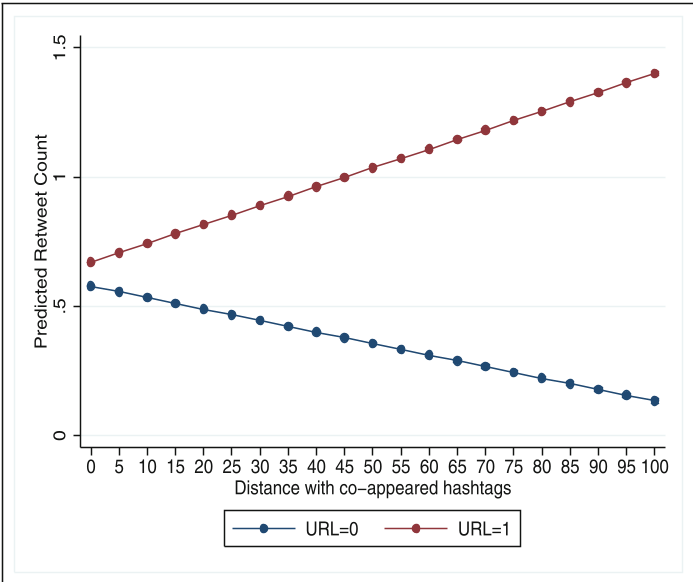 Figure: The crossover interaction showing that URLs significantly boost the retweet count of tweets containing dissimilar (high-distance) hashtags.
Experimental Results
- Insignificant Network Variables: Interestingly, PageRank of the author was often insignificant compared to the content of the hashtag itself. This supports the idea that content is king in hashtag virality.
- The "U-Shaped" Word Count: Having more words in a hashtag helps clarity initially, but too many words make it complex and decrease popularity.
- Event Impact: During the earthquake, the strength of these effects increased. People sought clarity and information more desperately, making the role of URLs even more pivotal.
Critical Analysis & Takeaways
This paper provides a robust framework for understanding social media strategy through the lens of cognitive psychology.
For Researchers: It highlights that information diffusion isn't just a topological (network) problem; it's a psychological one. For Practitioners:
- Synergy: If launching a brand hashtag, pair it with existing, similar trending tags.
- The Context Bridge: If you must use a diverse set of tags to reach different communities, always include a link. The link acts as the glue that turns confusion into "interestingness."
Limitations: The study is based on a Japanese dataset during a crisis. Future work should investigate if these "metacognitive" rules hold true for more "frivolous" content like fashion or entertainment memes.
Conclusion
Hashtag popularity is a delicate balance between cognitive ease and informative surprise. By understanding the patterns of co-occurrence, we can better predict—and potentially engineer—the next trending topic.