
Hate Speech in Political Discourse: Decoding the "Pile-On" Effect against UK MPs
Hate Speech in Political Discourse: A Case Study of UK MPs on Twitter
This paper presents a comprehensive case study of hate speech directed at UK Members of Parliament (MPs) on Twitter, utilizing a dataset of 2.5 million tweets. The researchers implemented a robust ensemble detection method using 18 state-of-the-art classifiers to identify hate speech and analyze its correlation with MP demographics, political affiliation, and topical events.
TL;DR
In a massive study of 2.5 million tweets, researchers have mapped the geography of hate directed at UK Members of Parliament. By using an ensemble of 18 AI classifiers, the study identifies a "pile-on" phenomenon where MPs face disproportionate abuse during high-visibility events. Key findings highlight that ethnicity and holding a government position are major targets for toxicity, while the volume of hate between genders appears surprisingly balanced.
Problem & Motivation: The Context Crisis
Social media has democratized access to elected officials, but it has also weaponized it. Previous attempts to quantify "online hate" often suffered from a lack of context—treating isolated tweets as data points without looking at the conversation thread.
The authors argue that without understanding the context (Is it a reply to a controversy? Is it part of a coordinated attack?), we cannot truly measure the threat online abuse poses to democracy. Their goal was to move beyond "what" was said to "when," "why," and "against whom" it was directed.
Methodology: The Power of the Ensemble
To avoid the pitfalls of a single biased model, the team built a "Senate" of classifiers.
- Ensemble Detection: They ran 18 different variants of state-of-the-art hate speech models. A tweet was only labeled "hateful" if a majority (n > 9) of the classifiers agreed.
- Thread Capture: Unlike traditional scraping, they captured full conversation trees to distinguish between aggressive political debate and genuine hate.
- Topic Taxonomy: They manually categorized the top 1,000 hashtags into a hierarchy (Policy, Party Politics, Rhetoric, etc.) to see which triggers most abuse.
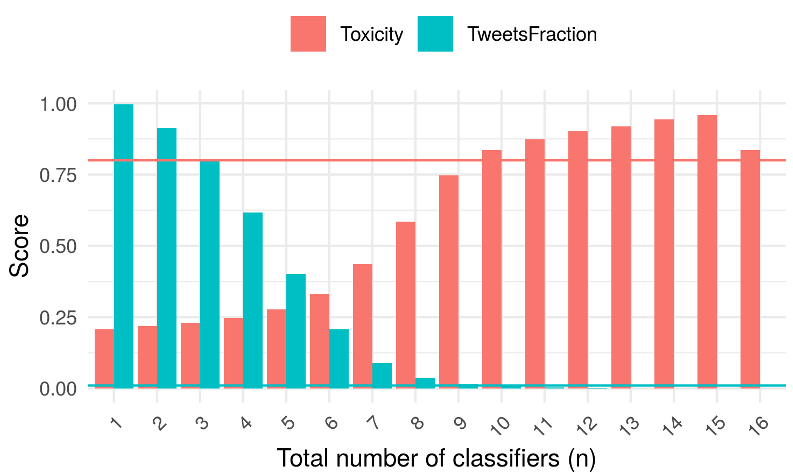 Figure: The correlation between classifier agreement and toxicity scores validates the ensemble approach.
Key Insights: Who is in the Crosshairs?
1. The "Pile-On" Effect
One of the most striking findings is that hate is not distributed evenly over time. It follows a "power-law" of attention. When an MP is mentioned frequently—due to a scandal or a major policy announcement—the density of hate speech increases. This suggests that high volume attracts "drive-by" abusers, leading to a coordinated harassment environment.
2. The Demographic Divide
The data confirms a grim reality for minority representatives. MPs from ethnic minority backgrounds receive statistically significant higher levels of abuse compared to their white counterparts.
Interestingly, the study contradicts some previous literature regarding gender; in this specific UK dataset, male and female MPs received roughly equal volumes of hate speech. However, the authors suggest the nature of the abuse (e.g., threats vs. insults) may still differ qualitatively.
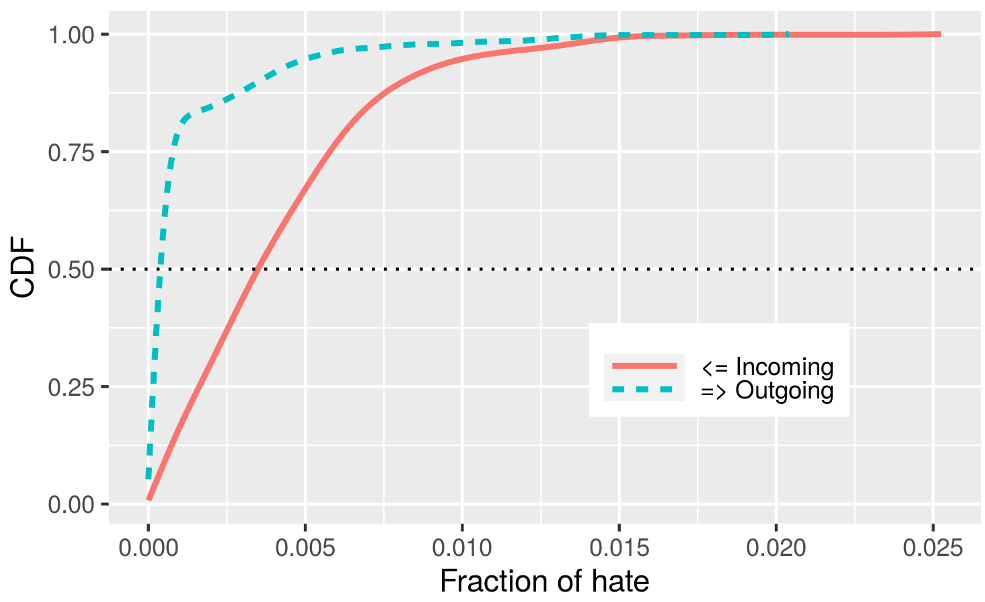 Figure: Comparative analysis of hate speech by ethnicity (Top) and gender (Bottom).
3. All Politics is Partisan
Hate speech is frequently a cross-party weapon. Supporters of one party (e.g., Labour) direct high concentrations of hate towards the opposition (e.g., Conservatives), especially those holding ministerial positions. The "Party in Power" is consistently the most frequent target of toxic rhetoric.
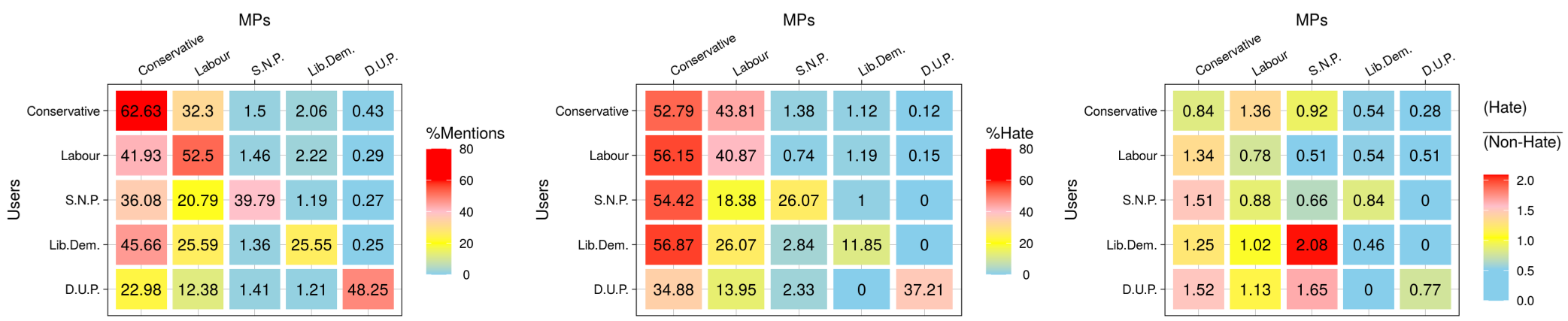 Figure: The interaction matrix shows how hate predominantly flows from supporters of one party to the MPs of another.
Critical Analysis & Conclusion
This paper provides an essential empirical base for the UK’s Online Safety Bill. Its value lies in its scale and its refusal to rely on a single "black-box" model.
Takeaway: The study proves that online hate is as much about visibility and identity as it is about policy disagreement. For platforms, the "pile-on" effect suggests that content moderation needs to be dynamic—protective measures should automatically ramp up for individuals currently at the center of a "viral storm."
Limitations: The study is a snapshot of 2017. Current political shifts (post-Brexit, post-COVID) might show different patterns. Furthermore, the reliance on automated classifiers, even in an ensemble, may miss subtle sarcasm or dog-whistles that only a human would catch.
Future Work: We need deeper research into the psychological impact of these "pile-ons" on recruitment—are qualified candidates, particularly minorities, being "chilled" out of seeking office because of this digital tax?