
Logic and Language: A Pragmatic Approach to Decoding Hate Speech on Twitter
Hate Speech on Twitter: A Pragmatic Approach to Collect Hateful and Offensive Expressions and Perform Hate Speech Detection
This paper introduces a pragmatic approach for hate speech detection on Twitter by extracting specialized unigrams and writing patterns from training data. Using a machine learning framework (J48graft), the method achieves 87.4% accuracy for binary classification (offensive vs. clean) and 78.4% for ternary classification (hateful, offensive, or clean).
TL;DR
Social media moderation is a battle against nuance. This paper presents a machine learning framework that moves beyond simple keyword filtering by extracting writing patterns and polarized unigrams. By combining these with sentiment scores, the authors achieved an 87.4% accuracy in identifying offensive content, proving that the structure of a sentence often reveals more than the words themselves.
Contextualizing the Conflict: Why Hate Speech Detection is Hard
In the realm of Natural Language Processing (NLP), hate speech detection is frequently confused with Sentiment Analysis. However, the authors argue these are fundamentally different. A user can say "I hate seeing my team lose," which is negative but clean, or use coded, structural language to target specific demographics without using a single "bad" word.
The core challenge lies in the "grey zone": the distinction between Offensive (rude but general) and Hateful (targeting protected groups). Prior work often treated these as a binary "Hate vs. Non-Hate," but this paper tackles the complexity of a ternary classification.
Methodology: The Architecture of Offense
The authors’ approach is grounded in Pragmatism. Instead of using pre-defined dictionaries, they derive features directly from the distribution of words in their training set.
1. Feature Engineering
The system relies on four pillars:
- Sentiment-based: Using SentiStrength to quantify the emotional "heat" of a tweet.
- Semantic: Tracking punctuation (!!!), capitalization (LOUD NOISES), and interjections.
- Unigram Features: Identifying specific words that appear statistically more often in hateful contexts (e.g., "muslims", "faggot").
- Pattern Features: This is the "secret sauce." The authors convert tweets into a sequence of PoS tags and sentiment polarities (e.g.,
Negative_ADJECTIVE + NOUN).
2. The Pattern Extraction Process
By simplifying a tweet into its grammatical "skeleton," the model learns the structural signatures of an attack. A pattern like PRONOUN + Negative_VERB + TARGET_GROUP can be flagged even if the specific verb or group hasn't been seen frequently before.
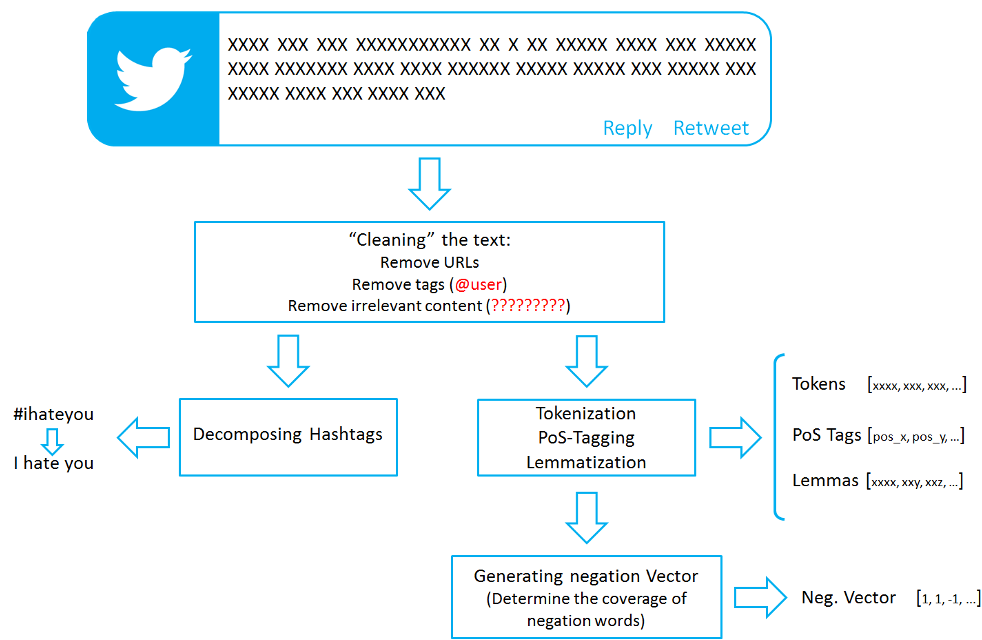 Figure 1: The pipeline from raw tweet to lemmatized, PoS-tagged tokens ready for pattern matching.
Experiments and Benchmarks
The study utilized a combined dataset of over 25,000 tweets, meticulously cleaned of URLs and tags.
J48graft vs. The World
Surprisingly, the J48graft (a decision tree variant) outperformed heavyweights like SVM (Support Vector Machines). The authors attribute this to the high volume of binary features (the presence or absence of specific patterns), which decision trees handle with higher surgical precision than vector-space models.
 Table 2: J48graft achieved a significantly higher F1-score (0.784) compared to Random Forest and SVM.
The Unigram Impact
The researchers found that unigram features alone provided a massive boost in accuracy (82.1% in binary tasks). When combined with patterns, the model reached its peak performance.
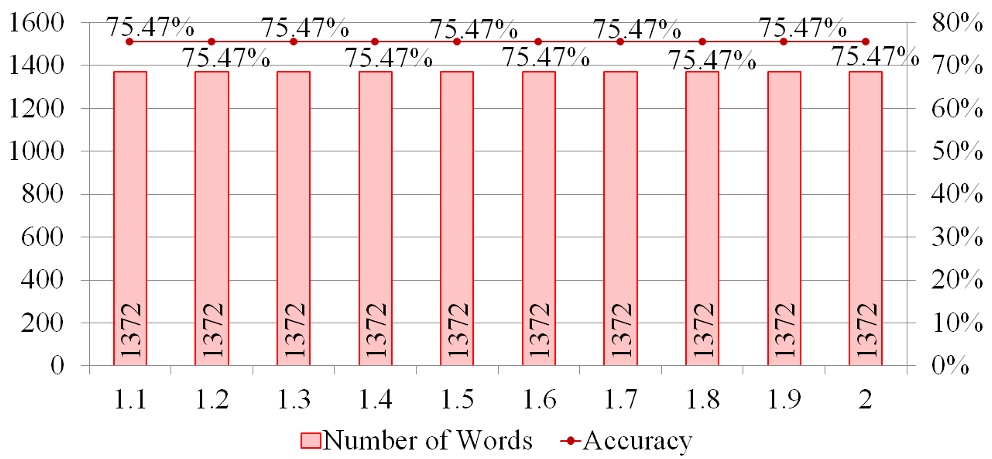 Figure 5: The optimization of the threshold (Thu) shows the delicate balance between the number of words collected and the final classification accuracy.
Critical Insights: The Limits of Logic
While the binary classification (Offensive vs. Clean) was highly successful, the Ternary Classification (splitting Hateful from Offensive) saw a performance drop. Why?
- Linguistic Overlap: Most hateful tweets are offensive, but not all offensive tweets are hateful. The "vocabulary of venom" is shared across both categories.
- Contextual Blindness: Without knowing the relationship between two users, a joke between friends might be indistinguishable from a genuine attack.
Final Takeaway
Watanabe et al. demonstrate that hate speech detection cannot rely on sentiment alone. By treating the writing pattern as a feature, they provide a blueprint for more resilient moderation systems—ones that understand the intent coded in the structure of human language. For future researchers, the focus must now shift toward better distinguishing the nuances of targeted hate from general toxicity.