
HBTOnto: Bridging the Gap Between Raw GPS Data and Human Behavior Semantics
HBTOnto: An Ontology Model for Analyzing Human Behavior Trajectories
HBTOnto is a semantic ontology model designed to represent and analyze Human Behavior Trajectories (HBTs). It extends traditional Location-Based Social Network (LBSN) data by adding semantic layers through Description Logics (SROIQ) and dynamic attributes like velocity.
TL;DR
HBTOnto is a specialized ontology model that transforms raw GPS "fixes" into meaningful "Human Behavior Trajectories." By leveraging Description Logics (SROIQ) and dynamic attributes like Velocity, it allows systems to not just track where a person is, but to infer what they are doing (e.g., commuting, shopping, or working).
The Evolution of Trajectory Analysis
In the era of Location-Based Social Networks (LBSNs), knowing a user's latitude and longitude is no longer enough. The real value lies in the semantic abstraction: understanding that a 20-minute stop at a specific coordinate represents a "Coffee Break" at a "Cafe" rather than just a pause in signal.
Current SOTA models like Baquara or QualiTraj have paved the way, but they often miss the "physics" of movement—the speed and acceleration that differentiate a person walking through a park from someone stuck in traffic.
Methodology: The HBTOnto Architecture
HBTOnto decomposes a trajectory into three fundamental building blocks, governed by formal mathematical axioms.
1. The FIX (Spatio-Temporal Point)
A Fix is more than a coordinate; it is a triplet associated with a specific intent. The model classifies them into:
- Starting/Ending Fixes: The boundaries of a journey.
- Stop Fixes: Intermediate points where direction or speed changes.
- Point of Interest (POI): A specific location where the speed reaches zero for a duration exceeding a defined threshold .
2. The SEGMENT
Segments represent the movement between fixes. HBTOnto differentiates between Starting, Ending, and Movement Segments (MOVSEG). Crucially, each segment is assigned a Velocity value and a Transportation Activity type.
3. Logic and Reasoning
The authors utilize SROIQ Description Logics to ensure the model transition is logically sound. For example, Axiom 4 and 5 define the "Role Chain Property" to ensure the continuity of movement ( and ).
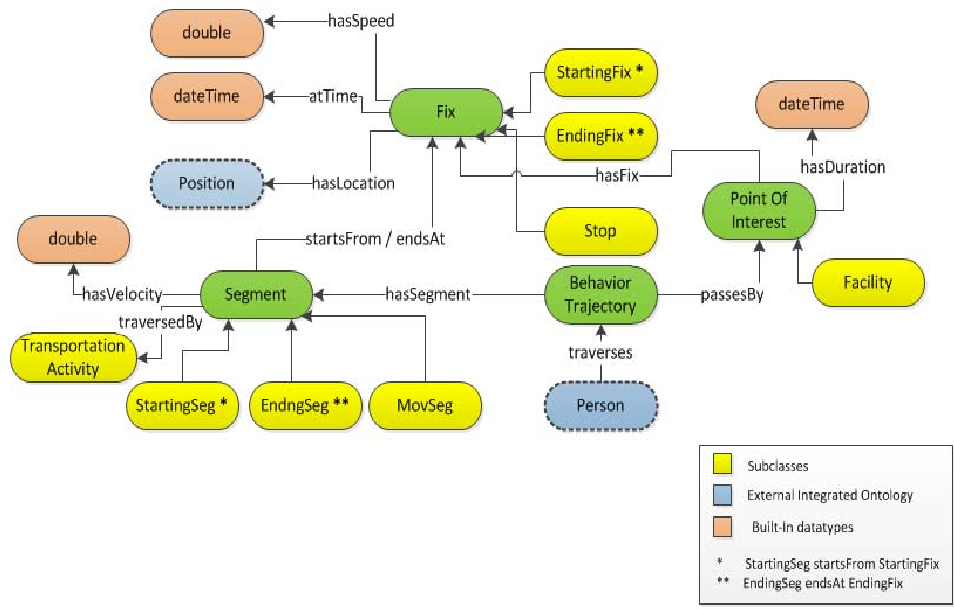 Figure 1: Schema description of the HBTOnto model showing the relationship between Person, Trajectory, and POI.
Experiments: Querying Human Behavior
To test the model, the authors simulated a typical daily routine: Home Office Club Market.
They compared two querying methods within the Protegé environment:
- DL Query: Effective for class-based logic but limited in retrieving specific individuals across multiple classes.
- SPARQL: Proved superior for complex trajectory retrieval, such as identifying all POIs traversed by a specific person across multiple segments.
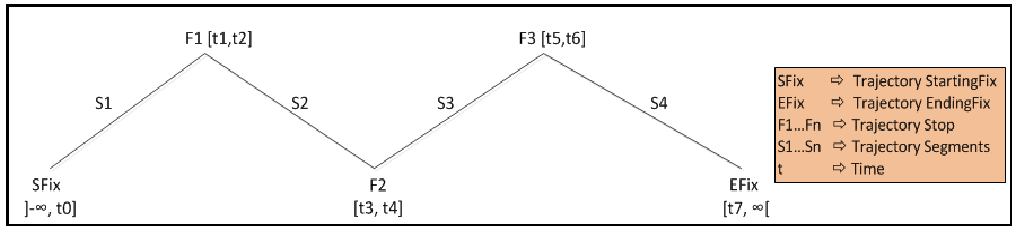 Figure 2: Analysis of a multi-segment trajectory with varying velocities ( to ).
Comparative Analysis: Why HBTOnto Matters
The paper concludes with a head-to-head comparison against existing frameworks:
| Feature | Baquara | QualiTraj | HBTOnto |
|---|---|---|---|
| Trajectory Type | Activity | Semantic | Behavior |
| Dynamic Attributes | Lacks Speed/Vel | Includes Profile | Segment-level Velocity |
| Formalization | Not Stated | Not Stated | SROIQ DL Axioms |
| Query Support | SPARQL | Not Stated | SPARQL & DL Query |
Critical Insight & Future Outlook
The core strength of HBTOnto is its formalism. By defining trajectories via Description Logics, it allows for automated discovery of behavioral patterns that purely statistical models might miss.
However, the current model is limited to 2D planes. As we move toward smart cities with multi-level buildings and drone-based logistics, the authors' plan to integrate 3D spatial semantics will be the necessary next step to make HBTOnto viable for complex urban environments.
Key Takeaway
HBTOnto successfully adds a "logic layer" to the "data layer" of human mobility, providing a robust foundation for building context-aware recommendation systems.