
HCS: Optimizing Mobile Social Networks through Hierarchical Social Clustering
HCS: hierarchical cluster-based forwarding scheme for mobile social networks
The paper introduces HCS (Hierarchical Cluster-based Forwarding Scheme), a novel routing protocol for Mobile Social Networks (MSNs). It leverages agglomerative hierarchical clustering based on common neighbor similarity to select optimal relay nodes, significantly reducing network traffic while maintaining acceptable delivery delays.
TL;DR
The Hierarchical Cluster-based Forwarding Scheme (HCS) is a breakthrough for Mobile Social Networks (MSNs) that drastically cuts redundant network traffic. By organizing mobile nodes into hierarchical clusters based on their "social similarity" (shared contacts), HCS routes messages through "shortcuts" in the social fabric, outperforming classic flooding-based methods like Epidemic routing.
Background: The Chaos of Opportunistic Networks
In a Mobile Social Network, there is rarely a direct connection between you and your destination. Devices move, signals drop, and the topology is constantly shifting. Standard protocols often resort to Epidemic Routing—essentially spamming every node you encounter—which wastes bandwidth and battery.
The authors of HCS realized that human movement isn't random; it follows social patterns. If two people share many common friends, they are likely to meet again or stay within the same social "neighborhood."
Methodology: The Social Hierarchy
HCS operates in three distinct phases:
1. The Warm-up: Gathering Social Intelligence
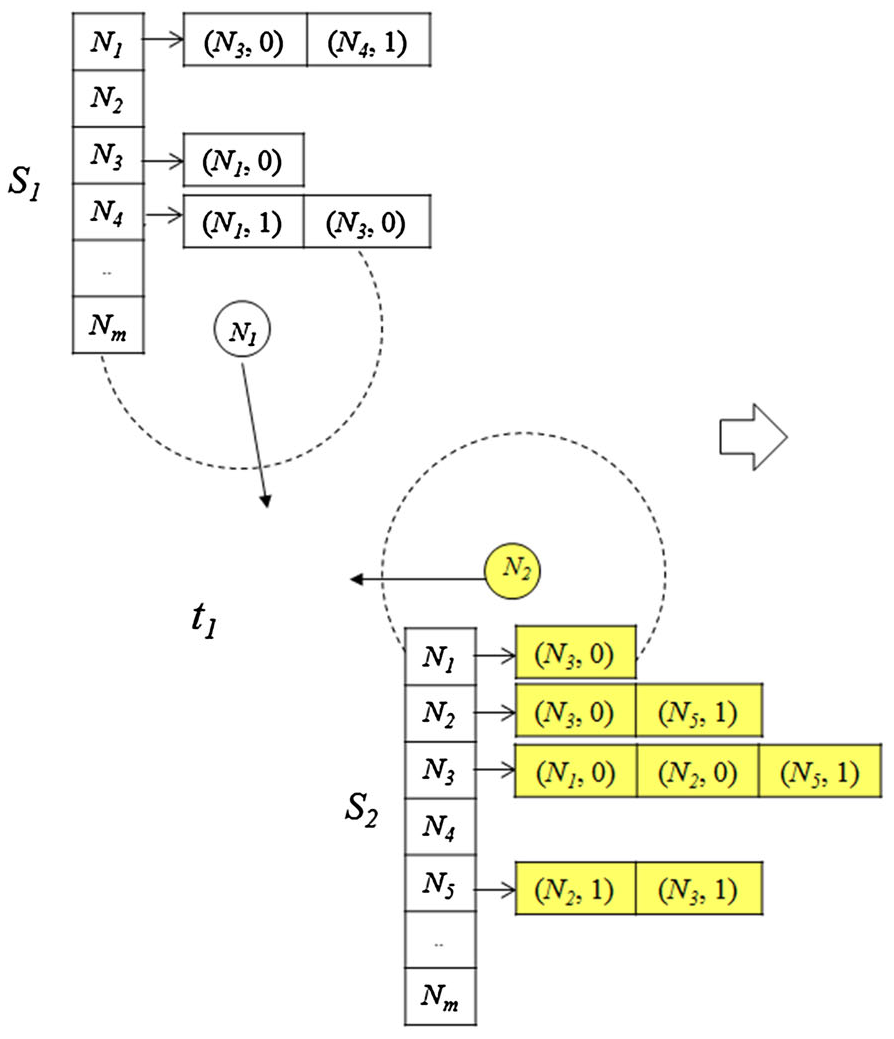
During an initial period, nodes exchange "Information Vectors" including their contact history () and similarity scores (). This allows nodes to build a local map of the global network structure without needing a central server.
2. Hierarchical Clustering (Agglomerative)
At the end of the warm-up, each node runs a bottom-up clustering algorithm. Nodes with the highest similarity are grouped at Level 1, then these groups are merged iteratively.
3. Dual-Mode Forwarding
When a node carries a message, it uses two logic paths:
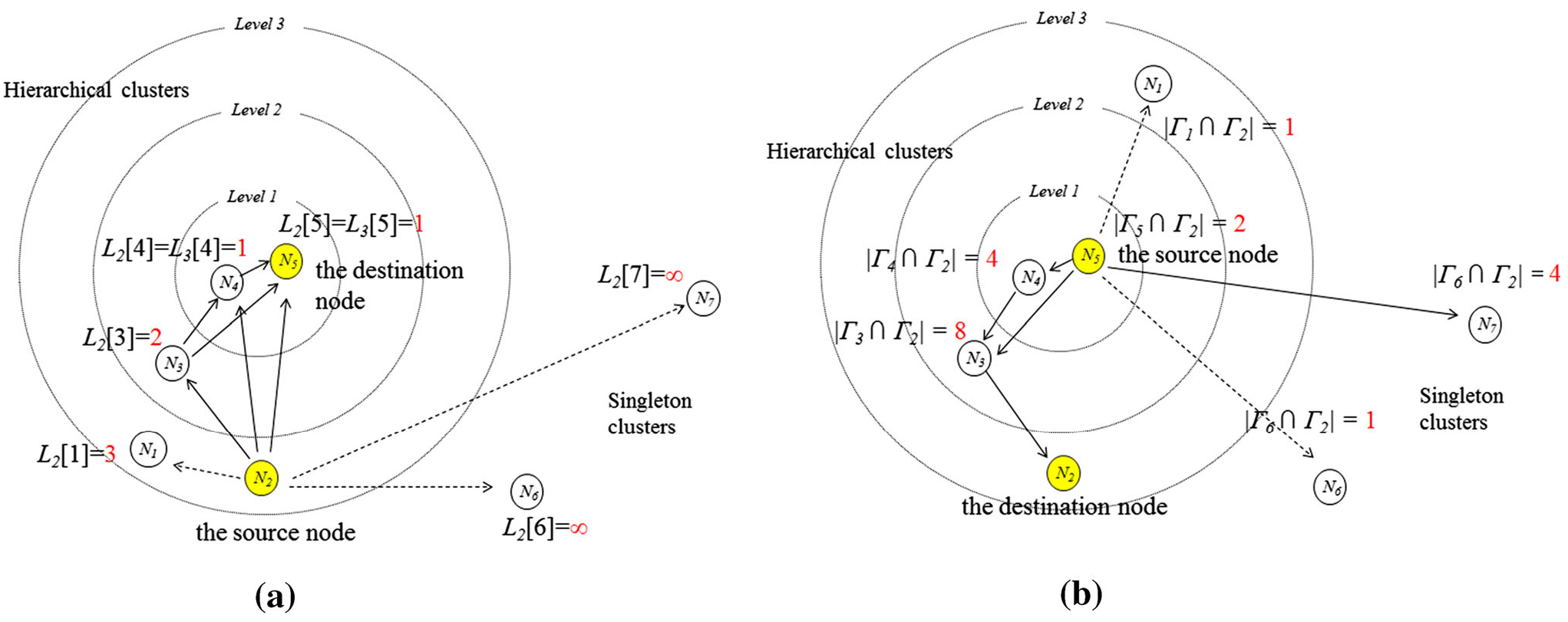
- Level-based Forwarding: If the destination is "deep" in a cluster (low level), the message is handed to any node belonging to a lower level (closer to the destination's social core).
- Similarity-based Forwarding: If the destination is outside current cluster knowledge, the node finds a peer with a higher similarity score to the target.
Performance: Efficiency vs. Speed
The core value of HCS lies in its Traffic-Delay Tradeoff.
- Network Traffic: HCS shows a massive reduction in packet duplicates. While Epidemic routing traffic grows exponentially with the number of nodes, HCS remains relatively flat and efficient.
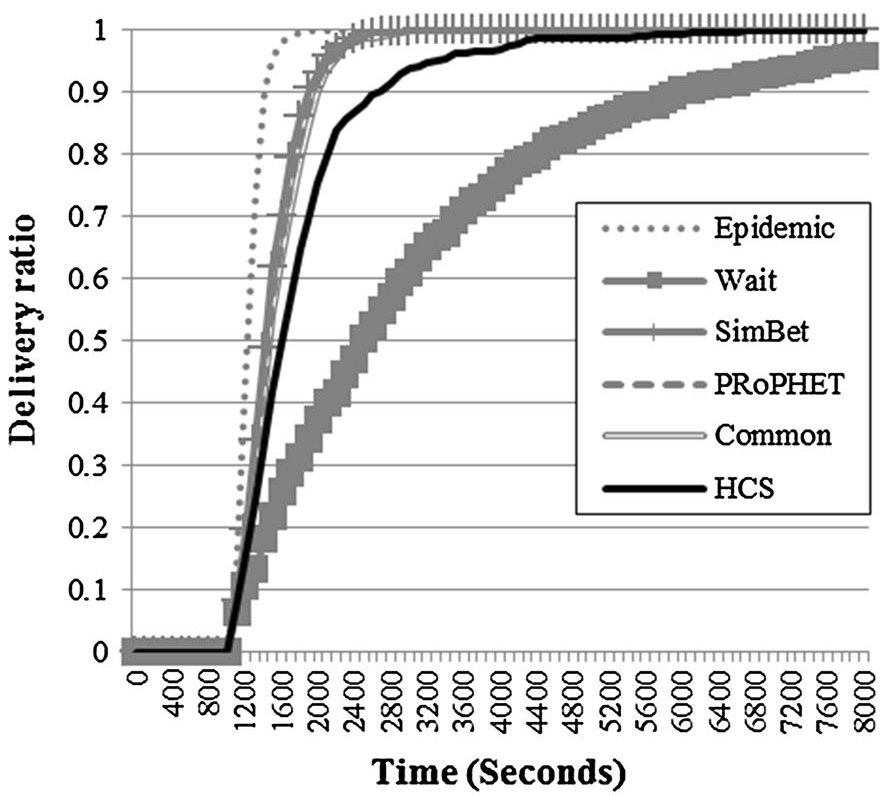
- Delivery Delay: While "Wait" (holding the message until the destination is met) has infinite delay in some cases, HCS delivers messages much faster, approaching the speeds of high-overhead probabilistic models like PRoPHET.
Deep Insight: Why It Works
The "magic" of HCS is its use of Inductive Bias regarding human sociality. By using Common Neighbor Similarity, the protocol identifies "bridges" in the network. A node at a lower hierarchical level acts as a local hub. Handing a message to a "lower-level" node is the digital equivalent of giving a letter to a person who is the "center of the party"—they are simply more likely to cross paths with your target.
Critical Analysis & Conclusion
HCS is a significant step toward "Green" MSNs, where energy and bandwidth conservation are paramount.
Limitations:
- Sensitivity to Threshold (): The performance depends on choosing the right cluster level threshold, which may vary by environment (e.g., a university campus vs. a city center).
- Warm-up Dependency: The scheme requires an initial period of "observation," making it less effective for extremely short-lived networks.
Future Outlook: As we move toward 6G and ubiquitous edge computing, the ability to build decentralized social hierarchies will be vital for IoT devices and autonomous vehicles navigating "dead zones" in connectivity.