
As You Are, So Shall You Move Your Head: Unlocking Traits through Earable Sensing
As You Are, So Shall You Move Your Head: A System-Level Analysis between Head Movements and Corresponding Traits and Emotions
This paper presents a system-level analysis using the eSense earable device to identify human physical traits and emotional states through head movements. By leveraging accelerometer and gyroscope data from 46 participants, the researchers developed a unified machine learning framework that correlates 3D translational and rotational head motion with 14 traits and 5 emotional categories, achieving near-perfect accuracy in several classifications.
TL;DR
Researchers have developed a novel system that can predict your habits (like smoking), dietary patterns, and family medical history simply by analyzing how your head moves. By using an earable device called eSense, the system captures subtle rotational and translational head movements, applying machine learning to identify traits with up to 100% accuracy.
Executive Summary
This study moves beyond traditional facial recognition or heart-rate monitoring to investigate a more subtle biometric: head dynamics. Positioned at the intersection of Human-Computer Interaction (HCI) and Ubiquitous Computing, the work demonstrates that our head movements are not just random physiological responses but are deeply encoded with our personality traits, health conditions, and emotional states.
Problem & Motivation: The Quest for Ubiquitous Biometrics
Why do we need another way to identify traits? Current methods are flawed:
- Clinical Tests: Blood or dope tests are accurate but expensive and invasive.
- Questionnaires: Subjective, prone to bias, and cannot be scaled for real-time applications.
The authors hypothesize that just as "body language" reveals emotion, "head language"—captured via high-precision accelerometers and gyroscopes—can reveal who we are. The goal is a ubiquitous, non-intrusive system that works in the background of daily life.
Methodology: The Magic is in the Motion
The researchers employed the eSense device—a specialized earable equipped with a 6-axis Inertial Measurement Unit (IMU).
1. Data Capture
The system monitors:
- Translational Motion: Acceleration along the X, Y, and Z axes.
- Rotational Motion: Gyroscopic data (pitch, roll, yaw).
2. Emotional Induction
To ensure the data was robust, participants were exposed to five different "emotional environments" using video clips (e.g., Mr. Bean for happiness, malnutrition documentaries for sadness). This allowed the researchers to see if traits like "being a smoker" remained detectable regardless of whether the person was happy or sad.
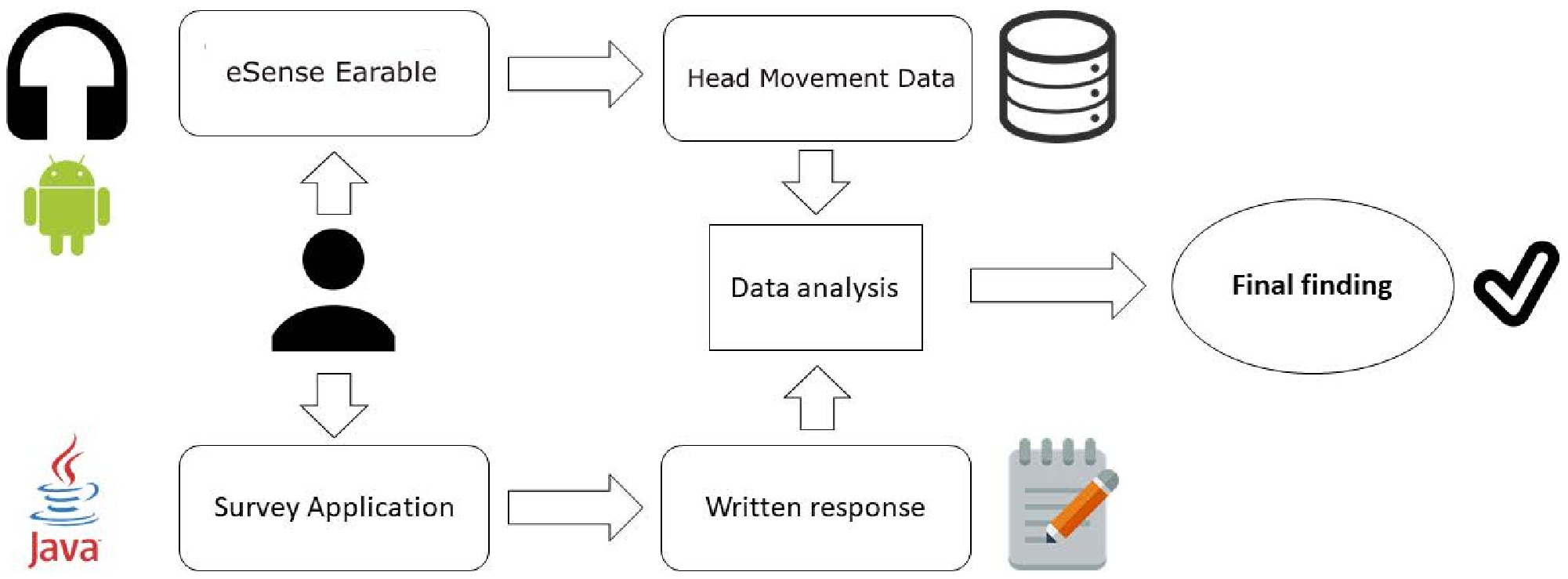 Figure 1: The proposed workflow from earable sensing to ML-based trait identification.
3. Machine Learning Pipeline
Using Auto-WEKA, the authors didn't just pick one algorithm; they let the system find the best fit. They transformed the 6D raw data into statistical features (Mean and Standard Deviation), reducing noise while preserving the physical "signature" of the movement.
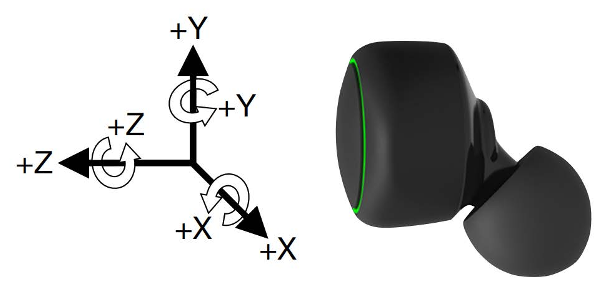 Figure 2: The 3D axis orientation used to capture granular head movements.
Experiments & Results: Surprising Precision
The results were remarkably consistent. The system outperformed traditional behavioral models in identifying specific traits:
| Trait | Highest Accuracy achieved |
|---|---|
| Family Heart Disease | 100% |
| High Fat Intake | 100% |
| Smoking Habit | 97.5% |
| High Sugar Intake | 97.5% |
| Emotion Detection | 100% |
Key Insight: The "Emotional Filter"
The researchers found that some traits are easier to identify during specific emotional states. For instance, Practitioner (Regular Praying) was identified with 92.5% accuracy during a "Disgust" induced state, but only 62.5% during "Surprise." This suggesting that certain emotional triggers "activate" the physical markers of our traits more clearly than others.
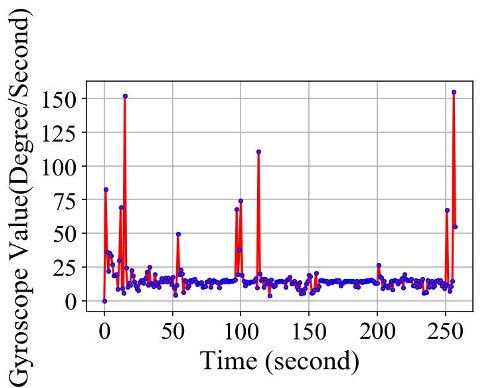 Figure 3: Representative accelerometer and gyroscope data across different induced emotional states.
Critical Analysis & Conclusion
Takeaway
This work proves that Earable Computing is a powerful frontier for behavioral science. Head movements are a "system-level" reflection of our internal state.
Limitations
- Controlled Environment: The experiments were done in a lab. Real-world "noise" (walking, talking) might interfere with the subtle trait signals.
- Diversity: While 46 participants is a good start, larger and more diverse datasets (including those with motor disabilities) are needed to prove generalizability.
Future Outlook
The authors plan to extend this to visually-impaired individuals, potentially helping them navigate the world while simultaneously monitoring their health and emotional well-being through simple, everyday earwear.