
RFS-SVM: Achieving Near-Perfect Precision in Healthcare Data Analysis
Health care data analysis using evolutionary algorithm
This paper introduces an assessment model for healthcare data analysis, specifically targeting chronic disease prediction like diabetes. It combines K-means clustering for outlier detection with a wrapper-based Recursive Feature Selection using Support Vector Machines (RFS-SVM) to enhance classification performance.
TL;DR
Predicting chronic diseases like diabetes requires navigating through noisy, high-dimensional patient records. This paper presents a robust assessment model that combines K-means clustering for outlier rejection and an Improved Recursive Feature Selection with SVM (RFS-SVM). The result? A clinical diagnostic accuracy of 98.82% on the Pima Indians Diabetes dataset—far surpassing traditional J48 and Naïve Bayes baselines.
1. The Context: Why Healthcare Data is Challenging
Medical data isn't just "big"; it is inherently messy. The gap between Information Technology and clinical practice often leads to datasets filled with missing values, noise from sterile environment equipment, and human diagnosis inconsistencies.
The authors identify two critical bottlenecks in current Clinical Decision Support Systems (CDSS):
- Feature Redundancy: Not every medical test result is relevant to a specific diagnosis.
- Outliers: Approximately 33% of the Pima dataset instances were identified as outliers—data points that deviate so significantly they mislead standard learning algorithms.
2. Methodology: The Hybrid Pipeline
The proposed model operates on a "Clean then Select" philosophy, which is visualized in the system architecture.
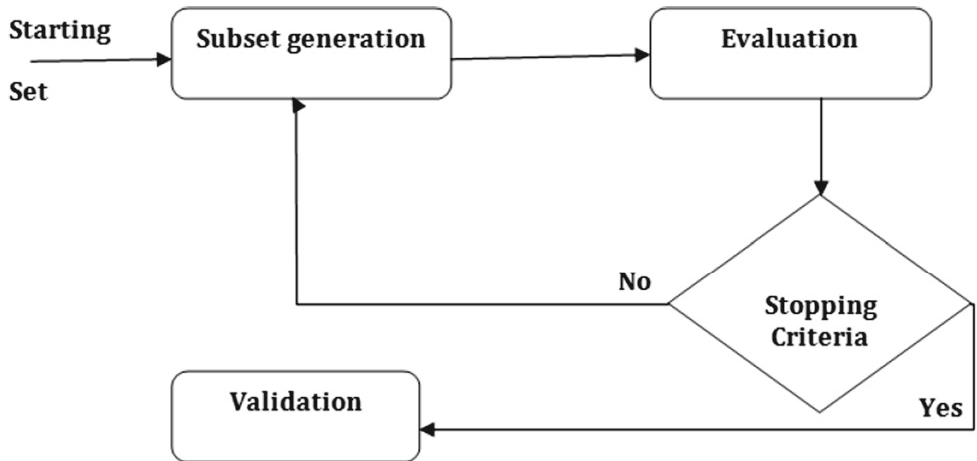
Step A: Preprocessing & Outlier Detection
Before any learning happens, the data undergoes normalization. Missing values are replaced by the mean. Crucially, K-means clustering is employed not for classification, but to identify the "neighborhoods" of data. Points that do not fit into the primary clusters are treated as noise and discarded, preserving the integrity of the manifold.
Step B: Recursive Feature Selection (RFS-SVM)
Instead of using a simple filter (like correlation), the authors use a Wrapper Method. The SVM itself is used to rank features based on their weights ().
- Train a linear SVM.
- Rank features by their weight vector magnitude ().
- Iteratively remove the least relevant features.
- Repeat until the optimal subset (in this case, 5 features) is identified.
3. Results: Breaking the Performance Ceiling
The most striking takeaway is the performance jump when noise is removed. Under standard "noisy" conditions, most classifiers hover between 70–82% accuracy. However, once the proposed pipeline is applied, the RFS-SVM hits a staggering 98.92% accuracy.
Comparative Performance Analysis
| Classifier | Accuracy (Noisy) | Accuracy (Cleaned) |
|---|---|---|
| Naïve Bayes | 72.34% | 77.73% |
| J48 (Decision Tree) | 78.82% | 86.46% |
| RFS-SVM (Proposed) | 82.56% | 98.92% |
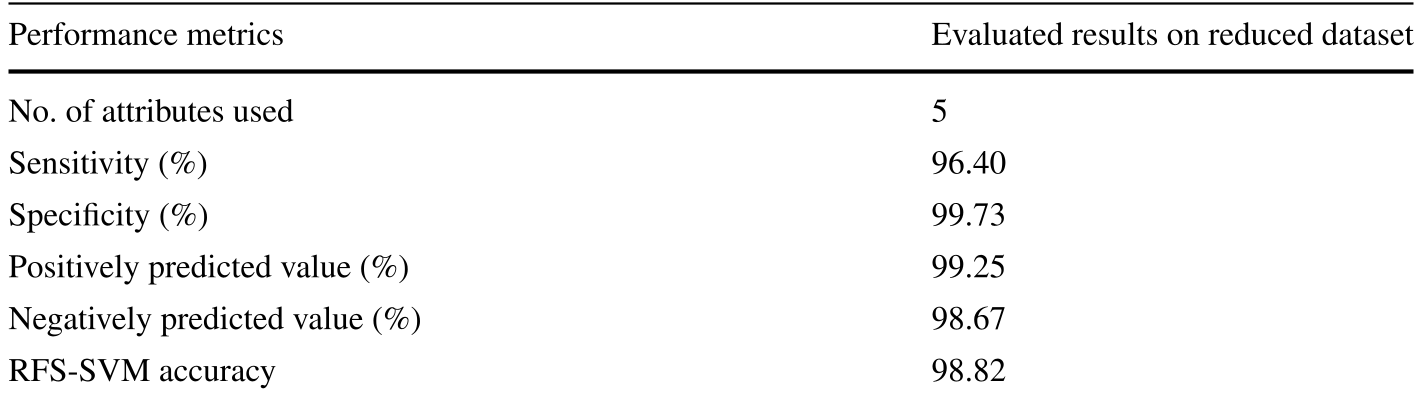
The experiment highlights that for the Pima Diabetes dataset, Pregnancies, Plasma Glucose (PG) concentration, and Age were the three most critical indicators. By reducing the feature set from 8 to 5, the model not only became more accurate but also computationally leaner.
4. Academic Insight: Why it Works
The success of this work lies in the Inductive Bias of the SVM. Unlike Naïve Bayes, which assumes feature independence, SVMs look for a maximum-margin hyperplane in a transformed space. When paired with Recursive Feature Selection, the model effectively "prunes" the dimensions that introduce high variance, allowing the SVM to find a much cleaner separation in the feature space.
5. Limitations & Future Horizon
While the results are impressive, the study is limited to the Pima dataset (8 attributes). The next logical step is applying this robust pipeline to "Big Data" healthcare contexts with thousands of features (e.g., genomic sequencing). The authors suggest that integrating Evolutionary Algorithms like Artificial Bee Colony (ABC) could further optimize the initial parameter tuning of the SVM, potentially making the model fully autonomous in its feature discovery.
Conclusion
This paper proves that the "secret sauce" to high-accuracy medical AI isn't just a more complex model, but a smarter way to clean and select the input data. The RFS-SVM framework offers a blueprint for highly reliable diagnostic tools that can assist clinicians by focusing only on the biological markers that truly matter.