
The Digital Echo Chamber: How Altmetrics Predict Scholarly Success at Harvard Medical School
Research productivity of health care policy faculty: a cohort study of Harvard Medical School
This study evaluates the research productivity and scholarly impact of 22 core Health Care Policy faculty members at Harvard Medical School. It utilizes a comparative framework between traditional bibliometric indices (Web of Science citations) and alternative metrics (Altmetric Attention Scores) to assess professional influence at the article level.
TL;DR
In the modern "publish or perish" landscape, the value of a research paper is no longer locked solely within the ivory tower of traditional citations. This study of Harvard Medical School’s Health Care Policy faculty proves that Altmetric Attention Scores (AAS)—measures of social media, news, and blog mentions—not only correlate strongly with traditional citations but may actually predict a paper's future academic trajectory.
The Motivation: Why Citations Aren't Enough
For decades, the h-index and citation counts have been the gold standard for tenure, grants, and prestige. However, citations are "lagging indicators"; they take years to accumulate. In the fast-paced world of healthcare policy, waiting three years to gauge an article's impact is inefficient.
Furthermore, traditional metrics fail to capture societal impact. If a paper changes how the public views vaccination or insurance, but isn't cited by another academic for two years, does it have zero impact? Altmetrics were born to fill this gap, yet their relationship with "real" academic rigor remains a subject of intense debate.
Methodology: Mining the Harvard Cohort
The study focused on 22 core faculty members, ranging from Assistant Professors to Full Professors. Using a specialized Python script, the author filtered 2,343 articles that appeared in both the Web of Science and Altmetric Explorer.
The researcher didn't just look at a snapshot in time. By collecting citation data in November 2018 and again in January 2020, the study could measure citation growth and see if high social media engagement in the past predicted a surge in citations in the future.
The Measuring Stick: Spearman Rank Correlation
To avoid the bias of extreme outliers (like a single viral tweet), the study used Spearman Rank-Order Correlation. This method ranks faculty by their scores rather than using raw numbers, providing a more stable view of professional standing.

Core Findings: The Social Media Surge
The results were striking. There was a significant strong positive correlation () for every single faculty member studied.
- Leading Indicators: Articles with high social media buzz (Twitter, Blogs, News) almost invariably saw a subsequent rise in traditional citations.
- Productivity vs. Popularity: Some faculty members (like Timothy J. Layton) were "Social Media Stars," receiving high AAS but fewer citations, while others (like Barbara J. McNeil) were "Academic Titans," with massive citation counts but nearly zero social media presence.
- The Mendeley Factor: Interestingly, Mendeley readership (saving a paper to a digital library) was the most popular altmetric indicator, suggesting that scholars are "bookmarking" research digitally long before they cite it.
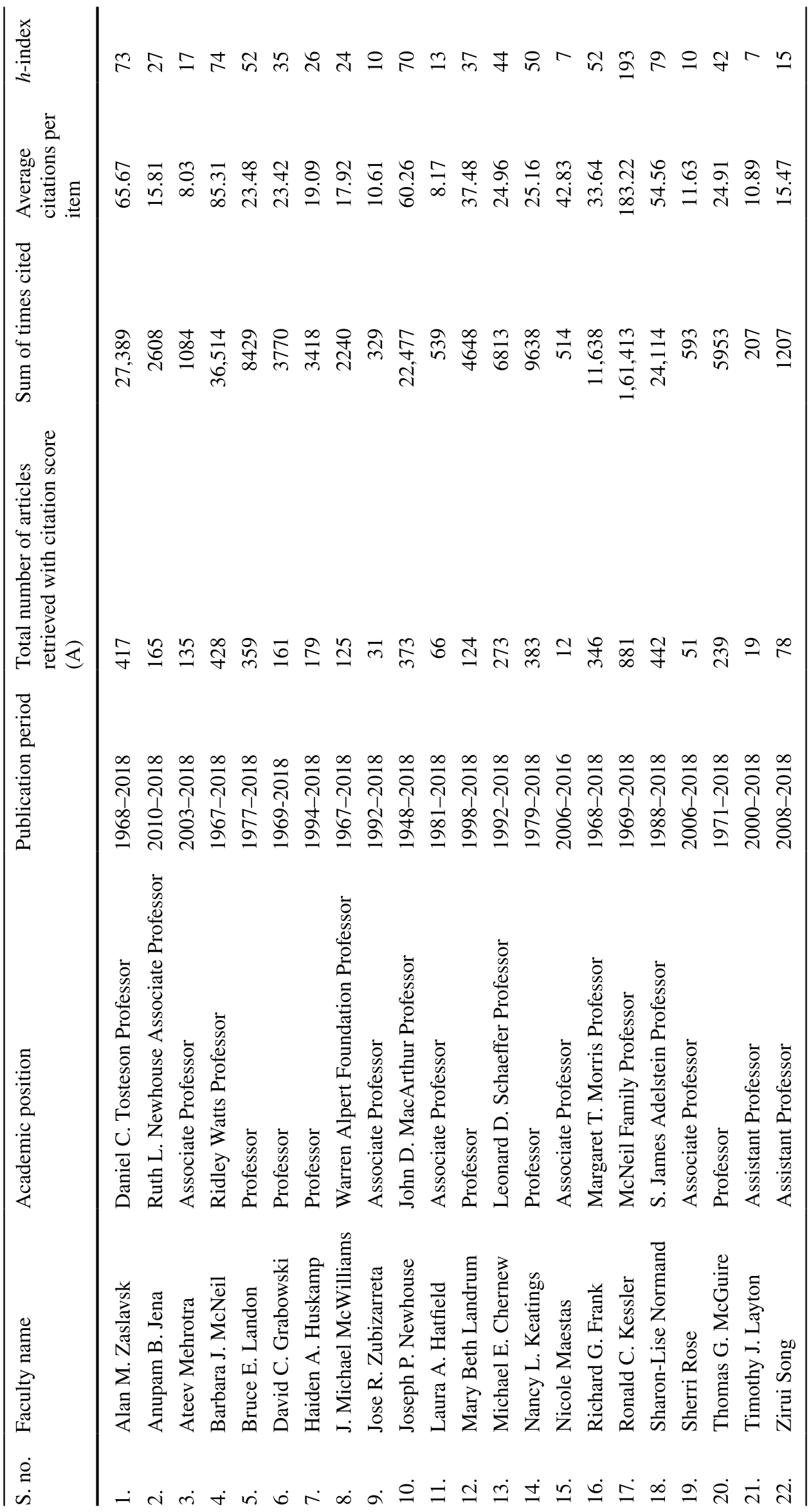 Table: Traditional Citation Profiles of Harvard Faculty members.
Deep Insight: The "Policy" Paradox
A surprising takeaway was the meager percentage of policy-related document mentions. For a department specifically dedicated to "Health Care Policy," one would expect their research to be cited frequently in government white papers or NGO reports.
Instead, the data suggests that even policy research is primarily consumed by other academics on Twitter and Mendeley. This reveals a potential "bottleneck" in how academic research translates into actual government policy—or a limitation in how current tools track those policy citations.
Critical Analysis & Future Outlook
While the correlation is clear, correlation is not causation. Does tweeting about a paper make it more cited, or do high-quality papers simply attract both tweets and citations naturally?
Limitations:
- The study is confined to a single elite department (Harvard), which may benefit from the "Matthew Effect" (the famous get more famous).
- Altmetric weights (8 points for a news story, 1 for a tweet) are somewhat arbitrary and decided by Altmetric.com staff rather than a peer-reviewed formula.
The Future: For young researchers, the message is clear: Digital dissemination is a part of the job. Sharing your work on social platforms isn't just vanity; it is the "early warning system" for your research's eventual scholarly impact.
Conclusion
This study legitimizes Altmetrics as a vital tool for departmental evaluation. By combining the "slow" metrics of citations with the "fast" metrics of social media, we get a high-resolution map of how health care research actually moves through the world.