
Health Drive: Merging V2X and Mobile Health for the Next Generation of Safe Driving
Health Drive: Mobile Healthcare Onboard Vehicles to Promote Safe Driving
Health Drive is a mobile healthcare platform utilizing a Multi-tier Vehicular Social Network (M-VSN) to integrate context-aware sensing for driver safety. It bridges the gap between health monitoring and traffic environment data, achieving real-time safety alerts even in data-intensive scenarios (performing reasoning in under 7s for large datasets).
TL;DR
Health Drive is a multi-tier platform that integrates driver physiological data with vehicular and environmental sensors. By utilizing a "Mobile-Cloud Parallel" architecture, it performs sophisticated semantic reasoning on a driver's health status in real-time, providing life-saving alerts before accidents occur.
Context & Motivation: Why Current Systems Fail
Despite the rise of smart vehicles, road traffic injuries remain a global crisis. The core issue is that safety isn't just about the car; it's about the driver's interaction with the environment.
Existing solutions are often siloed:
- Health monitors track your heart rate but don't know you're driving 120km/h in a storm.
- Collision warnings track distances but don't know the driver is currently suffering from extreme fatigue or a medical episode.
The authors identified that a "seamless solution" must interpret three data streams simultaneously: Healthcare data, Vehicular data, and Dynamic Traffic data.
The M-VSN Architecture: Beyond the Cloud
The most striking technical contribution of Health Drive is its Multi-tier Vehicular Social Network (M-VSN). Unlike traditional systems that treat mobile phones as passive "data mules" that simply upload bits to the cloud, Health Drive's Mobile Tier is a first-class citizen in the computation process.
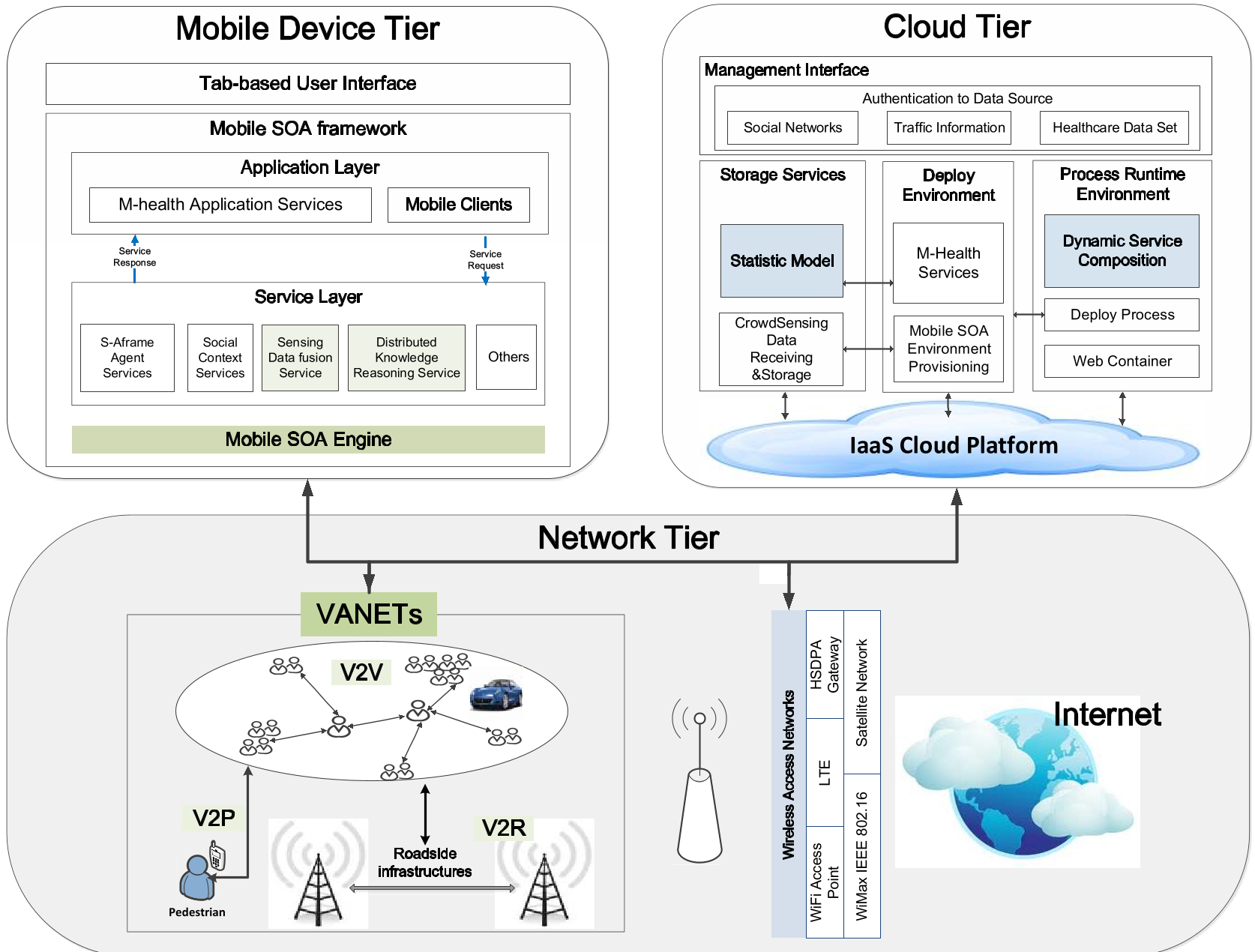
1. Network Tier (The Connectivity Layer)
It employs a heterogeneous mix of V2P (Personal body sensors), V2V (Vehicle-to-Vehicle), V2R (Roadside units), and V2C (Cloud). This ensures that even if cellular data (V2C) is slow, local alerts (V2P/V2V) remain high-priority and low-latency.
2. Mobile Device Tier (The Local Brain)
This tier features two critical services:
- SDSS (Sensing Data Storage Service): Uses a SQLite-based information tree to categorize data into Vehicle, Environment, Person, Device, and Network.
- DKRS (Distributed Knowledge Reasoning Service): This is the "secret sauce." Instead of simple keyword matching, it uses Ontology-based reasoning to calculate semantic and context similarity.
3. Cloud Tier (The Global Coordinator)
The cloud handles heavy-duty data aggregation and "Context-Aware Mapping." It resolves conflicts like unit differences (km/h vs mph) and stores historical driving behavior to provide personalized feedback.
Methodology: Semantic & Contextual Reasoning
The paper introduces a rigorous mathematical approach to determine if a driver is "safe."
The similarity between a "Safe Driving Profile" () and the "Real-time Sensing Profile" () is calculated as:
By adjusting the weights ( for shallow semantic match and for deep contextual match), the system can balance between the limited processing power of a smartphone and the infinite resources of the cloud.
Experimental Performance
The researchers tested North American road scenarios using a Google Nexus 4 and an Amazon EC2 instance.

Key findings include:
- Local is Faster for Small Data: When dealing with under 1500 data assertions, the local mobile device responded in ~2.2s–4.7s, faster than the cloud-plus-network round trip (~4.7s–4.9s).
- Stability Under Stress: Even with a massive 36,000-concept medical ontology (Ɛ£-GALEN), the system utilized the cloud to return results in ~6.8 seconds.
- The 9-Second Rule: Since the safe time distance between vehicles is typically >9 seconds, the system's sub-7-second reasoning speed provides a vital safety buffer.
Critical Insight & Future Outlook
Health Drive moves away from the "One-Size-Fits-All" healthcare application. By using a RESTful Web Service architecture and Ontologies, it allows developers to deploy customized apps (as seen in Figure 3 of the paper) that can alert a driver to "decrease throttle input" based on a combination of their high blood pressure and upcoming complex urban intersections.
Limitations: The current work lacks a robust security/privacy framework—a critical requirement when handling sensitive medical data on a vehicular social network. Future iterations must address how to anonymize V2V health alerts while maintaining their urgency.
Conclusion: Health Drive proves that the smartphone in your pocket, when correctly integrated into the vehicular network, isn't just a distraction—it's a sophisticated medical safety device.