
From Health-Persona to Societal Health: Engineering the Objective Self
From health-persona to societal health
The paper introduces a framework for building a "Health-Persona" by correlating heterogeneous data from wearable sensors, social media, and life logs. It proposes using "Focused Micro Blogs" (FMB) and the "EventShop" platform to transition from individual "Quantified Self" data to actionable "Societal Health" insights and personalized interventions.
TL;DR
This seminal position paper proposes a paradigm shift from the Quantified Self (collecting data) to the Objective Self (correlating data). By unifying wearable sensor streams, calendars, and social data into a "Health-Persona," the authors demonstrate how a systematic "Event-based" approach can provide personalized medical insights and predict societal health trends with higher accuracy than noisy platforms like Twitter.
Context: Why "Subjective Self" Is Failing
Historically, medical history has been anecdotal. A physician asks, "How much did you exercise last month?" and the patient provides a flawed, subjective memory. Even with the rise of fitness trackers, data often remains "siloed"—your heart rate data doesn't talk to your calendar. The authors argue that this lack of correlation prevents us from seeing the "Why" behind health anomalies.
The Problem: The Noise of Big Data
The authors identify two fatal flaws in current digital health systems:
- Low Signal-to-Noise Ratio (SNR): Platforms like Twitter are too broad. Trying to track the flu via tweets is like looking for a needle in a haystack of sarcasm and unrelated content.
- Lack of Correlative Context: Knowing your heart rate was 110 BPM is useless unless the system knows you were in a high-stress meeting (via Calendar) rather than running (via GPS/Motion).
Methodology: Building the Health-Persona
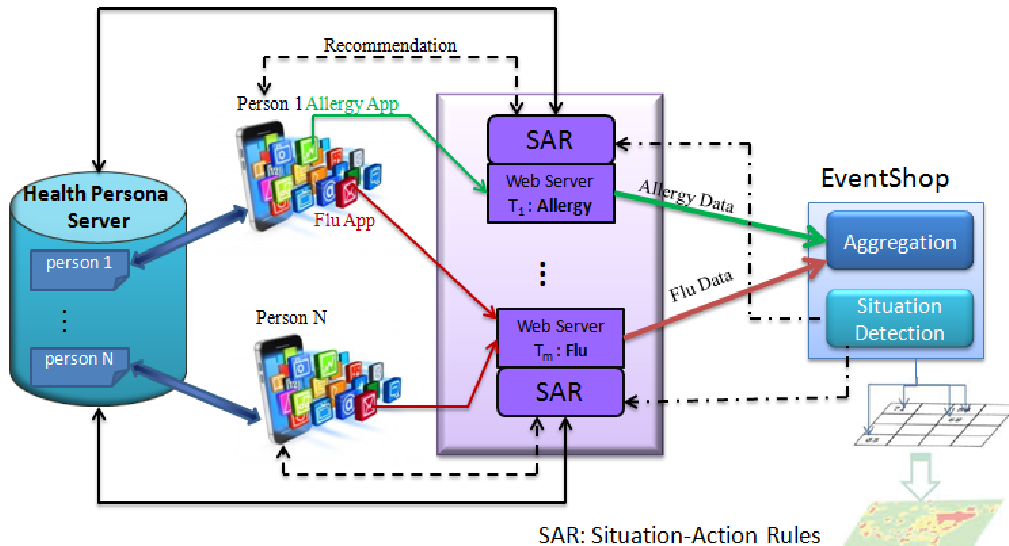
The core of the paper is the EventShop framework. It acts as a unification engine that converts multi-modal data into a common temporal and spatial "Event" format.
1. The Four Pillars of Health Events
The Health-Persona is built by correlating four distinct streams:
- Life Events: Scraped from Facebook, LinkedIn, and Calendars.
- Food Events: Logged via smartphone inputs.
- Fitness Events: Captured by wearable sensors (e.g., Fitbit, Nike Fuel).
- Body Parameters: Heart rate, temperature, and oxygen levels.
2. Focused Micro Blogs (FMB)
Moving away from the chaos of Twitter, the authors propose FMBs. Think of Waze for health: instead of general typing, users provide structured, high-SNR updates (e.g., "stalled car" or "flu symptoms"). This structure allows for automated parsing and immediate response.
Experimental Insight: Searching for the "Unusual"
The power of the Health-Persona is best shown in the authors' example:
Mr. A attends a weekly meeting. His calendar shows the meeting; GPS confirms he is there; motion sensors show he is sitting still. However, his BASIS heart monitor shows a spike in heart rate and temperature.
Without correlation, a system might ignore this. With the Health-Persona, it suggests a "Situation": either the meeting is high-stress, the room is too hot, or the food at that specific restaurant is causing a physiological reaction.
Societal Impact and Results
The paper highlights a looming crisis: The Physician Shortage. By 2025, demand for doctors will significantly outpace supply.
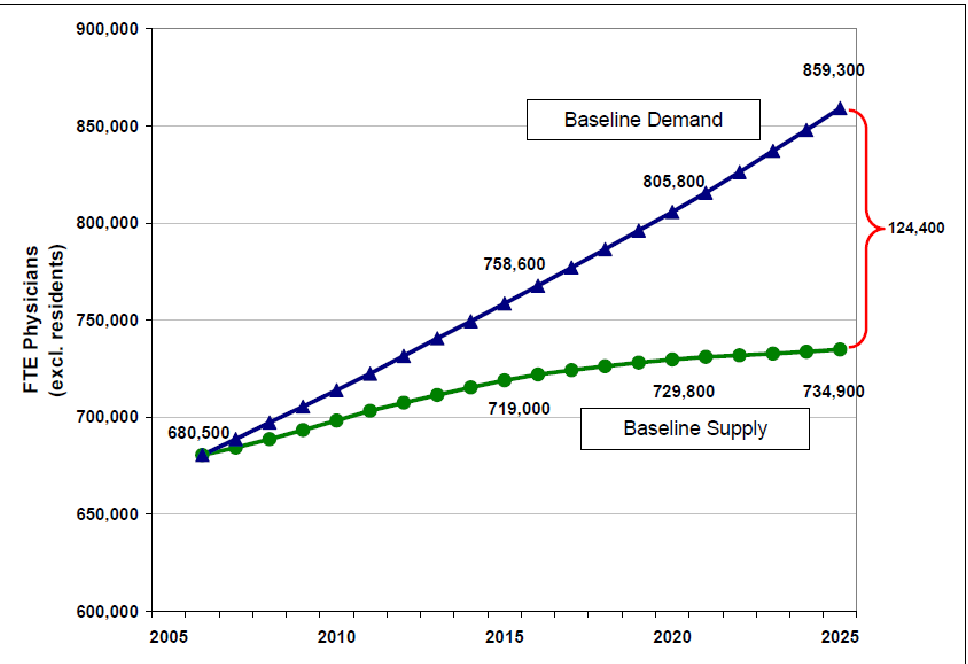
The proposed solution isn't just "more doctors," but "better tools." The Health-Persona serves as an extension of the physician—an automated, 24/7 record that makes medicine evidence-based rather than preference-based. By aggregating these personas using Situation-Action Rules (SAR), health authorities can detect flu outbreaks or environmental hazards (like high pollen) before they appear in hospital records.
Critical Analysis & Future Outlook
Takeaway: The real value of Big Data in health isn't the volume—it's the interconnectedness. The Health-Persona acts as a unified digital twin that allows for proactive rather than reactive care.
Limitations: The authors acknowledge the elephant in the room: Privacy. As we move from lifelogging to an "Objective Self," the legal and ethical framework for who owns this personal "asset class" remains a contentious frontier.
Future Outlook: Since this 2013 paper, we have seen the rise of Apple Health and Google Fit, which act as early iterations of the Health-Persona. However, the true "Societal Health" observatory—where individual sensor data proactively directs public health policy—is still a work in progress.