
Precise Brain Tumor Diagnosis: Overcoming Data Imbalance with Hybrid Feature Selection
SPECIAL SECTION ON HEALTHCARE BIG DATA
This paper introduces a GANNIGMA-based hybrid feature selection method combined with ensemble classification (Bagging + Decision Trees) specifically for diagnosing the 1p/19q genetic variant of oligodendroglioma. The approach achieves State-of-the-Art performance on small, imbalanced histopathological datasets by integrating global optimization into neural network-based feature weighting.
TL;DR
Researchers have developed a novel data mining pipeline that combines globally optimized neural networks for feature selection with ensemble classification to accurately identify specific genetic variants of brain tumors (Oligodendroglioma). By addressing the "Small Data/Imbalanced Class" problem common in EHRs, this method provides clinicians with interpretable, rule-based diagnostic tools that outperform traditional SVM and Decision Tree baselines.
Background Positioning
In the landscape of neuropathology, the 1p/19q co-deletion is a critical biomarker—it indicates high chemosensitivity and a better prognosis. However, traditional molecular testing (FISH) is expensive and often unavailable. This work positions itself as a secondary, cost-effective diagnostic layer that uses automated morphometric analysis of H&E stained slides to provide objective results.
The "Small & Imbalanced" Data Crisis
In medical imaging, we rarely have the luxury of "Big Data." For specific brain tumor subtypes, researchers often work with fewer than 100 instances. Existing machine learning models face two major hurdles:
- Heterogeneity: Histopathological features (like "chicken-wire" vasculature or perinuclear halos) vary wildly between patients.
- Imbalance: Because the disease variant is rarer than the non-variant, models tend to over-predict the majority class, leading to high False Negative rates that are unacceptable in oncology.
Methodology: The GANNIGMA-Ensemble Framework
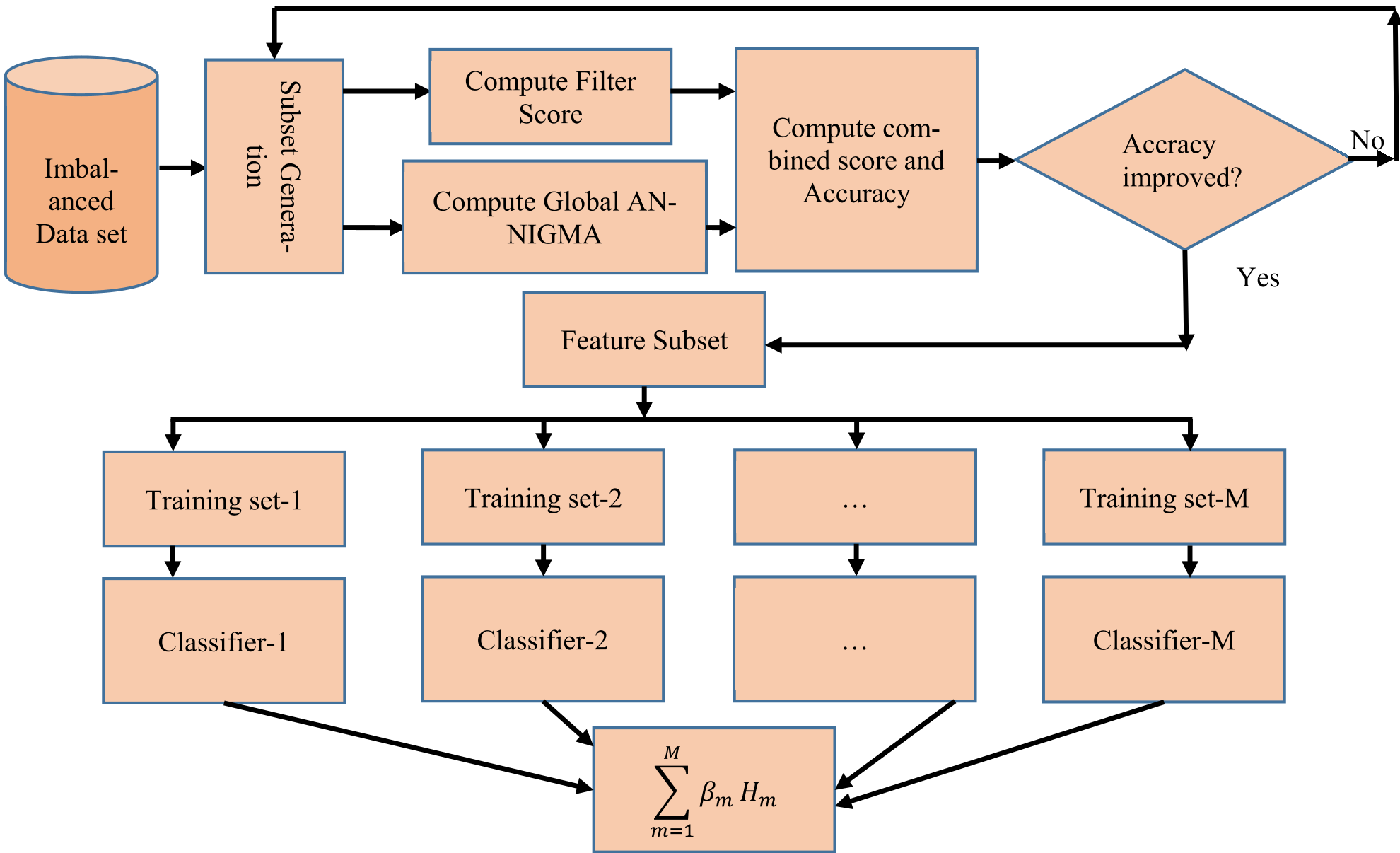
The core innovation lies in how the authors select features. Instead of relying on a single metric, they use a Hybrid Wrapper-Filter approach.
1. The Global Wrapper (GANNIGMA)
Standard wrappers (using Backpropagation) often get stuck in local optima, especially with noisy medical data. The authors utilize GANNIGMA (Artificial Neural Network Input Gain Measurement Approximation) optimized via a global search algorithm (AGOP). This calculates the "Gain" of each input feature relative to the output, effectively ranking features by their true diagnostic power.
2. The Filter (MRMR)
To ensure the features are not just relevant but also non-redundant, they incorporate Maximum Relevance Minimum Redundancy (MRMR). This prevents the model from picking multiple, highly correlated features (like area and radius) which can lead to overfitting.
3. Interpretable Ensemble
Once the optimal feature subset is identified, the system uses Bagging with Decision Trees. Unlike "Black Box" deep learning, this produces a human-readable decision tree, allowing pathologists to see why a tumor was classified as a genetic variant.
Key Results and Performance
The experimental results on 63 real-world samples demonstrated that "throwing more data" isn't the solution—"smarter selection" is.
| Technique | F-Measure | ROC Area |
|---|---|---|
| All Feature SVM | 0.367 | 0.379 |
| GANNIGMA + Decision Tree | 0.492 | 0.507 |
| GANNIGMA + MRMR + Bagging (Proposed) | 0.648 | 0.636 |
The hybrid approach roughly doubled the F-measure compared to a raw SVM. More importantly, it produced the simplified decision rule shown below, which focuses on core morphological attributes like orientation and radius.

Critical Insight: Why This Works
The "Secret Sauce" is the Globally Optimized ANNIGMA. In highly imbalanced datasets, the "loss landscape" of a neural network is fraught with plateaus and local minima. By using AGOP, the authors ensured that the feature importance weights were calculated from a globally optimal model, leading to a much more stable and reliable feature subset than standard gradient-descent-based methods could ever achieve.
Future Outlook
While the F-measure of 0.648 shows there is still room for improvement (potentially through deep feature extraction or larger multi-center cohorts), this study proves that Interpretable ML is viable for complex neuropathology. Future iterations could integrate fractal geometry and chaos theory features more deeply into the hybrid selection process to further refine accuracy.
Author Analysis: This paper is a testament to the fact that in specialized medical domains, the design of the feature selection mechanism is often more critical than the complexity of the final classifier.