
Intelligent Adjudication: Eliminating Healthcare Claim Denials with Machine Learning
Assessment of healthcare claims rejection risk using machine learning
This paper introduces an automated Machine Learning (ML) framework for assessing healthcare claim rejection risks. By employing classification methods such as SVM and Decision Trees, the authors achieve up to 100% accuracy in identifying claims likely to be denied before submission, leveraging a novel feature engineering approach based on Claim Adjustment Reason Codes (CARC).
TL;DR
Administrative rework from denied medical claims costs the healthcare industry billions. This study presents an ML-driven engine that predicts claim rejections with nearly 100% accuracy. By treating Claim Adjustment Reason Codes (CARC) as primary features through one-hot encoding, the authors demonstrate that traditional algorithms like SVM can outperform complex Neural Networks in high-stakes billing environments.
The Cost of Administrative Friction
In the modern healthcare cycle, a "Claim" records every interaction between a Provider (Doctor) and a Payer (Insurance). However, between 1.38% and 5.07% of these are denied on the first pass. For a 300-bed hospital, even a 1% denial rate translates to a $2 million annual loss.
Prior work focused on manual audits or simple "claim scrubbers" that look for formatting errors. This research asks a deeper question: Can we predict the inherent risk of a claim being rejected based on its historical and financial features before it even hits the payer's desk?
Methodology: Mining CARC for High Information Gain
The authors argue that the secret to high accuracy isn't just the algorithm—it's the Feature Engineering. They conducted three experimental runs (CR):
- CR1: Standard features (Total Charge, Paid Amount, Days) with CARC as a single status.
- CR2: Adding synthetic features like "Duplicate Claims," "Overlapping Claims," and "Expired Time Limits."
- CR3: One-Hot Encoding of 13 specific CARC codes (e.g., [45] Charge exceeds fee schedule, [29] Time limit expired).
The Power of the Decision Tree
The authors used Classification and Regression Trees (CART) to find the "rules" of denial. They discovered a clear logic: claims with a Total Charge > $168K or those exceeding 140 days in the service cycle are prime candidates for rejection.
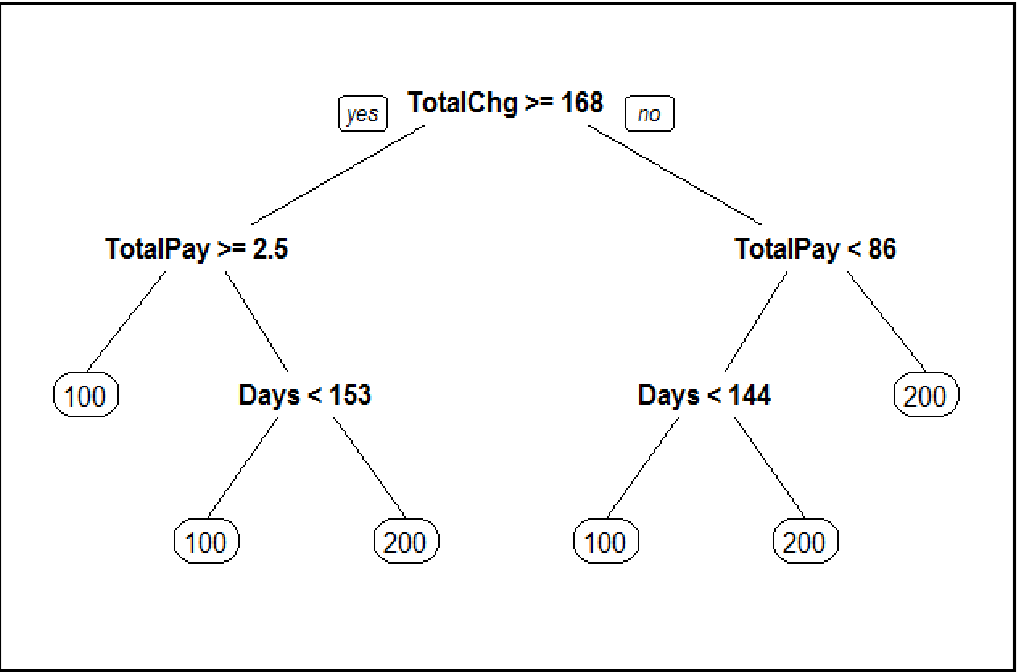 Figure 2: The Binary Classification Tree shows how 'TotalChrg' and 'Days' act as the primary gates for claim risk.
Experimental Results: SVM vs. The World
The study compared three heavyweights: CART, Neural Networks (NN), and Support Vector Machines (SVM).
- Neural Networks performed poorly (45% accuracy), likely due to overfitting on the specific, structured patterns of billing data.
- SVM reigned supreme when combined with One-Hot CARC features, achieving a "perfect" score.
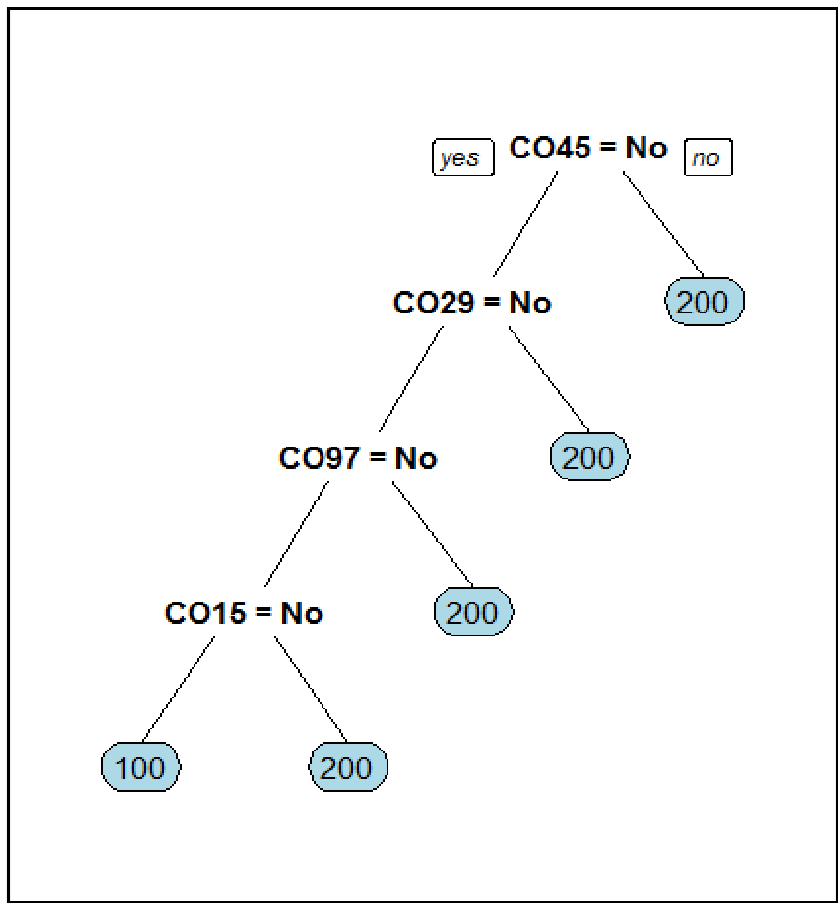 Figure 3: SVM classification separating rejection-prone (magenta) from normal (blue) claims based on charge amount and duration.
Performance Breakdown
| Algorithm | Accuracy | Precision |
|---|---|---|
| Decision Tree (CR3) | 98% | 97% |
| Neural Network (CR3) | 45% | 0% |
| SVM (CR3 - One-Hot) | 100% | 100% |
Critical Insight: Why One-Hot Encoding Won
The "Aha!" moment of this research is that CARC codes are not just reasons for past failures; they are high-signal predictors of future risk. By expanding these codes into 13 separate dimensions, the SVM could find a hyperplane that perfectly separates valid claims from "rework" candidates.
Conclusion and Future Outlook
This work marks a shift from reactive claim scrubbing to proactive risk assessment.
- Takeaway: If you are building healthcare fintech products, focus on the engineering of Domain Codes (like CARC/ICD/CPT) rather than chasing the latest deep learning architecture.
- Limitations: The 100% accuracy was achieved on a specific dataset of 13,000 claims. Real-world performance may vary as Payer rules shift dynamically.
- Next Steps: Future research should focus on "weak" datasets where expert manual labeling isn't available, perhaps using Unsupervised Learning to cluster new types of rejection patterns.
Senior Editor's Note: This paper is a masterclass in how domain expertise (Medical Coding) informs feature engineering to solve a high-value industrial problem where standard "black-box" approaches like Neural Networks often fail.