
Beyond the Check-in: Decoding Why Users Stick with Location-Based Apps
Hedonic and utilitarian benefits as determinants of the application continuance intention in location-based applications: the mediating role of satisfaction
This study investigates the determinants of user persistence in Location-Based Applications (LBAs) like Swarm and Foursquare. By integrating the Technology Acceptance Model (TAM) and the Expectation Confirmation Model (ECM), the authors identify hedonic and utilitarian benefits as key drivers, achieving a robust model that explains substantial variance in application continuance intention.
TL;DR
In the hyper-competitive mobile app economy, getting a download is easy; keeping the user is the real battle. This research dives into Location-Based Applications (LBAs) like Swarm and Foursquare to reveal that Satisfaction is the ultimate gatekeeper, mediating the relationship between two core pillars: Hedonic (fun/beauty) and Utilitarian (speed/utility) benefits.
Academic Positioning: This work bridges the gap between the Technology Acceptance Model (TAM) and the Expectation Confirmation Model (ECM), moving the discourse from "How do we get users?" to "How do we keep them?".
Problem & Motivation: The Retention Trap
Most developers focus on the Utility of an app—does it find a coffee shop? Does it save time? However, the authors argue that in the social sphere of LBAs, functional utility is only half the story. Existing studies often overlook the "hedonic" side—the sheer pleasure and aesthetic joy of the interface. This study seeks to understand why young users (the 18-34 demographic) stay loyal to specific LBAs while abandoning others.
Methodology: The Dual-Benefit Engine
The researchers split "Value" into two distinct categories, each with two sub-components:
- Hedonic Benefits:
- Application Aesthetics: The visual allure and design "feel."
- Perceived Enjoyment: The intrinsic fun of the "check-in" ritual.
- Utilitarian Benefits:
- Application Utility: Productivity, time-saving, and effective location discovery.
- Application Quality: Accuracy of GPS data and system responsiveness.
The authors then tested whether these factors lead directly to Application Continuance Intention (ACI) or if they must first pass through the "filter" of Satisfaction (S).
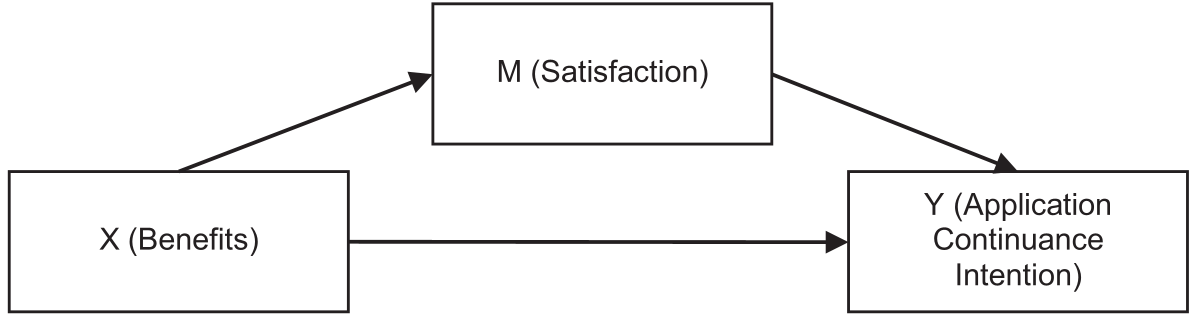 Figure 1: The hypothesized structural model showing the mediating role of satisfaction.
Experiments & Results: Quantitative Proof
Using regression analysis and the Sobel Test on a cohort of 400 university students, the results were definitive:
- The Power of Utility: Utilitarian benefits had a stronger correlation with satisfaction (r = 0.681) than hedonic benefits (r = 0.492). If the app isn't useful, users don't just get bored—ils get frustrated.
- Satisfaction is the Bridge: The "Third-Order Regression" proved that satisfaction partially mediates both paths. When satisfaction is included in the model, the direct impact of features on retention drops, proving that emotions (satisfaction) are the primary driver of behavior.
- Statistical Significance: The survival of the model was confirmed with an Adjusted R² of over 0.54, suggesting that more than half of a user's decision to stay can be explained by these four factors.
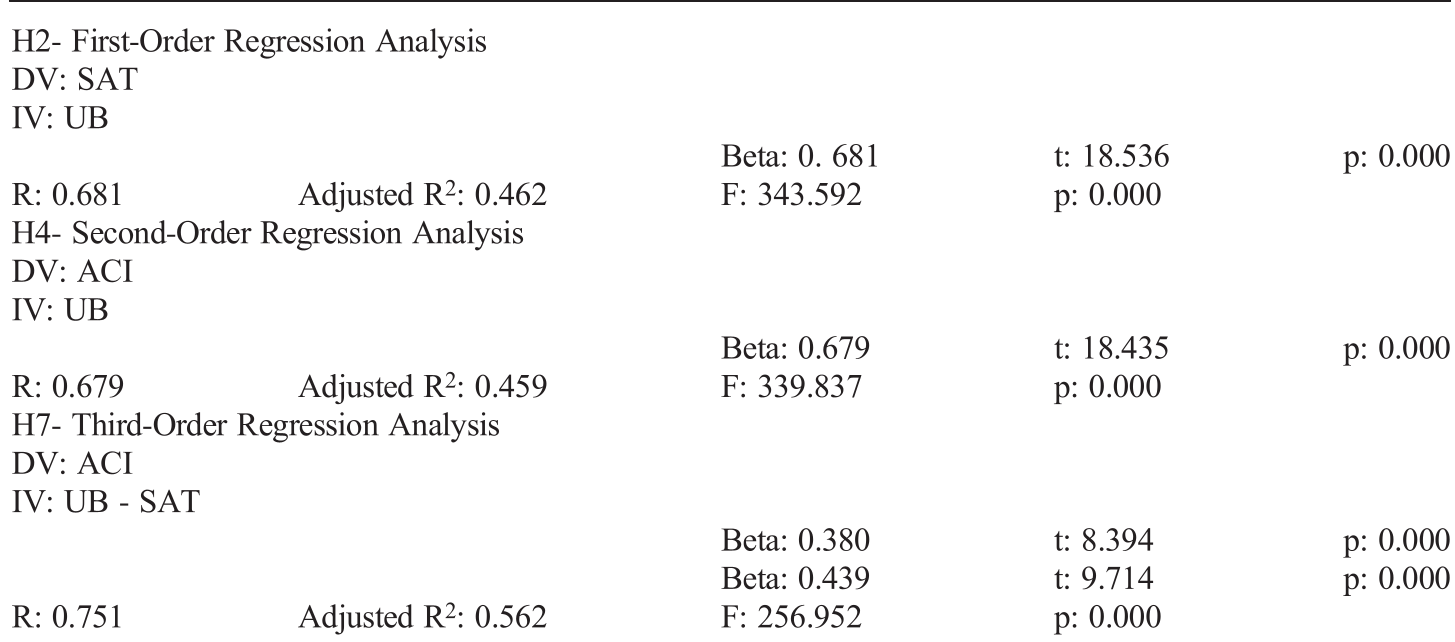 Table 1: Detailed regression analysis confirming the strength of Utilitarian Benefits on Continuance.
Deep Insight: Critical Analysis & Takeaways
The "Why" Behind the Success
Why does this work? Because it recognizes that LBAs are Experiential Systems. Unlike a banking app (purely utilitarian) or a game (purely hedonic), a tool like Foursquare sits in the middle. The "Mayorship" is fun (Hedonic), but the "Restaurant Recommendation" must be accurate (Utilitarian).
Limitations & Future Outlook
While the study is robust, it focuses on young users (students). Older demographics might prioritize utility significantly more than aesthetics. Furthermore, as privacy concerns grow, a new "cost" variable—Privacy Risk—likely needs to be subtracted from the benefit equation in future models.
Conclusion
For Product Managers and Developers, the message is clear: Aesthetics are not "fluff." They drive the hedonic satisfaction that keeps a user from switching to a competitor. However, beauty cannot save a broken tool; Accuracy and Quality remain the foundation upon which that satisfaction is built.