
Beyond Topology: Shielding Weighted Social Networks via Hellinger Distance
A Hellinger Distance Based Anonymization Method for Weighted Social Networks
This paper introduces a novel anonymization method for weighted social networks using a Hellinger distance-based privacy model called (k,λ)-similarity. It leverages the SWBADP algorithm, which combines sliding windows and binary approximation to perturb edge weights, effectively preventing identity re-identification through weight distribution analysis while preserving data utility.
TL;DR
Social network anonymity isn't just about hiding "who is connected to whom"—it's about hiding the intensity of those connections. This paper introduces a (k,λ)-similarity model that uses Hellinger Distance to prevent "Weight Distribution Attacks." By employing a clever sliding window algorithm (SWBADP), the authors mask unique weight patterns while keeping the graph's statistical utility intact.
The Hidden Leak in Weighted Graphs
Most researchers focus on -anonymity, ensuring a node's degree is identical to at least others. However, in a weighted network (where edges represent frequency of contact, transaction amounts, etc.), the distribution of weights acts as a biometric signature. Even if three nodes have a degree of 2, if only one node has edges with weights , an adversary with that background knowledge can instantly de-anonymize the user.
The core challenge is balancing this privacy with Data Utility. If we simply average all weights, the graph becomes useless for analysis (like shortest-path routing or community detection).
The Methodology: Hellinger Distance & SWBADP
The authors argue that traditional metrics like Earth Mover’s Distance (EMD) are too computationally expensive, while Kullback-Leibler (KLD) is unsymmetrical. Instead, they pivot to Hellinger Distance, a bounded metric () used to quantify the similarity between two probability distributions.
The (k,λ)-similarity Model
A graph satisfies -similarity if every node's normalized weight probability distribution is within a distance from at least other nodes.
SWBADP: The Engine of Perturbation
To achieve this without destroying data, the paper proposes Sliding Window and Binary Approximation based Data Perturbation (SWBADP):
- Grouping: Nodes are initially clustered by degree.
- Sliding Window: Instead of modifying the whole distribution at once, a window moves across the weights, performing localized adjustments.
- Binary Approximation: One-way modifications (ascending or descending) ensure values converge toward the target distribution efficiently without "ping-ponging" inconsistencies.
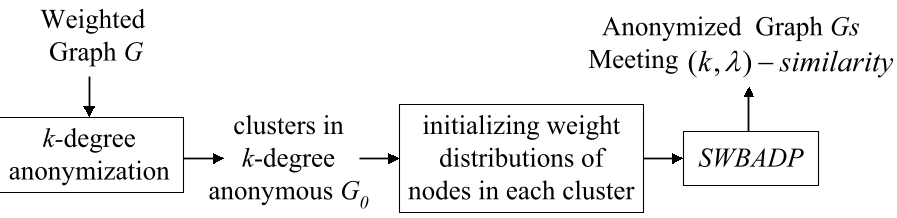 Figure 1: The overall workflow from a raw weighted graph to a (k,λ)-similarly anonymous graph.
Depth Clustering: Closing the Edge Leak
The authors observe a sophisticated flaw: even with -degree anonymity, if an attacker knows an edge exists between two specific clusters, they might still triangulate identities. To solve this, they introduce Depth Clustering, which ensures no edges exist within the same cluster and limits the density of edges between clusters to below .
Experimental Validation
Using the Arnet researcher dataset and a synthetic SGraph, the team tested two key metrics:
- SDCR (Standard Deviation Change Ratio): Measures how much the weight "spread" shifted.
- ACR (Average Change Ratio): Measures the average shift in individual weights.
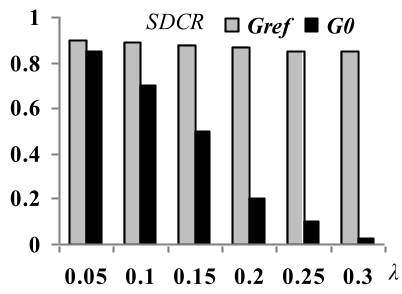 Figure 2: Performance comparison on SGraph dataset showing lower utility loss for SWBADP compared to baseline averaging (Gref).
The results show that as the threshold (the allowed "slop" in similarity) increases, the algorithm runs faster and preserves significantly more data utility than naive averaging methods.
Conclusion & Insight
This work highlights a critical evolution in privacy: we are moving from protecting structure to protecting statistics. By treating weight distributions as probability vectors and applying information theory (Hellinger Distance), we can create "crowds" for users to hide in without blinding the analysts who seek to study the network's value.
The main limitation remains the trade-off inherent in Depth Clustering—structural changes to the graph (adding/deleting edges) can be more disruptive than simple weight perturbation. Future work in this space will likely look at how to maintain weighted kNN queries and Minimum Spanning Trees under these constraints.