
Hello: Reimagining Social Networks as Tangible Wearables
Hello: bracelets communicating nearby presence of friends
The paper introduces "Hello," a conceptual wearable system consisting of interactive "friendship bracelets" that notify users of a friend's proximity (within 100 meters) via color-coded LED signals. Developed as a technology probe for participatory design, it aims to augment social awareness in crowded physical environments.
TL;DR
The "Hello" project transforms the digital social graph into a physical, glowing experience. By utilizing low-power radio transmitters embedded in jewelry, these bracelets allow users to "feel" the presence of friends within a 100-meter radius, acting as a technology probe to study how we domesticate social technology.
Background & Positioning
Published during an era of burgeoning interest in "wearable computing" (PDC 2008), this work sits at the intersection of Participatory Design and Ubiquitous Computing. Unlike contemporary mobile apps that use GPS to show locations on a map, "Hello" is a "Technology Probe"—a tool designed not just for utility, but to provoke new behaviors and social patterns.
Problem: The Visibility Gap in Local Social Spaces
The authors identified a recurring social friction: the "Crowded Beach Paradox." Even if your inner circle is physically nearby, the sensory overload of a crowd makes them invisible. Previous solutions, like the Reima Smart Shout, relied on heavy GSM networks and voice messaging, which were deemed too complex and global for the intimate, local notification of "I am here."
Methodology: The Logic of the Glow
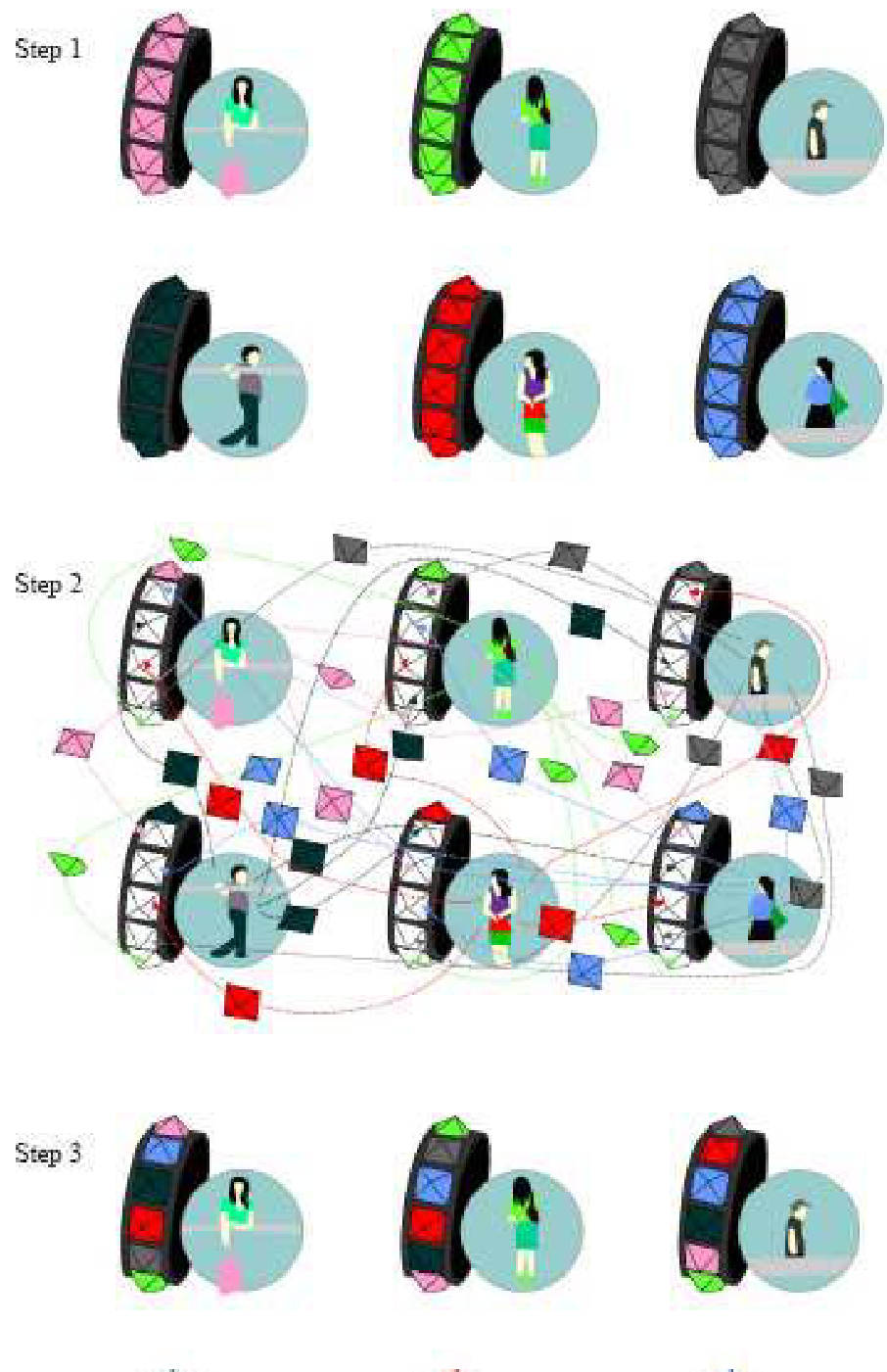
The "Hello" system is elegant in its simplicity, utilizing a three-step interaction model:
- Identity Mapping: Each user has a bracelet with a specific "indicative color."
- Physical Symbolism: Friends swap "studs." By wearing a friend’s stud, you "subscribe" to their proximity.
- Proximity Activation: When two matching bracelets come within 100 meters, the low-energy radio transmitters trigger the LED within the stud to glow.

Technical Insight: Ultra-Low Energy Design
To maintain the form factor of jewelry, the authors optimized for power. The signal is transmitted for less than 1% of the time. This "pulsing" approach ensures that the "transmitted power equals to one LED being turned on," making it a sustainable wearable long before modern BLE (Bluetooth Low Energy) became ubiquitous.
Evaluation through Participation
The prototype was deployed at the PDC conference, turning the event into a living laboratory. The goal was to observe "Co-experience"—how individuals act when they sense a friend is near but cannot see them.
The authors specifically look for:
- Domestication: How the device becomes a part of everyday practice.
- Emergent Play: Whether users invent new games (like "social hide and seek") using the signal.
Deep Insights & Conclusion
The "Hello" bracelet is a masterclass in Minimalist Interaction Design. It avoids the pitfalls of "screen-addiction" by using peripheral vision (a glowing light) to facilitate human connection.
Takeaways for Modern AI & IoT:
- Tangibility Matters: As we move toward AI wearables (like the Humane Pin or Rabbit R1), "Hello" reminds us that social connection is often more powerful when it is passive and non-linguistic.
- Privacy by Proximity: By keeping the data local and radio-based (rather than cloud/GPS-based), the system inherently protects user privacy—a lesson many modern social apps have forgotten.
In conclusion, "Hello" proves that the most effective social technologies don't necessarily give us more information; they give us a better sense of the people who matter most.