
Helping John (and Everyone Else) Escape the Social Login Trap: A GDPR-Driven Redesign
Helping john to make informed decisions on using social login
This paper presents a human-centered design approach to improve informed decision-making and consent in Social Login (SSO) systems. It introduces a two-pronged solution: an informational tutorial on sign-up methods and novel "Drag and Drop" (DADA) and "Question and Answer" (Q&A) user interfaces (UIs) designed to comply with GDPR requirements.
TL;DR
Social login (SSO) is a double-edged sword: it offers convenience but sacrifices privacy through obscure data-sharing practices. This paper introduces a radical redesign of the Facebook login flow, using active engagement (Drag and Drop) and knowledge verification (Q&A) to ensure users finally understand what they are signing away. While it takes longer to complete, it nearly doubles the accuracy of user awareness regarding shared data.
Context: The Illusion of Choice
Most of us use "Log in with Facebook" or "Sign in with Google" to avoid creating yet another password. However, in the process, we become victims of habituation. We click "Continue" without realizing that Service Providers (SPs) might gain perpetual access to our friend lists, birthdays, or even the ability to post on our behalf.
The authors correctly identify that current UIs are fundamentally broken from both a usability and a legal (GDPR) perspective. They suffer from:
- Hidden Opt-outs: Privacy settings are buried in "Edit This" links.
- Single Point of Failure: If your social account is hacked or banned, you lose access to everything.
- Conceptual Gaps: Most users wrongly believe their social network privacy settings (e.g., "Friends Only") protect them once data is shared with a third-party app.
Methodology: Designing for Friction
The authors argue that "Informed Consent" requires active affirmative action. To achieve this, they moved away from the "Click-Through" model to a "Human-Centered" Privacy by Design approach.
1. The Informational Tutorial
Before selecting a sign-up method, users are given a tutorial explaining the pros (no new password) and cons (user profiling, single point of failure) of SSO versus manual accounts.
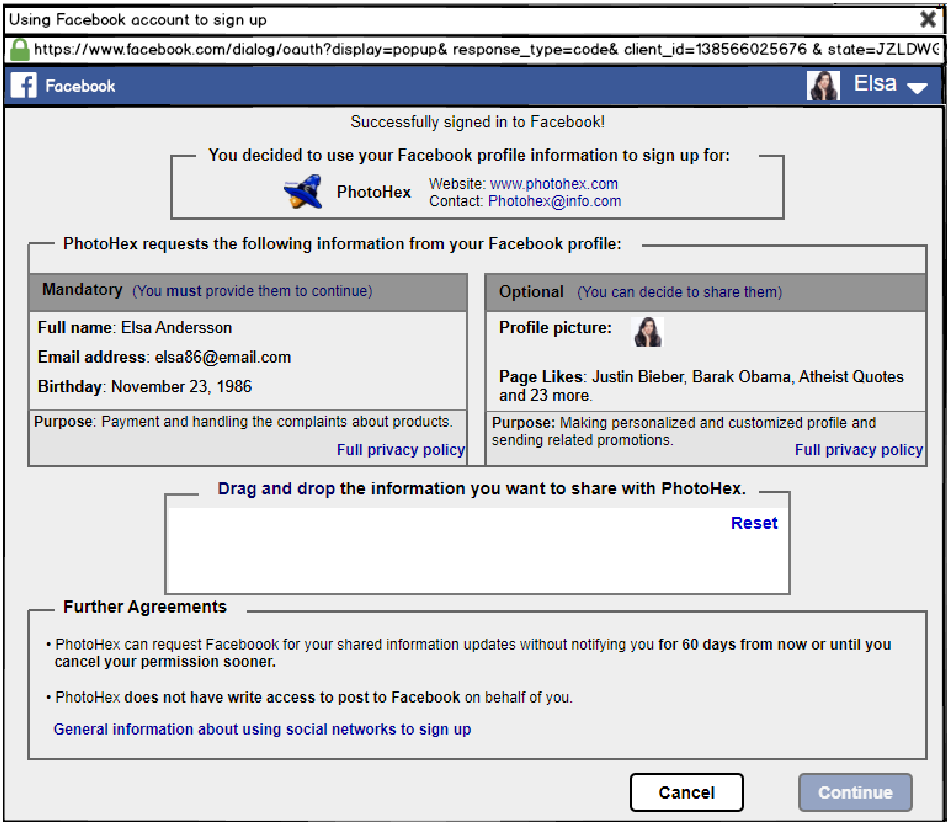
2. The Drag & Drop (DADA) Interface
Instead of pre-checked boxes, users must physically drag icons representing their data (Email, Birthday, etc.) into a "Sharing Box." This forces a conscious decision for every piece of information disclosed.
3. The Q&A Verification
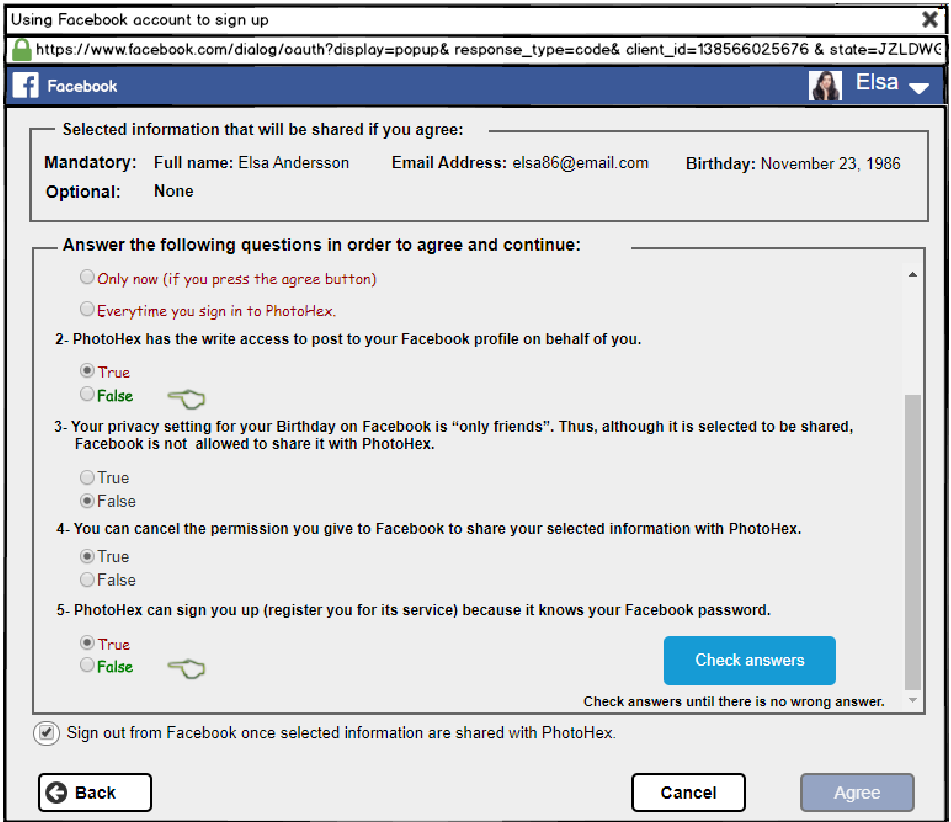
To ensure the consent is truly "informed," a quiz is presented. If a user thinks the SP gets their Facebook password or if they think their "Friends Only" setting still applies, the UI corrects them.
Experiments: Awareness vs. Efficiency
The researchers conducted a between-subject study with 80 participants to compare the "Old" (Standard Facebook) vs. "New" (GDPR-compliant) interfaces.
Key Findings:
- Recall Accuracy: Users of the new interface recalled 83.5% of shared data items correctly, compared to just 48.7% for the standard UI.
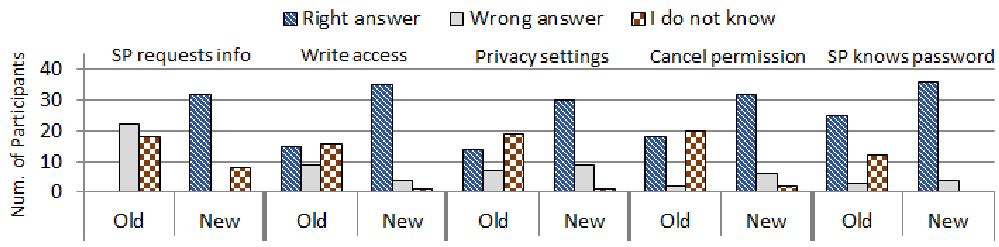
- Misconception Corrections: The new UI significantly reduced the error rate for statements like "The website knows my Facebook password" and "My privacy settings protect me."
- The Efficiency Tax: The major drawback? The new UI took over 4 minutes on average, while the current Facebook UI takes about 1 minute.
- Usability (SUS): The System Usability Scale (SUS) score for the new UI was lower (around 61-67) compared to the old UI (73-75), indicating that "informed" users feel more burdened by the process.
Critical Insight: Can Privacy Be Usable?
The paper highlights a painful reality in HCI: Transparency and Efficiency are often at odds.
The authors effectively demonstrate that when we make a system "usable" (fast and seamless), we often strip away the user's ability to be "informed." To comply with the GDPR’s requirement for "clear affirmative action," some level of friction is necessary. The question for future product designers is: How much friction will users tolerate before they abandon the service entirely?
Conclusion & Future Work
This research is a wake-up call for Identity Providers. The current "one-click" culture is legally shaky and ethically problematic. While the Drag & Drop and Q&A models are effective at educating users, they need further optimization to reduce the time burden. The authors' future work focuses on making these interfaces robust against habituation over the long term—preventing users from eventually "blindly dragging" icons just as they now "blindly click" buttons.