
Herd Clustering: Vitalizing Static Data through Collective Intelligence
Herd Clustering: A synergistic data clustering approach using collective intelligence
Herd Clustering (HC) is a nature-inspired, two-stage clustering algorithm that leverages collective intelligence and moving particle dynamics to revitalize "static" data. By simulating herd behavior where data instances attract one another locally, HC creates a self-organizing mechanism that outperforms several state-of-the-art methods across 30+ datasets.
TL;DR
Most data mining algorithms treat data as a collection of static points sitting in a latent space. Herd Clustering (HC) flips this script by treating data instances as "living" particles. Inspired by the collective behavior of animal herds, this method allows data points to move, attract each other, and self-organize into dense clusters. By the time the algorithm is done "moving" the data, the clustering task becomes trivial.
The Motivation: Why Move Static Data?
The "Static Data" assumption is a bottleneck. When we look at complex manifolds—like the interlocking or curved shapes common in real-world datasets—traditional distance-to-centroid metrics (K-means) fail because they expect globular shapes.
The authors argue that by giving data points a "brain" (a simple set of movement rules), we can use Collective Intelligence to simplify the topology of the data space. Instead of building a complex model to fit the data, we let the data evolve into a form that fits a simple model.
Methodology: The Two-Stage Herd Dynamics
The algorithm operates in two distinct phases:
1. The Kinetic Stage (Moving the Herd)
Every data instance is initialized as a particle. If two particles are within a specific threshold, they exert an attraction force on each other.
- Unit Vector Attraction: Unlike Newton's law where force depends on the square of the distance (which causes "explosive" instability when points get too close), HC uses unit vectors. This ensures steady, predictable movement.
- Terminal Speed: To mimic natural drag (like air resistance), the authors implement a maximum speed—specifically half of the distance threshold. This prevents particles from "overshooting" their clusters during high-velocity interactions.
 Figure 1: Visualization of data self-organizing. Deceptive shapes are gradually pulled into dense, globular clusters.
2. The Static Stage (Assigning Labels)
Once the particles have converged (usually within 10-30 iterations), the "herd" has effectively merged into distinct points or very tight groups. A simple centroid-pass algorithm then scans the space and assigns cluster IDs to any points within the threshold distance.
Performance: Better than the SOTA
The study compared HC against a massive suite of baselines: K-means++, Spectral Clustering (SC), DBscan, and CLUTO.
- Robustness to Noise: While DBscan is often the go-to for non-linear shapes, it frequently collapses in the presence of noise. In contrast, HC’s local attraction mechanism allows it to ignore outliers that don't satisfy the "herd" criteria.
- High-Dimensional Superiority: On the UCI Machine Learning Repository (including datasets like WDBC, Wine, and Yeast), HC secured the highest Rand Index and Purity scores in 80% of the tested scenarios.
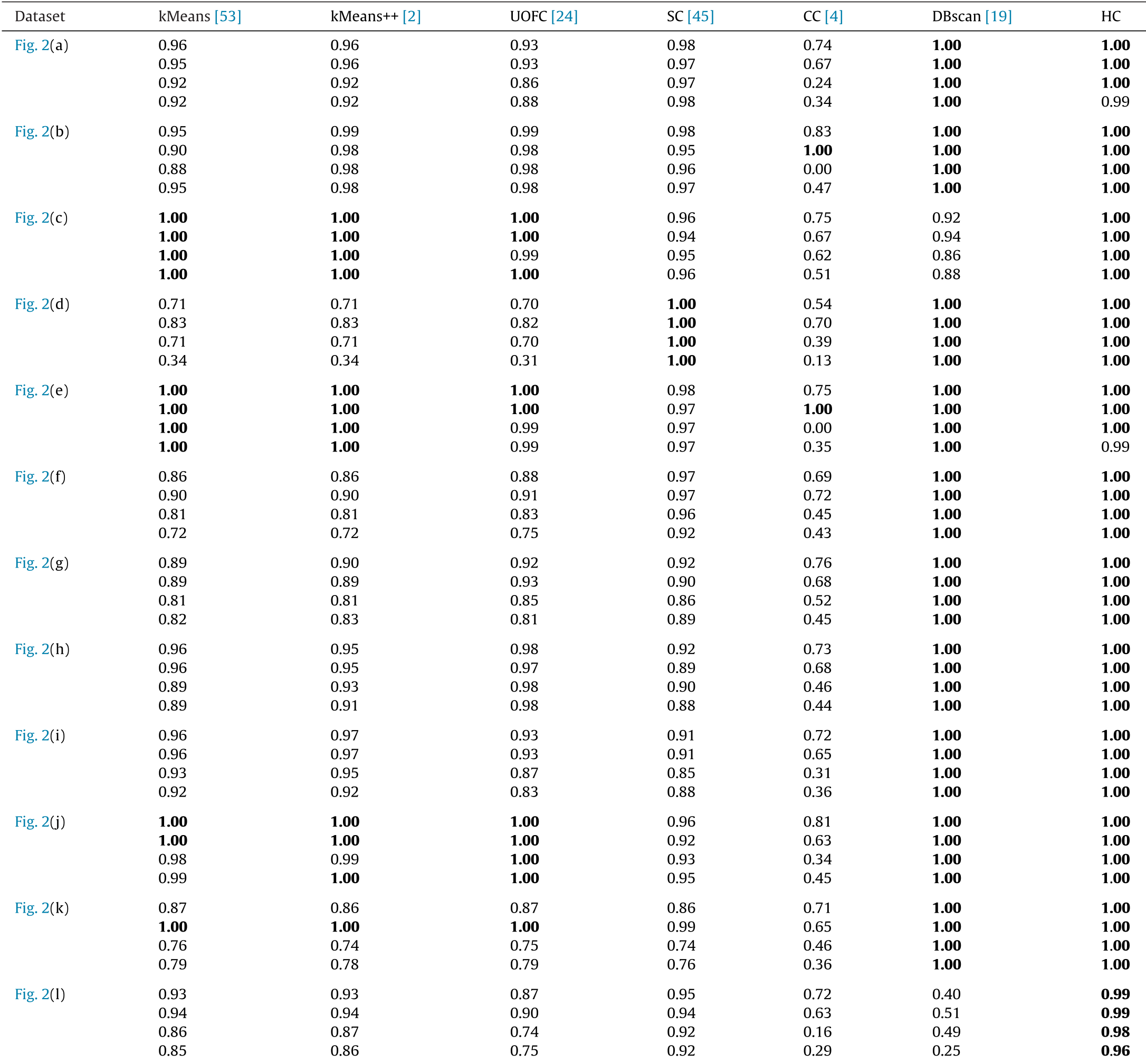 Table 1: Performance comparison across 2D datasets showing HC and DBSCAN as top contenders, with HC excelling in the most difficult cases.
Real-World Application: DNA Motif Discovery
The authors applied HC to DNA motif discovery, a critical task in bioinformatics for understanding protein-DNA binding. By clustering k-mers based on signal intensities from Protein Binding Microarrays, HC successfully identified the Oct-1 protein binding motifs, matching results from expensive biochemical experiments.
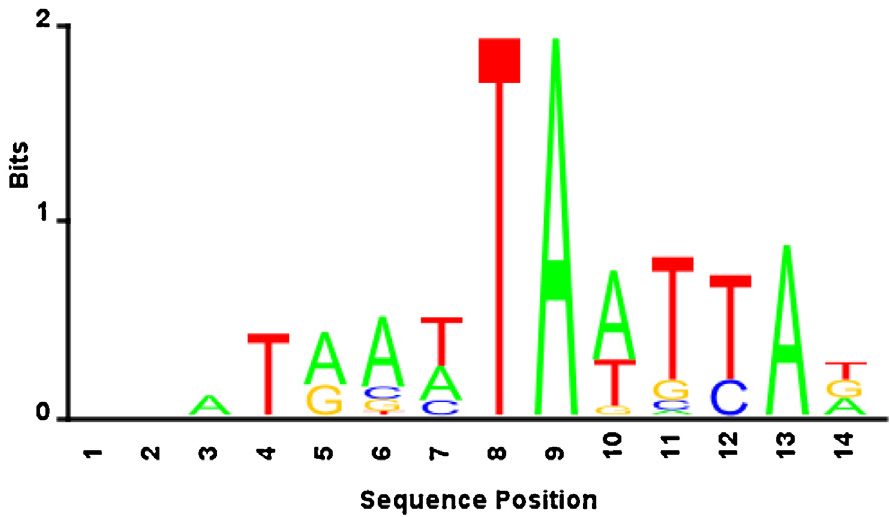 Figure 2: Sequence logos derived from HC clusters, demonstrating its biological accuracy.
Critical Analysis & Conclusion
The Takeaway: Herd Clustering proves that the "Synergistic" approach—combining local movements with collective intelligence—is a powerful alternative to purely analytical clustering. It requires only one main parameter (threshold), making it significantly easier to tune than methods requiring k (number of clusters) or complex kernel parameters.
Limitations: While the algorithm is efficient (O(n log n) with optimization), it lacks a formal theoretical guarantee of convergence, relying instead on empirical proof. Additionally, moving the data changes the original distribution, which might lead to the loss of subtle features if not handled with proper normalization (Z-score standardization is recommended).
HC stands as a fascinating bridge between Natural Computing and Data Mining, providing a robust tool for researchers dealing with complex, noisy manifold data.