
Here&Now: Rewiring Social Interactions via Localized Opportunistic Dataspaces
Here&now: data-centric local social interactions through opportunistic networks: demo
The paper introduces "Here&Now," an opportunistic experience-sharing application that creates a "local dataspace" for co-located users. It utilizes the Scampi platform to enable data-centric networking and peer-to-peer dissemination without relying on centralized internet servers.
TL;DR
The "Here&Now" project challenges the paradigm of centralized social media by creating a local dataspace that exists only in the physical proximity of its users. By leveraging opportunistic networking, it enables co-located strangers to collaborate on shared content—such as photos and comments—without needing a "cloud" or permanent identifiers, effectively turning the physical environment into a live, digital canvas.
Background: The Paradox of Modern Social Silos
In the digital age, we are more connected than ever to people thousands of miles away, yet we remain digitally isolated from the person standing next to us. When you attend a music festival or a technical conference, your content flows to Instagram’s servers in California, available to your followers but invisible to the person in the same row. This spatial and temporal disconnect fragments experiences into proprietary silos, preventing the formation of transient, "on-purpose" social communities.
The "Local Dataspace" Concept
The authors suggest a radical pivot: from communication-centric to data-centric networking. Instead of sending messages between users, users interact by mutating a shared dataspace.
Imagine a digital "bulletin board" that only exists within the range of a specific Wi-Fi signal or Bluetooth mesh. This dataspace is:
- Geographically Bounded: Content stays where it was born.
- Time-Variant: It evolves as users add, edit, or "remix" postcards and topics.
- Peer-to-Peer: Data moves directly from device to device using the Scampi platform.
Methodology: How Here&Now Works
The system architecture is built on three pillars: data-centric networking, opportunistic dissemination, and mutable content mechanisms.
1. System Architecture
The application runs on the Scampi platform, which handles the heavy lifting of peer-to-peer data distribution and discovery. This allows the dataspace to be "open"—any app using the Scampi protocol can theoretically access and interact with the data, breaking the siloed nature of traditional apps.
 Figure 1: The Here&Now interface showing "trending" and "fresh" local content.
2. Deployment Modes
The researchers detail two ways this network survives in the wild:
- Uncontrolled Mode: A decentralized mesh. If a group of people is at a park, their phones form an ad-hoc network using local Wi-Fi, passing data packets like a digital "game of telephone."
- Controlled Mode: Ideal for organized events (workshops). An "anchor node" (a local server) acts as a persistent repository, ensuring that even if everyone leaves the room momentarily, the data remains available.
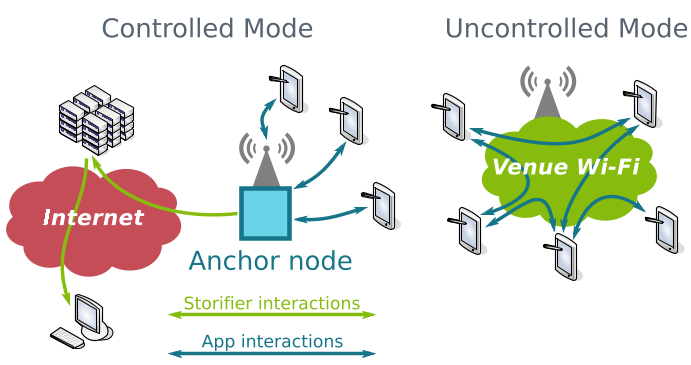 Figure 2: Contrast between opportunistic mesh (left) and anchor-based star topology (right).
Experimental Insights
The Here&Now demo showcases that human social interaction can be successfully mediated through collaborative data modification.
- Instantaneous Updates: Through the Scampi API, modifications (likes, comments) appear in real-time on nearby devices.
- Content Lifecycle: The application supports "Topics" as high-level containers, under which "Cards" (media + text) are attached. This hierarchy allows for structured yet flexible local storytelling.
Critical Perspective: The Future of Proximity
While the "Here&Now" framework is a powerful proof of concept for local social networking, it faces challenges common to all opportunistic networks: content persistence and user density. Without an anchor node, the "memory" of the social network depends entirely on the physical presence of the users' devices.
However, the transition to Data-Centric Networking (DCN) is a profound shift. It removes the need for complex address-based routing and focuses on what the information is, rather than where it is stored. This makes the system resilient to the intermittent connectivity typical of crowded events.
Conclusion
"Here&Now" serves as a bridge between the physical and digital worlds. It proves that by limiting the scope of data to the "here and now," we can actually enhance the richness of our immediate social experiences. As we move toward more decentralized web technologies, the principles of local dataspaces will likely become a cornerstone of how we interact in smart cities and massive public gatherings.