
Bridging the Data Gap: Enhancing Ontology Learning with Web Mining in the Automotive Industry
Heterogeneity Reduction for Data Refining Within Ontology Learning Process
The paper introduces a hybrid (semi-)automated approach for ontology learning and data integration, specifically designed to handle large-scale document sets. It combines Web mining with structured external resources like WordNet and DBpedia to resolve data heterogeneity and has been successfully validated on the Ford Supply Chain Ontology.
TL;DR
Integrating massive amounts of raw data into a formal ontology is a bottleneck for Industry 4.0. This paper presents a semi-automated framework that leverages Web mining, WordNet, and DBpedia to resolve data heterogeneity. By transforming cryptic spare part labels into structured ontological concepts, the system provides a scalable solution for supply chain interoperability, validated specifically within Ford Motor Company's infrastructure.
Problem & Motivation: The Heterogeneity Wall
In the context of modern supply chains, companies frequently swap suppliers or update production plans, necessitating the import of thousands of new parts into their information systems. However, manual integration is a nightmare due to four types of heterogeneity:
- Syntactic: Differences in data formats or languages.
- Terminological: Using different names for the same entity (e.g., "Paper" vs. "Article").
- Semantic: Different ways of modeling the same domain.
- Semiotic: Differences in human interpretation based on context.
The authors argue that standard lexical databases like WordNet are often too general. To handle highly specialized domains (like automotive spare parts), a more dynamic source of knowledge is needed: the World Wide Web.
Methodology: The Hybrid Learning Pipeline
The proposed solution follows a structured workflow designed to refine data before it enters the target ontology.
1. Normalization and Expansion
Input labels are often highly abbreviated (e.g., "SE CSHAFT"). The system uses an internal acronym database to generate potential expansions and then employs Web mining to determine which variation is most common in real-world documents.
2. Concept Identification
The system checks if the term already exists in the ontology using string similarity measures. If not, it looks for synonyms and linguistic variants to account for terminological differences.
3. Knowledge Acquisition (Web & Structured Data)
If a concept is entirely new, the system seeks its "place" in the world through:
- WordNet/DBpedia: To find hierarchical relations (is-a, part-of).
- Web Mining: Using lexico-syntactic patterns (e.g., "X is a type of Y") to discover relations not yet indexed in structured databases.
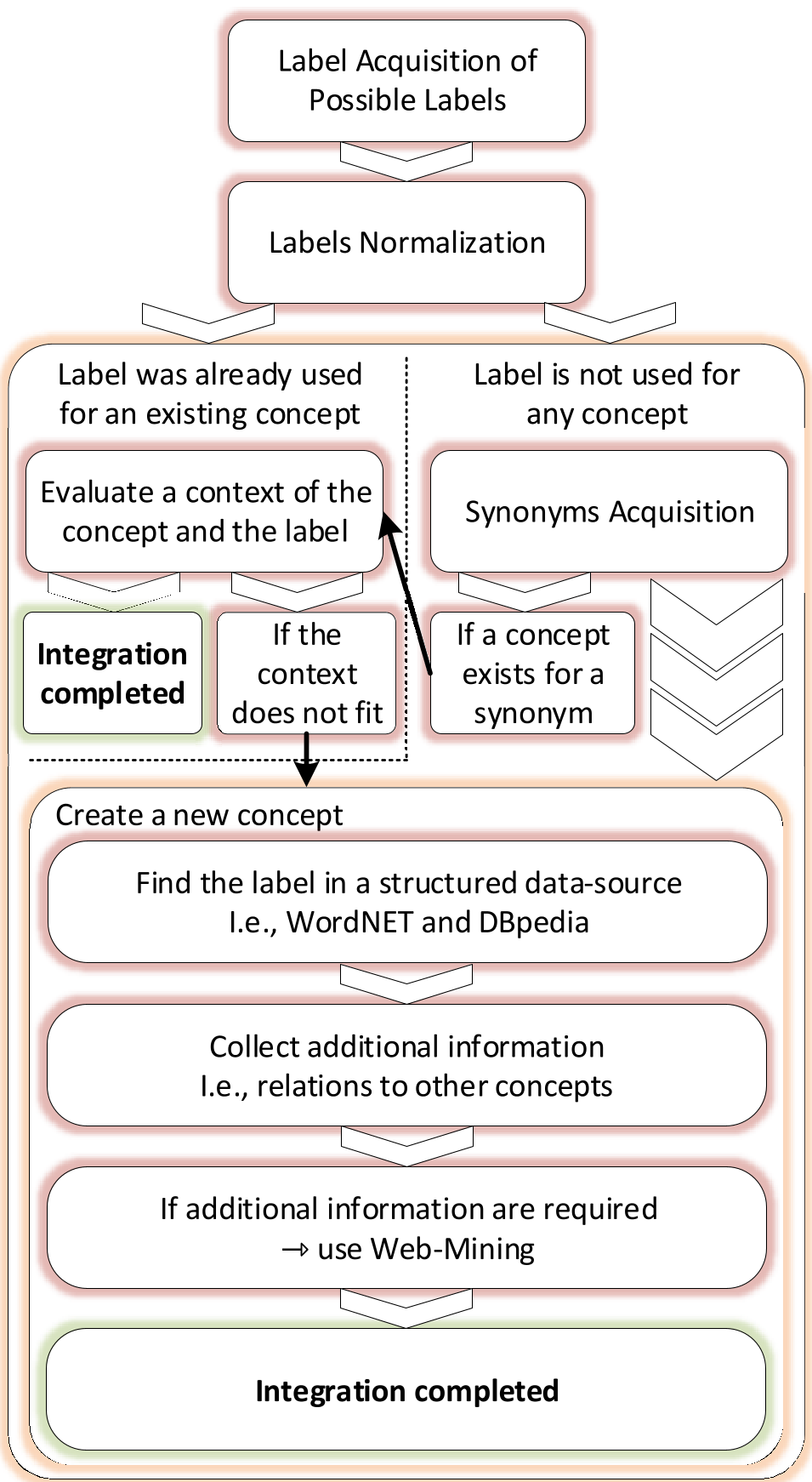 Fig 1: The proposed workflow for integrating new information into an existing ontology.
Experiments: The Ford Case Study
The methodology was tested on the Ford Supply Chain Ontology. One of the most significant challenges was resolving spare part labels like O/RG-RR AX WHL SHFT SPCR.
By querying DBpedia and WordNet under specific "super-concept" constraints (e.g., limiting searches to the Automotive Vehicle domain), the system successfully mapped these parts to concepts like "Rear Axle" and "Shaft."
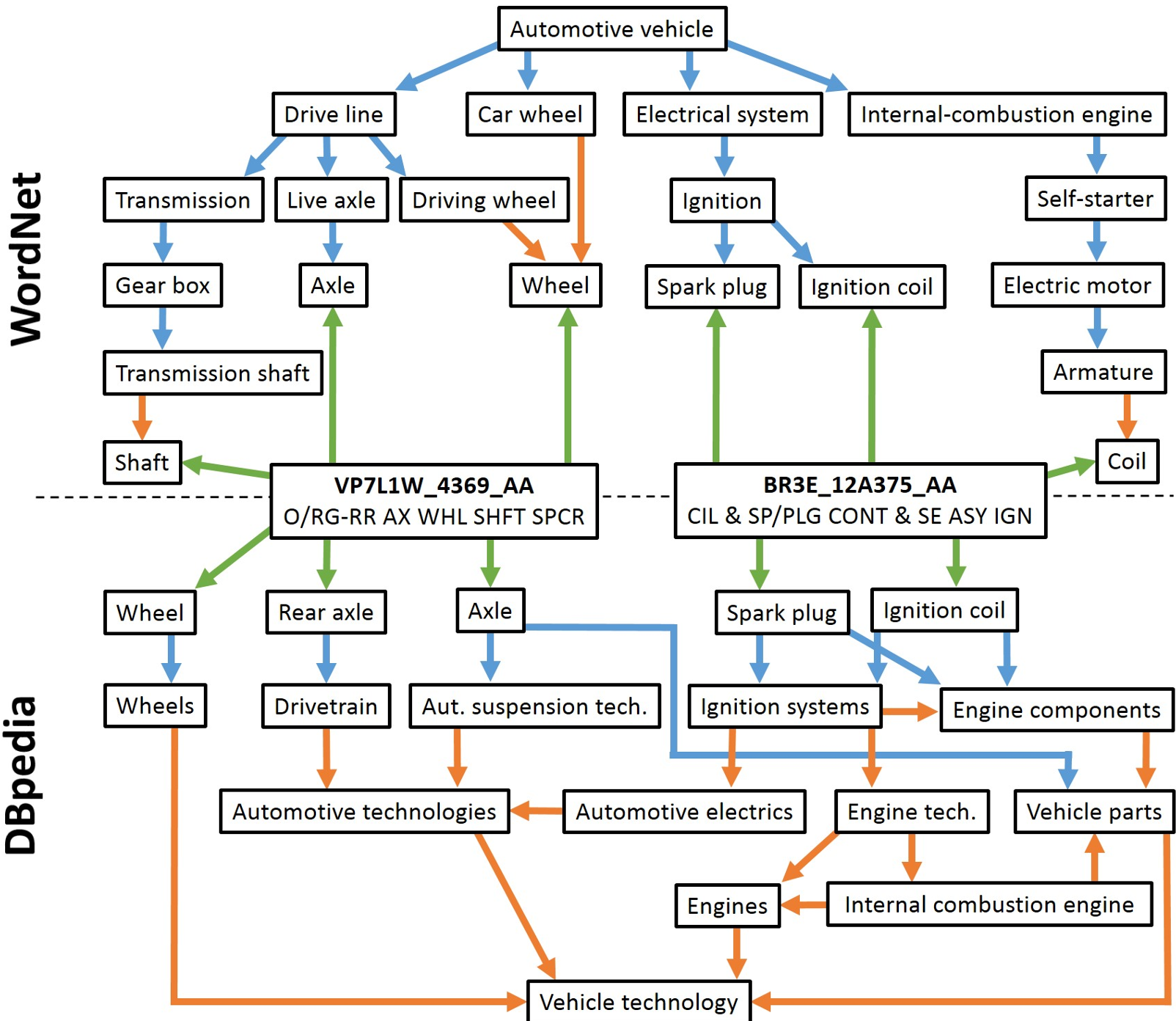 Fig 2: Visualization of new concepts mapped to external knowledge sources. Green arrows indicate mappings, while blue arrows indicate holonymy (part-of) relations.
Key Metrics:
- Terminology Refinement: Successfully decoded complex labels like "SE CSHAFT RR OIL" into "crankshaft rear oil seal" based on Web occurrence probability.
- Search Ambiguity: By restricting the search space to relevant domains (Vehicle Technology), the system filtered out irrelevant meanings of common words (e.g., "Seal" as an animal vs. "Seal" as a mechanical component).
Critical Analysis & Conclusion
Takeaway
The integration of Web mining acts as a "safety net" for domain-specific terminology that curated databases like WordNet might miss. This dual-source approach ensures that the ontology remains robust and up-to-date with industrial nomenclature.
Limitations
Despite the automated steps, the authors admit that semantic heterogeneity is too complex for 100% automation. A "human-in-the-loop" is still required to verify ambiguous mappings (e.g., distinguishing between a "Car wheel" and a "Driving wheel" if the context is unclear).
Future Work
The next frontier for this research involves more sophisticated natural language processing and potentially integrating live technical documentation to further automate the extraction of properties and axioms, moving closer to a fully autonomous "self-learning" ontology.